First. I had surgery today. There is a cyst that’s been bothering me on my lip for the past three months and after several trips to dentists and dermatologists, I decided it was time to see an oral surgeon. The waiting room reminded me of a 1970’s office with blue plastic furniture and yellowed blinds. I sat with my hands folded in the patient chair while the surgeon explained the procedure and the risks (discomfort was the biggest… so you can tell this was a mild surgery). Then I prepared myself for the novocaine, the only part that really terrifies me about medical procedures. The feeling that comes with the initial shot is a loss of feeling, to eliminate the potential pain we might experience. This sensation is called “numb.”
PC: Jon TysonToday of course is the 16th anniversary of the attacks on September 11, 2001. Last year on this day, I was frantically sharing the media pieces that the Revolutionary Love team had put together in honor of the 15 year mark. 15 felt like a big milestone, perhaps because 5-year increments do, perhaps because the impending election trumpeted hateful rhetoric reminiscent of the days and months and years after the attacks. But this year as I sat dreading the needle that would make my whole face feel nothing, I wondered if we as a nation have shifted to a kind of numbness after this pivotal moment in history.
“No,” I quickly decided. There may be fewer media pieces and ceremonies, but the calls to action for help in hurricane relief and fighting white supremacy are not so different than calls to affirm our Muslim neighbors and to practice compassion. Further and perhaps more importantly, as impactful as a single moment can be, sixteen years later we should not ignore the effects this days has had on every day following. Not to mention the deep-seeded racism and xenophobia the attacks helped to expose to those oblivious.
This evening I met the new Revolutionary Love Project team and I feel like I did last year on our first team call. Recognizing that we have our work cut out, I feel grateful that we may be angry and scared, but we still believe in our message. That is not “numbness.” That is genuine, blessed feeling.
It’s the end of Labor Day Weekend, traditionally a transitional weekend. Even though the temperature this past week in Los Angeles has climbed over 100 every day, I admit that pumpkins and apples have been appearing in my feeds and emails. Fall is near. Many of us live according to an academic calendar, which means we have just started a new school year (if you’re on the quarter system, we’ve got a few more weeks!). Excitement and anxiety and anticipation abound, and Tuesday morning traffic has returned to ever freeway in southern California in full force.
I just finished reading Diane Guerrero’s In the Country We Love yesterday. In case her name isn’t immediately familiar, Guerrero plays Maritza in the Netflix series Orange is the New Black and Lina on Jane the Virgin. She also happens to be a best-selling memoirist. Her book details the story of growing up in Boston in a family of Colombian immigrants, she the only US-born member. Since everyone should read this book I won’t give everything away, but the crux of the story is the scene in which Guerrero returns home from school at age 14 and finds her parents have been taken by ICE. Within weeks, they are both deported back to Columbia, and Guerrero is left totally alone as a new high school freshman.
With the decision to end DACA confirmed this week, Guerrero’s book feels more than relevant, it should be a textbook read for all of us. As many of us enjoyed a day free from labor yesterday, at least in a formal sense, I thought about Guerrero’s daily struggle with a different, invisible kind of labor- emotional labor. Her situation forces her to grow up years beyond emotionally in a matter of days. The emotional struggle translates to many physical issues, and an especially chilling scene shook me to my core. The thing about her story is that 800,000 DACA-mented folx and other undocumented people in the United States struggle through a similar narrative every day.
This emotional labor often takes a much larger toll than many realize. For a few years I have sought out and listened to stories of immigrants in the United States, their statuses mixed. It seemed like the best way to engage. This will never make me understand the struggle, mind you. The stories I heard made me consider mindless choices I make every single day, like booking a flight and putting my address, applying for a part-time job, or even walking in public places. The emotional labor of these decisions for undocumented folx hangs in the air every day, until their meaning is internalized. Unknown. Unrecognized. Unwanted. The labor it takes to live a full life despite these internalized attitudes is one that does not allow a day off.
As the season of new school years pushes off the dock, I think my emotional labor should involve more listening and awareness around the internalized attitudes that create roadblocks. My roadblock this week comes from deep-seeded anger. It’s an anger that can only prove productive if it drives me to keep working.
Last night I watched a fantastic Incubus show right underneath a glorious and terrifying lightning storm. I drove 300 miles to Phoenix from San Diego yesterday morning, through the desert, along the steel wall that separates Baja California and Sonora from the United States. Border patrol stopped me, asked to search my trunk, and I said “no.” The agent listened. I went on my way unharmed.
2000 miles away, some of my greatest heroes stood arm in arm facing men with riot gear and automatic weapons. They weren’t police. These heroes are the clergy of our time. They’re pastors and preachers. Scholar activists. I admired a picture of them standing linked together, singing and praying while just feet from them violence erupted and a young woman lost her life as a terrorist plowed his car into the crowd. Their prayers and songs are heard. They were echoed this morning in churches around the country, and will be this week in many forms of sacred space.
I’ve found such hope in the writings and teachings of Zen Master Thich Nhat Hanh. He was an activist, exiled from his home country and now helps people from all nations understand that Buddhist practice requires us to recognize we are all connected. Our suffering is bound up together, and thus we must show up and care for each other.
Sometimes it feels as though my faith has told me not to get attached to the fight for justice. At the root this teaching points to attachment as the core of suffering, and I believe this to be true. But turning off the thirst to learn and simply exist ignorant from the real suffering in my country at this moment does not lead any closer to Nirvana, it only lulls me into false notions of self-care as the only necessary form of practice. We come to the cushion to find awareness of ourselves, and this is called a “practice,” not “our life.”
Because the world is waiting for us when our sit is over. Sitting helps us to be mindful in the action, to remain unattached to outcomes but stand hopeful that love will prevail.
I’m proud of the religious and spiritual leaders for recognizing that they have voices. I was thinking today about the Civil Rights Movement and subsequently the internment of 120,000 Japanese immigrants and American born citizens, two moments that feel both far in time and close in context. We might read about the leaders who ushered change and progress in textbooks, or hang pictures in our offices years from now. But they show us a great example of remaining present in this moment, armed with the texts and words of timeless prophets and teachers, focused on saving lives today.
The lighting storm terrified me. It lit up the sky as if we sat trapped in an electric glass bubble, and the thunder boomed directly on top of us. I kept looking to my right to see if I could run for it. The band had left the stage, and I wanted to book it to my car. But I stayed in my seat, feeling safer among the crowd. The cheers and shouts around me reminded me I wasn’t alone, even if I was terrified. We are not alone in this fight, we have arms to link and songs to harmonize. I am grateful for every pulpit that spoke truth today, especially to call us in.
…But what are we celebrating? I’ve been thinking about that question all week as the flags have come out, the barbecue grill tops scraped off, red white and blue cupcakes to car decals .
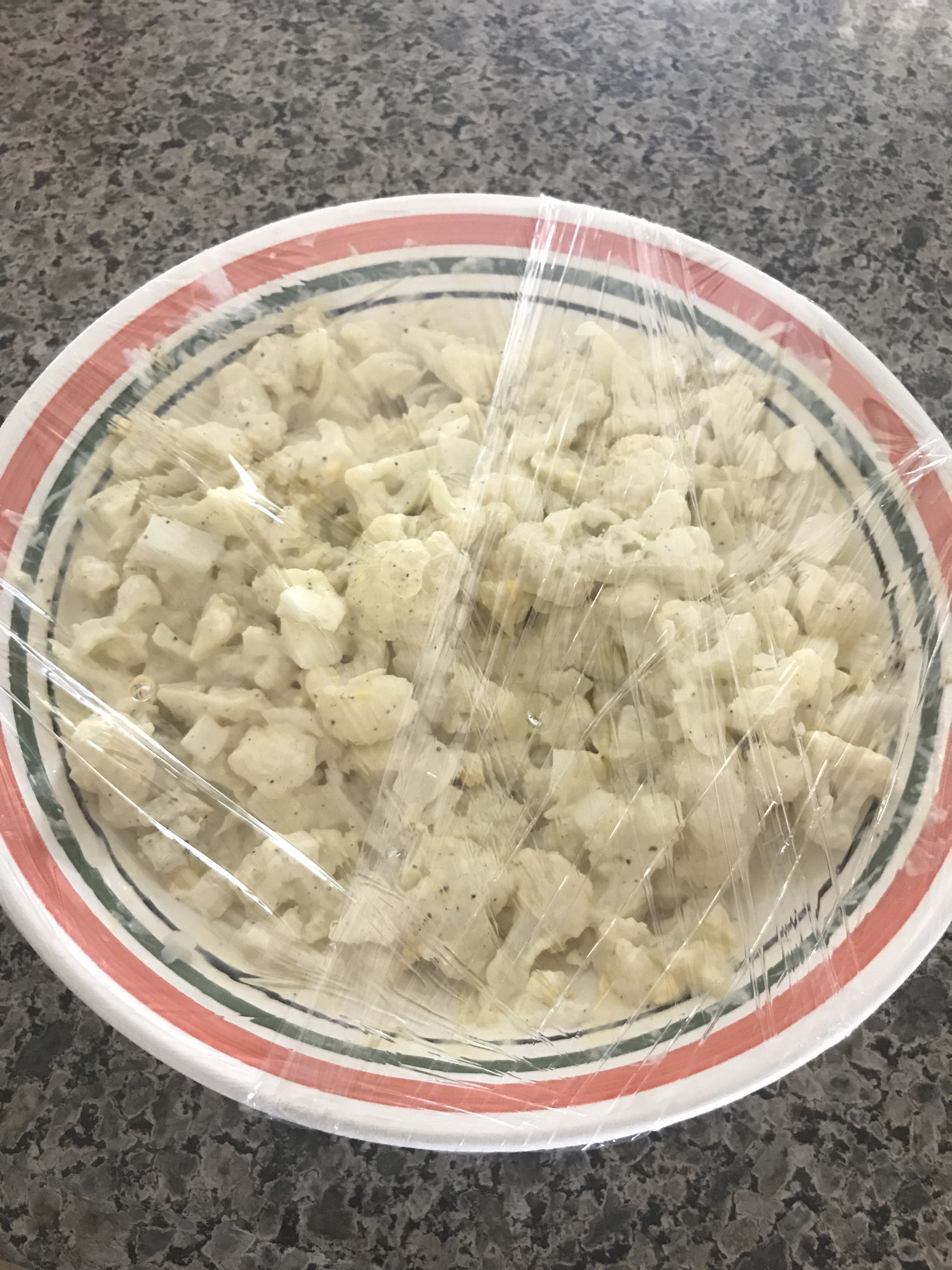
My not so famous (yet) cauliflower “potato” salad
This past May I got a unique opportunity to drive across the country on the way home from Boston to LA. As you can imagine, I saw plenty of landscapes and moreover, significantly distinct ways of life from farms to fabulous mansions across the street from national art museums. The trip felt like a giant learning expedition, helping me understand just slightly better what “divided” means in our country. Maybe the one thing each place had in common was that it rained. And fast food. I cannot soften how apparent it is that we are not a unified nation, because that would gloss over so many struggles and injustices I saw right outside the car door window.
Today is a day to celebrate, not despite these struggles, but because of them. Sojourner Truth, a suffragette and influential fighter for women’s rights during and after slavery, once said: “I will not allow the light of my life to be determined by the darkness around me.” Joy is an act of resistance. We all agree on this as we fight for justice, a path often surrounded by strife and mourning and wondering when, how, what.
I was in Las Vegas this past weekend with one of my best friends from USC and her sister. We sat around a shisha pipe (my request) as I fired off life questions. “What is your greatest fear? What are you most proud of? Who is someone you let go of too soon? What is one thing you want to see for yourself in five years?” I don’t remember exactly which question we began discussing, but our parents came up as a subject of both respect and recognition of imperfection. We all confessed that one thing our parents have given us is a safety net: an ability to take risks and even make pretty terrible mistakes without letting us fall completely to our demise. Maybe it’s money, maybe a place to stay, maybe simply a listening ear, but we could not downplay the sacrifices of our parents and grandparents who worked and still work to give us what this country is supposed to provide for everyone: freedom.
Freedom is a big word, and as someone who practices Buddhism most humbly and often in a state of questioning, I think about freedom from suffering as a goal for which to strive. Help to free others from suffering, free my own mind of craving and desire that causes suffering. Today I firmly believe we are celebrating the people who have risked their own suffering to free others from it. Immigrants who settled here 50 years ago or yesterday to transform their rootedness into the branches for their children and grandchildren. Women who persist, nevertheless. Queer folx who selflessly write and speak and talk to the people around them and the world to educate us, even though that is exhausting and by no means a requirement of them or their bodies. People of color who tear down “normal” behavior, speech, culture, bound up in whiteness. Dreamers, teachers, the friends who gently push us to think about how our words and actions affect everyone around us, sometimes in causing pain. These are the people who take on greater binds of suffering every day, under the star-spangled banner, believing we can be better.
These are the people who fight to bring joy, making the fight worth it. Today as I am blessed to have dinner with my family around a nourishing meal, I am grateful for the unheard and unseen who work tirelessly without an ounce of recognition except the unflagging hope for all of us.
Taking a 6 am bus is pretty committed. Or silly. I’m not totally sure which. Anyway, at 6 am our bus left Boston for NYC, so I could make it in time for the Revolutionary Love Conference at Middle Collegiate Church. I was looking forward to this gathering for several reasons, including getting to meet the Revolutionary Love Fellows for the first time in person, hearing from many of my activist and organizer heroes, and finally getting the chance to visit Middle Church. The conference focused on racial justice and specifically, how we might make love a public ethic in a time of great division.
As more speakers took the stage- Valarie Kaur, Van Jones, Brian Maclaren, Dr. Eboni Marshall Turman, Dr. Traci West- the crowd filling the sanctuary listened and learned, cheered and encouraged. I felt myself experiencing a sense of joy and belonging that I haven’t for a long time. This is not to say that the content of every speaker’s message was uplifting- in fact, they shared some downright despairing stories and facts. The urgency to do this work together- the work of intersectional racial justice- is not at all overhyped. Yet the authenticity of each person on the stage inspired me to believe I can do the work without knowing all the answers. Perhaps without knowing any answers at all.
During one of the first panels, Anurag Gupta challenged us to imagine a world without racial bias. Gupta is the CEO of Be More America, an organization that trains leaders to examine and let go of unconscious bias.
“Close your eyes,” he asked us. “Imagine what this world would look like.”
I have to admit something- this was an extremely difficult exercise for me. I imagined the big loud streets right outside the church I sat in, in the middle of New York City. If you’ve ever walked down 2nd Avenue on the Lower East Side, you know the cliches are true. There aren’t many places you can smoke hookah at bar owned by an Egyptian man that sits next to world-famous Japanese restaurant on one side and a Halal Indian market on the other. You can meet one million kinds of people in New York City- and yet, this romantic picture does not do justice to the injustice. It would be so easy to sing the praises of diversity without recognizing the bias, the racism, the bigotry. I couldn’t fully imagine a world without the bias, which both scared me and then, empowered me.
One thing I know for sure is that eliminating bias cannot eliminate our differences, any single one. The danger of creating a more similar society is far worse than one in which people must grapple with particularities. As the conference carried on, I realized each person’s vision for fighting racism and bias is not the same- in fact, some of the ideas shared vehemently disagreed with others spoken.
So perhaps the question “what does the world without bias look like” is better asked, “what does A world without bias look like,” recognizing that even the vision must fracture. As Becky Bond and Zack Exley write in Rules for Revolutionaries, “the revolution isn’t handed to us on a silver platter.” We are inventing the mechanism as we build it. The important thing is not to agree completely, but to utilize the variety of gifts we hold to work toward the vision. We learn along the way.
Last week my friend Katie Gordon visited Boston so of course we had to get dinner and catch up. I showed Katie around campus, took her to the LGBTQ Resource Center to see our mutual friend and colleague Lee, and after a quick tour of our Sacred Space, we wandered over to Newbury Street. We stopped in Trident Books and mused over some titles, mainly discussing what had been happening on our respective campuses. We nerded out about a few particular books, mostly related to feminism and/or religion. Finally, we sat down to a delicious South Asian dinner.
PC: Samantha Sophia
Katie is the Program Manager for the Kaufman Interfaith Institute at Grand Valley State University in Grand Valley, Michigan. She identifies as secular, but make no mistake- Katie is one of the most influential interfaith leaders of our time. She trains for the Interfaith Youth Core’s Interfaith Leadership Institutes and has introduced Krista Tippett, creator and host of the radio program On Being, because she’s that cool. I have known Katie for a while through our mutual Interfaith Youth Core affiliations. One thing I really appreciate about Katie is her ability to unapologetically be who she is without inhibiting anyone else from doing the same. She is open about her whiteness and privilege, but not guilty or frozen in working to make change.
At some point in our conversation, we both expressed concern for the interfaith movement as it exists now. What does it mean to train leaders when many people of faith live under real threat for their lives- because of their faith? Can white, secular young people train in the same spaces as black Muslim women? As queer Jews? As Hindu immigrants? As refugees who, despite looking death in the face, have held close to their devotions? How do we expect those who seem to lose power and voice every day to lead others when there is real, imminent danger?
I have been reflecting on this question for some time now. One of the reasons I feel so strongly about activist and filmmaker (among other amazing things) Valarie Kaur’s message and definition of Revolutionary Love is that I feel so strongly about Valarie herself. She represents to me the very type of leader that begins to answer this difficult question of how we as developing interfaith leaders might live into our identity as such. You see, Valarie may have several thousand Facebook friends, a database of over 100,000 subscribers via different projects she has started, and one of her recent speeches has now acquired over 16 million views on social media (that’s remarkable, just FYI), but Valarie never does her work alone. She always thinks, speaks, and acts in community because she recognizes that while her voice is essential- as a woman of color, a Sikh American, an accomplished pioneer in filmmaking and civil rights law- hers is by no means the only voice with one particular set of concerns. We need not look further than the daily news to see how many communities need more voice for dire concerns.
In this way, I think our answer begins not at the “I” that defined the previous era of interfaith leadership, the years I spent building my toolbox and story collection. Interfaith work has always been about bringing communities together, but allowing particular individuals to serve as the face of communities, to represent traditions and belief systems even if inadvertently has in the past been enough- we look around our table to see a Christian, Jew, Muslim, Hindu, Buddhist, and seeker, and we feel good about our group. We can dialogue and serve together. We might not talk at all about the intersections of our own identities, or how unequal access to this table might be.
We have reached a moment in our public landscape in which the “I” interfaith leaders will quickly feel devastatingly alone or completely exhausted, and probably both. The interfaith movement is at a true “we” moment- a time when it needs to be acceptable and encouraged for us to ask each other to do things like march on the front lines, speak publicly against bigotry, or give money to civil rights organizations. Going to prison for disorderly conduct. The reality is, we cannot all risk the same things. We need to know our limits. Focusing on “I” can help us learn these things about ourselves, but will not build networks. Right now, the fact that our different identities afford us unique privileges is an advantage if we use them in community.
As Valarie so beautifully stated recently, “We can practice Revolutionary Love for those who are in prison because they have committed great harm. This does not mean they shouldn’t be in prison. This means we free our hearts to believe they can be greater.” For some of us, practicing Revolutionary Love, just like interfaith leadership, means asking our allies to put their words and bodies on the line. At the same time, for some of us, it means being asked and saying yes.
PC: Jose Revuelta, Flea Market Comics. Check out more art here.
I left work early on Wednesday, went home, and wept. I just bawled. It was all too much. And it was only Wednesday.
Our campus observed Holocaust Remembrance Week this past week. On Friday, we hosted a dialogue about the future of politics in the United States. I see the exhaustion. I see the fear. I see the overwhelming sense of hopelessness, and I admit: I feel it too.
Not for myself. One of the ickiest thoughts that has floated through my overcrowded brain this week was “if I did nothing, if I had no idea what was happening in our country…I would be blissfully ignorant. I could go about my daily tasks and probably notice nothing. And I heard phrases like, “It’ll be ok, he’s just crazy..” or “Stay strong!” UGH. I understand the desire to deescalate a situation for coping sake, but…I just can’t. This is horrible. So many people are really, really suffering. And as a Buddhist I know, that suffering begets suffering, and it affects us all.
Of course my students feel overwhelmed and in despair. There is no end in sight. It feels as though we are fighting not only an uphill battle, but one behind a giant steel wall! (sorry, that was just too real.) I try to tell myself to keep working, keep putting on a strong face for my students that I love, but on Wednesday I just couldn’t any longer. Recognizing when we need to take a moment to breathe is important, because the situation is both urgent and will be a long haul.
I ran 16 miles today, the most I have ever run. I felt great: there were thousands of people on the course today. Every few miles a group was giving away water and snacks. I ran the last half of the course with a new friend who teaches near my home in Boston. Not bad for a self-care Saturday.
When I got home, I looked at my training schedule. Almost half way through the 18 weeks before the big race day. Suddenly I felt anxious: The mileage only increases. I will need to carve out more time and need more strength to keep to my plan. I have to be efficient, make good food choices, and no matter what, not give up. There is no skipping a day, even in the rain, the snow, after eating too much cake.
Consider this time a marathon AND a sprint: the urgency is NOW, dammit. Shit already hit the fan and is now spreading around the room. I think my marathon training is symbolic of the work cut out for me and the people I look up to, leading the charge. We’ve got to contribute in every way possible and not skip a day. At the same time, we need to suck down that weird GU to stay fueled- take moments of rest to recharge. And there are others among us, at every step. Our paces may be different but we’re running toward the same place. I’m sustaining my energy off the communities I graciously get to find solace in, and take wisdom from. One foot in front of the other.
I don’t have any words of wisdom today, or even a “let’s be hopeful!” message, except that I know some pretty damn amazing people working their asses off and I’m lucky to call myself a fan/supporter/hopeful ally (NOT ally- working toward it). Revolutionary Love today, every day.




 The Practivist