Knowing Students

I don’t know how this is possible but this quarter seems more overwhelming than the previous two. A very real possibility is that I’m tired and ready for summer. Last week, I went to bed before 11 almost every night, which is pretty rare. Finally, it occurred to me that my exhaustion was caused by teaching. I love teaching, and I feel terrified of teaching.

alexis-brown-82988-unsplash.jpg
Photo by Alexis Brown on Unsplash

“Teaching” in my class consists of leading a thirty minute discussion twice a week, during the latter half of class. 19 students and I crowd around an amalgamation of tables. The space feels cramped. The students work very hard; they exude excellence. Given my background in dialogue facilitation, this should be a piece of cake, right? Wrong. First of all, there was no baking soda in the time of Jesus, so cake probably didn’t happen. Second, leading a discussion about a subject that is not my expertise feels wrong, in a way. Who am I to make judgments about whether someone makes a good point, or needs to be pushed further? Very gradually, I have relaxed into the role knowing I will never feel like an expert, and that saying “I don’t know” will be an essential phrase in the next two months. Maybe on the last day of class, I will feel like I got the hang of this discussion thing.

Just when things began to feel smooth, a handful of students turned in papers for me to grade. Grading is not something I have much experience doing, and so I feel even more overwhelmed by the activity. This week, three papers sit on my desk waiting for assessment. I’ve read each one twice already and tried to utilize a rubric, only to feel more confused. You see, I find it impossible to separate the writer from the writing. Even with the limited knowledge I have about my students, their contexts influence my perception of their writing.

One student, for example, diligently sent a rough draft two days before she turned in her paper. She explained that English is her third language, and she likes when readers can ask questions of her writing to improve it. Even from the draft, I see improvement in her writing. Do I ignore the few missing articles and some awkward tenses? Another student explained that he wanted to turn in the paper early because his team would be competing in national championships during the week. Without expressing too much enthusiasm, I felt so excited for him. Who gets to compete in national championships?

The framework of college chaplaincy never stopped influencing how I see the world, and especially how I see students. This means above all else, my commitment to students is to learn who they are. It’s not just skills or exciting news, I need to know how they learn, what makes them excited or upset or discouraged, and how to push them outside their comfort areas. The key warrant is that students don’t enter a classroom having left the rest of themselves outside the door. Though perhaps more exhausting, knowing my students actually makes me feel like I can grade their work. It’s not about excuses, it’s about particularity. Good thing, because reading 20 papers with the exact same thesis would be pretty darn boring.

Reflecting on Better Together Day

As we celebrated Better Together Day yesterday, I felt exhilarated by the photos and social media posts from around the country. Folks in their stylish shirts attending gatherings, sharing what they appreciate about different sources of wisdom, and especially getting outside (weather permitting!) to cultivate a presence on college campuses across the country appeared throughout the day. I even took a selfie with my shirt because I wanted to feel included in the celebrating 🙂

IMG_3024.JPG
Happy Better Together Day!

This past week has been full of interfaith happenings on Stanford’s campus. On Monday night, I watched a Buddhist leader speak about mindfulness meditation to a crowd of almost 1000 people in Memorial Church, the heart of the Main Quad. The Office of Religious Life prepared an Open House to celebrate the CIRCLE (the Center for Inter-religious Community, Learning and Experiences) 10th Anniversary. We also worked to finalize readers for an interfaith service that will take place this Sunday as part of University Public Worship. Last night, I got to moderate a fantastic panel of four professors in the Religious Studies Department speaking about “faith and feminism,” which took place at Stanford’s Hillel House. Over 50 students showed up on a Tuesday evening to learn about women in Islam, Judaism, Christianity and Hinduism. What I loved so much about the panel was the panelists’ commitment to complicating the history of women in these traditions- they reflected on the term feminism within different contexts and why the word doesn’t necessarily help us understand women’s roles or agency- we must consider a variety of experiences. The students asked really difficult questions, especially related to oppression and equality.

What really moved me, beyond the wisdom I took from the panel, was representation. The crowd held many religious and non-religious identities, some of which caused me to reflect on difference as the basis of contention. Some of the questions roused deep emotion because they stemmed from a fundamental disagreement on what a sacred text tells us, or how women should function in a particular community. That contention helps us to be honest about difference. Further, it opens an opportunity for hearing. In that room, we heard each other, even if we didn’t agree.

For me, Better Together Day is about hearing and seeing each other. It sounds simple, but in a world where intolerance quickly leads to ostracizing and violence, seeing and hearing matter deeply in creating communities that can center learning as a way to build relationships. Though we may not remember the content of events and activities on the particular day, we do remember who is present and thus know that we have possibility for community. I will remember not only the panelists from last night, but the audience as well- how we showed up to a space together, listened, and acknowledged that we each carry questions important enough to ask out loud. Better Together Day reminds me that community can be built on difference, because a shared commitment creates the starting point for a contentious but deeply meaningful space. And of course, we all looked pretty great in our blue shirts.


When Someone Asks You About the Bible

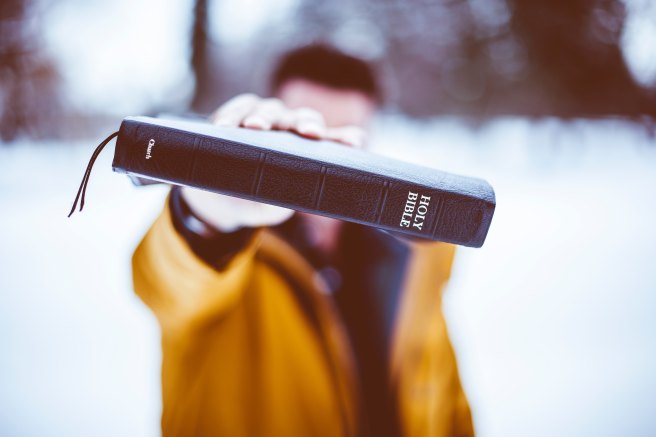
So today, I did something magnificent- I led my first section as a TA! The class is called Exploring the New Testament. You can probably guess what it’s about. Let me preface this by noting that I laughed way too loud exactly twice in class because the professor made jokes that were hilarious to any religious studies graduate student. Perhaps no one else. So much for keeping my cool.

ben-white-181034-unsplash
Photo by Ben White on Unsplash

Teaching felt similar to starting a half marathon. When I looked around the room at 35 faces, I started to feel nervous. Then we divided up into our groups and I felt SO nervous. In my mind, I babbled on like a broken fountain. Hyper-awareness of who spoke and what they said and was it smart and what did they say again swirled around me. At one point I did challenge a student to define what he meant by “sacred” and he finally came to the conclusion that the term was ambiguous. Silent high five! It was a fascinating experience.

Our purpose in class today was to problematize how we “know” what we do about the New Testament. We talked about textual criticism, issues with linguistics and language, and the evidence we have- manuscripts don’t match. What do we do with all of the conflicting information? More importantly, what do we do with silences? Our professor passed around papyrus and animal hyde so we could understand how manuscripts survived. We talked about garbage. Not a dull moment occurred in the hour and twenty minutes of class.

The discussion went fairly well, I think. The students seem eager to learn and talk to each other, even argue their points in productive ways. After we wrapped up, a student asked me a question I failed to answer well. In essence, she asked, “How can I treat the Bible as a moral compass when I haven’t spent years learning Greek and Hebrew and studying texts- basically, when we don’t know?”

This is a question we could apply to any text that exegetes truth claims. How can we use a text as an ethical guide when what we believe about it is upended? I sent the student off with some reading suggestions and an enthusiastic “you’re a budding religious studies scholar!” However, I don’t know if I really answered her question because there isn’t an answer. The answer is that maybe we derive morals from asking questions, not listening to what one text says.

I think I’ll enjoy teaching and probably be exhausted by it in no time at all. For all the theory and strategies and activities to implement in each class, ultimately the material masks what students really need, which is to find their voices and feel uncomfortable. I have a feeling more questions that have no answers are coming my way. What is awesome is how it makes me reflect on why I love this subject. The stakes can be high. It’s cool to be a curator of conversations that matter.

Horrible People (Or Not So?)

This past weekend, I traveled all the way across the bay to the Institute of Buddhist Studies in Berkeley for the American Academy of Religion Western Region Annual Meeting. That title sounds intimidating to me, but the meeting itself was great.

Pegasus Books Downtown sqr
http://www.pegasusbookstore.com

Why was it great? Well, there WAS a bookstore around the corner. First of all, every panel I attended had more POC presenters than white people, more non-men presenters than cis-men, and the audience felt empowered to participate in deep conversation after each presenter finished their paper. The papers all mattered- they told stories from unheard actors, suggested how the way we do things in the academy and elsewhere is perpetuating harm, and offered alternatives. Keynote speaker Dr. Jane Iwamura led us through meditation in her talk on kindness. The audience members told their stories to gentlely tweak or further a presenter’s point of view. People didn’t feel afraid to put themselves in their work. Overall, I found myself at home in this space as a listener and learner (and especially an un-learner).

I also found something bugging me, that I myself need to unpack and unlearn. While the meeting was one of the least-white of any academic I have been to, whiteness still permeated the spaces. That isn’t surprising. One of my classmates developed the hashtag #maleconferencing a few weeks ago after a particularly egregious all-white, all-male panel responded to all-white, all-male audience questions. That hashtag definitely surfaced here too. Beyond the visible panel-audience relationship, I have found that white people who feel “aware” or perhaps as allies or “hopeful allies” find ways to confide in other white people to whom they feel “safe” admitting things. Better than putting the burden on a POC. The problem is when we separate ourselves and our “knowledge” from “those people.” We lift ourselves up by putting others down.

This comes in a few forms. At the meeting, I presented a paper on college chaplains and how they cross boundaries to serve students. What my research showed was a lack of real intention, in some cases, toward students’ racial, ethnic, gender, ability, and other identities. In my paper I didn’t make a value judgement on this because it is “research” and I was channeling what my subjects shared with me. But the audience rightfully didn’t buy that. They wanted to know who served students without thinking about this. “Maybe this is obvious, but mostly white men,” I told them. “White men, white women, and Christians.” The people for whom the institution of chaplaincy was built. After the panel ended, a few folx found there way to me. They started telling me about “a terrible person who did ____.” How heartbreaking and shameful. In doing this, we white people uphold white supremacy. We just do it a little differently.

I struggle with this because something I’ve been socialized and taught to do is “be an expert.” Not to mention focus on strengths and not weaknesses. Skills not growing edges. The idea has always been to further hone what I’m good at and forget what I’m not good at. Most all white people are not familiar with admitting their own harm and reflecting on it. I definitely avoided it for a very, very long time. My goal was always to prove “how much I listened.” Truly, the only thing I prove is how much privilege I hold in being able to learn from the folx who taught me. It seems so laughable now, but I write this because I hope to nudge the folx that look on disgusted at white people who perform acts of racism to self-reflect more. We all perform them, and letting go of our need to separate ourselves begins to break down supremacy in ourselves.


Ceasing to Know

This past week we lost two prominent scholars. We lost two vastly intelligent, innovative, field-changing teachers, mentors and researchers. And most importantly, we lost two among many, many more great people who also died this week. I’m talking about Saba Mahmood and Stephen Hawking.

_-healthymond-288916-unsplash.jpg
Photo by _ HealthyMond on Unsplash

I remember reading The Politics of Piety, Dr. Mahmood’s first book, in college and finding it really difficult to understand. It was my own immaturity that caused this. When I read the book again as a graduate student, I began to realize how groundbreaking it was to study Muslim women in a way that didn’t pity them or espouse suspicion. Unfortunately, that was not the norm. Dr. Mahmood cast Muslim women with agency and showed us why we should pay attention.

Dr. Hawking’s research eludes me, but as a brilliant scientist who also worked the majority of his life with a rare disease that affected his physical being in the world, I have always admired his passion too. He talked about change as inevitable and necessary for us to use our intelligence. That speaks so well to a choice we have every day, to see the world as hopeless or to recognize injustice, but act as if we can change it.

What happens when a legacy of knowledge ceases? This happens every day, perhaps every minute- by living just a moment in the world, some kind of experience shapes a person, and yet every person ends. Even when people leave communities or change roles, a chain of knowing falls away.
These two experts spent their lives both accessing and creating knowledge. Their jobs required certain tasks: writing, experimenting, researching, communicating that research. But the internalization of ideas and beliefs, even when explained through in writing or other forms of communicating, vanished when they died. This isn’t just true for academics. My question is really about how we keep the chain linked, even if the wire is cut.
In the academy, I am learning that scholarship is a way to alleviate anxiety around finitude. Don’t we all worry, in some way, that the hardest part about our non-existence is the non-existence piece? Not just physically, but in terms of memory, legacy, influence. We write to communicate beyond bounds of time. Sometimes this makes us hesitant to challenge memory- what someone put into the world should remain until it no longer serves us. But memory isn’t lost when we no longer invoke someone’s work directly- the endless chain of ideas and evolution means existence is still possible.
Part of this question lessens my own tension around producing work that will cease to serve purpose. Perhaps it is helpful to replace “cease” with “assist,” so voices of influence change. As the poet Gary Snyder says, “Our job is to move the world one millionth of an inch.” In the scheme of things, that sounds like a pretty good accomplishment.

Women Who Grieve

Happy International Women’s Day! I love the outpouring of pictures and writing and speeches about the women who have trail blazed and led and mentored, those who are, and those who will.

aaron-burden-25844-unsplash
Photo by Aaron Burden on Unsplash

I’m going to say something bold. This week, it seems like grief and death have surrounded me- from Coco winning at the Oscars to thinking about empathy in end of life care in my class to an interfaith memorial service to…the horrid violence that can occur when grief goes unchecked. Now, this violence is also rooted in toxic patriarchal and white supremacist attitudes. Grief can play a role in exacerbating this. In my short life, I have encountered lots of grief and found that frankly, often women deal with it better.

On Sunday my partner and I watched a live performance of “Remember Me” at the Academy Awards. The song was up for best original song (and it won!). I think many people would say it’s easy to cry- the premise and the melody remind us of friends we have lost. We cried too. This morning my partner texted me saying that he listened to the song while looking at pictures of his father, and he didn’t understand why he did that. It only made him cry again. “It’s been more than a year, why am I still doing this?”

I’ve written about death and grief a fair amount. In my work, we think about memorial services, funerals, and other ways of ritualizing death quite often. I think what goes unnoticed is not the raw grief from more “fresh” loss but the grief we carry through the rest of our lives. We often hold this idea that at some point in time, grief will exit, it will leave us. We “get over” it. But that’s false. Several people that came to to the interfaith memorial service grieved for people they lost five, ten, or even thirty years ago, and perhaps their grief looks different than someone with raw pain, but the entity is there. Grief becomes a part of us as soon as we experience loss, and it stays with us- it morphs and changes and takes different forms. This is why we wake up crying, or feel empty, or sometimes even laugh out loud for no reason. The other day I was thinking about my grandmother who loved to tell anyone, much to their chagrin, who visited her house about these dolls she had- King Henry VIII and his wives. It was one of those moments that explodes with joy and pain and yearning and sorrow all in the same instant.

I think it’s crucial to talk about grief often. Grief is not always related to the end of life, but it is always related to death as an end. The end of a career, the end of a relationship, the end of living in a particular place. Is grief our friend? I think we might discover different ways to relate, but knowing it exists within us is helpful and actually soothing, sometimes.

Today I am lifting up the women in my life because they hold grief in ways that push them. My mom, my sister, my friends, my classmates, my professors, the activists and teachers and writers I admire- we all hold grief for loss. Some of this loss is what should be and simply isn’t because women constantly fight for space. Our grief can be shared by the space women make for each other.

scattergories

Last week I had a fabulous time with college chaplains in DC. Not to mention, I got some research in and nerded out HARD at the museums. I also got to see some old friends, which really made me consider how much pain even young people have experienced. Relationships that fail, struggling with work, and even the time for parents passing is by no means far and distant. I felt really proud to hear that in the midst of struggle, my friends committed to taking care of themselves through therapy, running, and the occasional night out to let loose. Being “an adult” has never made sense to me as I sit here typing in my star leggings and hot pink vest, but these commitments showed me one piece of adulting.

img_2631
Outside the Newseum in Washington, D.C.

I got to talking with one old classmate about the widespread influence of hetero-patriarchal norms that affect how we live- and how we believe we should live. We talked about a church pastored by wife and wife. The congregation feels overwhelmingly supportive and happy to have this couple as leaders and teachers. Of course we can never assume that means queerphobia doesn’t exist in this community, for it most certainly materializes. The main paradox we found was that the congregation would find fault if one of these pastors were seen out drinking with a friend- something that resembles “a date.” Pastors often take on the role of creating boundaries that form a moral compass. In preaching, in pastoral care, and especially in living a life that models this set of morals, pastors can certainly challenge their congregations and create discomfort. I think that’s important for growth and community building.

What feels more difficult to assess is how morals still abide by this hetero-patriarchy. The need we feel to categorize in order to still translate the norm onto new subjects. Example: a woman marries a woman; we accept this as “love means love,” and their relationship continues to be loving, sustaining, and monogamous. This can translate to the heteronormative family ideal through roles and emotions (love, not desiring another). But…what about people who build relationships that challenge the dichotomy between romantic and platonic? What if you love someone so deeply, and yet feel love just as intense for three other people? The reason this strains our moral compass, as opposed to a same-gender marriage, is that we lose the categories that work to uphold the hetero-patriarchy, even when it doesn’t look quite the same. When we cannot deliver a name for the emotions we feel, and the subsequent relationships we build based on these emotions, the moral compass falls apart.

I am certainly not saying we should abandon our marriages and partnerships and friendships, these really do form the foundation of our lives. I think pushing to live without category sometimes shows the boundaries that need to be challenged. As a practicing Buddhist, what most makes sense to me is to question how the morals I explore may be harmful to myself and others. On the other hand, noting where living in grey areas brings liberation is a sign to pursue the uncomfortable.

Build While Burning

I’ve been missing something.

The students have had enough. They’re marching. They’re Tweeting. They’re on MSNBC. It took students fearing for their own lives to tear apart myths about freedom, protection, and rights to own weapons.

The students aren’t just tearing down, though. They’re building a movement. This is not something I have thought about enough in the thick of feeling angry and bitter and sometimes, really frozen. The conversations in articles and news reports and even face to face has focused so much on what is wrong and what needs to end, alternative processes and even visions feel overwhelming and inaccessible. Dismantling is necessary, but so is constructing. At least starting the process of creating something different in order to believe it can be done.

Building a movement is messy. People disagree and we learn every single day what needs to change. In December, I received a small grant to build a traveling museum exhibit that narrates stories of interfaith relationships and religious diversity in California. Building this exhibit is the biggest and yet perhaps the most important thing I have ever done. With my curating power, I have to choose objects that get to speak. I have to dictate what these objects should make us consider in learning about traditions or communities we may never have seen or heard. I feel so anxious that I will fail to balance or tell truth or even be blunt about oppression and violence through this history that had inevitably occured, and continues today. And yet, something calls me to keep working instead of giving up because I feel reverence to these stories.

I’m back at the National Association of College and University Chaplains conference at Howard University in Washington, D.C. this year. We came together to think about “voices on the margin” and our practices in caring for students who live on the margins for many reasons. We are wondering how sometimes we exist on the margins, and how we fail to welcome others when we have the power to change. I feel a different sense this year. Last year, 45 had been in office for less than a month. I sensed despair and anxiety. This year, despair is no excuse to hide. Our undocumented students are sitting in congress people’s offices demanding a Clean Dream Act. No one in the administration can support them the way chaplains can and should, if we keep building spaces for the mess.

I read something in a class a few weeks ago that put my real passion in perspective. Care is the common perogative of both chaplains and curators. Care for stories, care for identities, care for the complexity and messiness that is learning to be in the world, and how we see it as other might see it. This is the reason I continue to build, despite not recognizing that creation needs to be my theme this year. We don’t need to wait until the entire city burns to the ground before laying the foundations for new community resources.

IDK

Every time I travel somewhere, two Yelp searches happen. The first is for donuts. The second is for used book stores.

glen-noble-18012
PC: Glen Noble

I have a pretty significant habit of collecting books on my shelves that go unread. For a while, I started feeling guilty about this habit. What a waste! Sometimes, ultimatums get thrown around. “No more buying until you finish this shelf.” That works approximately .2% of the time because lo and behold, another trip comes up, another bookstore appears only blocks from where I stay, and my suitcase fills up with volumes. Especially if the bookstores have a religion section. Or a cookbook section. Or memoir.

I read a delicious article the other day that demanded I stop feeling guilty about acquiring unread books (within limits). It suggested that seeing unread books on shelves makes us eager to keep learning each day, because we know that our knowledge is limited and we can keep expanding it. The unread books serve as a reminder that we don’t know everything.

As a PhD student, this attitude of “not knowing” often translates to poor work. It can be difficult to admit when we don’t know a particular fact, or an entire body of literature. There have been moments in class, in a workshop, even in a meeting when I feel silly asking a question that “I should know the answer to.” But not asking the question breeds further imposter syndrome, no matter how many Google searches one can do to alleviate the feeling of not belonging due to a lack of awareness.

It almost feels comical sometimes, the way we pivot conversations to disguise not knowing for what we do know. Think of the typical politician who somehow always gets their talking points in an interview, without being asked. One of my professors assured me that the longer I do this work, the more I will realize I actually don’t know.

Reframing my work brings some comfort to this awkward admission. Maybe my job isn’t “to know,” but actually to recognize what I don’t know, and to strategize ways to find out. Moreover, maybe it’s about the questions we ask. Why are we fascinated by people of the past? What do their lives mean for us? If I interview 50 chaplains about their work, will they give me similar answers?

Academia’s most exciting aspects rest in the unread section of the bookshelf. In fact, I believe life’s most virtuous moments appear in the form of the unread. Often, the stories we tell deal with surprise and an unexpected turn of events. How we react to our surprises dictates the kind of memory it is.

Perhaps the biggest question we will never know how to answer is what our purpose is, and I think it right that we never cease wondering. We can continue asking, and continue seeking, but in this case, not knowing is the one thing that connects us beyond our towns and counties and states. If only we could celebrate not knowing.

Strangers

February traditionally feels like a frustrating month (maybe it’s just me). We made it through the depths of January, and the daylight extends just a little more every day. We aren’t quite there. Now in my own academic storm, I remember my students feeling particularly exhausted this month. The quarter takes a serious turn toward “the second half” and finals week actually comes into view. Not to mention how many blizzards we all trudged through only to have a big event cancelled.

dev-benjamin-219172
Photo by Dev Benjamin on Unsplash

Congress frustrates me. The patriarchy REALLY frustrates me. For the past week or so my frustration has actually turned to anger. I admit- I feel pissed off. At least, I did. Last night I was talking to a friend who sent me a story about a mom who broke down at an airport because her toddler was literally being a terrible two. She couldn’t pick him up, couldn’t get him to sit down, couldn’t do anything so her exhausted, over-worked and underappreciated self just plopped down. And cried.

You might imagine this story could take several turns. As my mom likes to say, “someone is always filming! You can’t do anything wrong anymore!” I imagined people making fun of this woman on social media. Maybe even with a nickname. There would be video. But that’s not what happened, at least in this story.

In this story, strange women saw what was happening and got to work. They didn’t hesitate or ask questions. You can read the details here. The important part is, they showed up. My friend who sent me this story said, “I hope I would be like those women” (she is). Imagine, strangers at your aide.

This quarter I am CDAing (kind of a fancy word for TAing, with a few caveats) a course on empathy and medicine. Five pre-med students come to class with fascinating and often heartbreaking stories and questions about empathy. Many relate to their field. I am no stranger to the comparisons between medicine and care. With a sister completing her first year of surgical residency, I could point to many examples. What we find in the class is how difficult empathy is to define. It’s different than sympathy, or compassion, or care. This week we even read a book against the concept of empathy. The most meaningful literature for me was the biblical story of the Good Samaritan because it calls out “religious” people for failing to use empathy as a source for action. Is religion supposed to teach empathy?

I think what really lifts me in this story of strange women is the unspoken shared experience. They know motherhood. I imagine it’s beautiful, but also exhausting and sometimes downright horrible. Especially at an airport, where you wait to be smashed into a metal box. One of my questions about empathy is whether our own suffering makes us more or less likely to alleviate someone else’s from the same source (in this case, the toddler is the source). The answer is most certainly it depends, but when joy can come from suffering, I believe perhaps we seek to help others find it. This week I’m working to let go of my anger so I can seek joy with others, maybe even strangers.