Some Anecdotes for my Northeastern Family

I made it. I made it through my first full time job. On Friday at 5 pm, I walked to the train station with the gifts and cards my students so lovingly chose and wrote for me. I didn’t say goodbye forever to anyone, because I want to personally see to it that for us it is not goodbye.
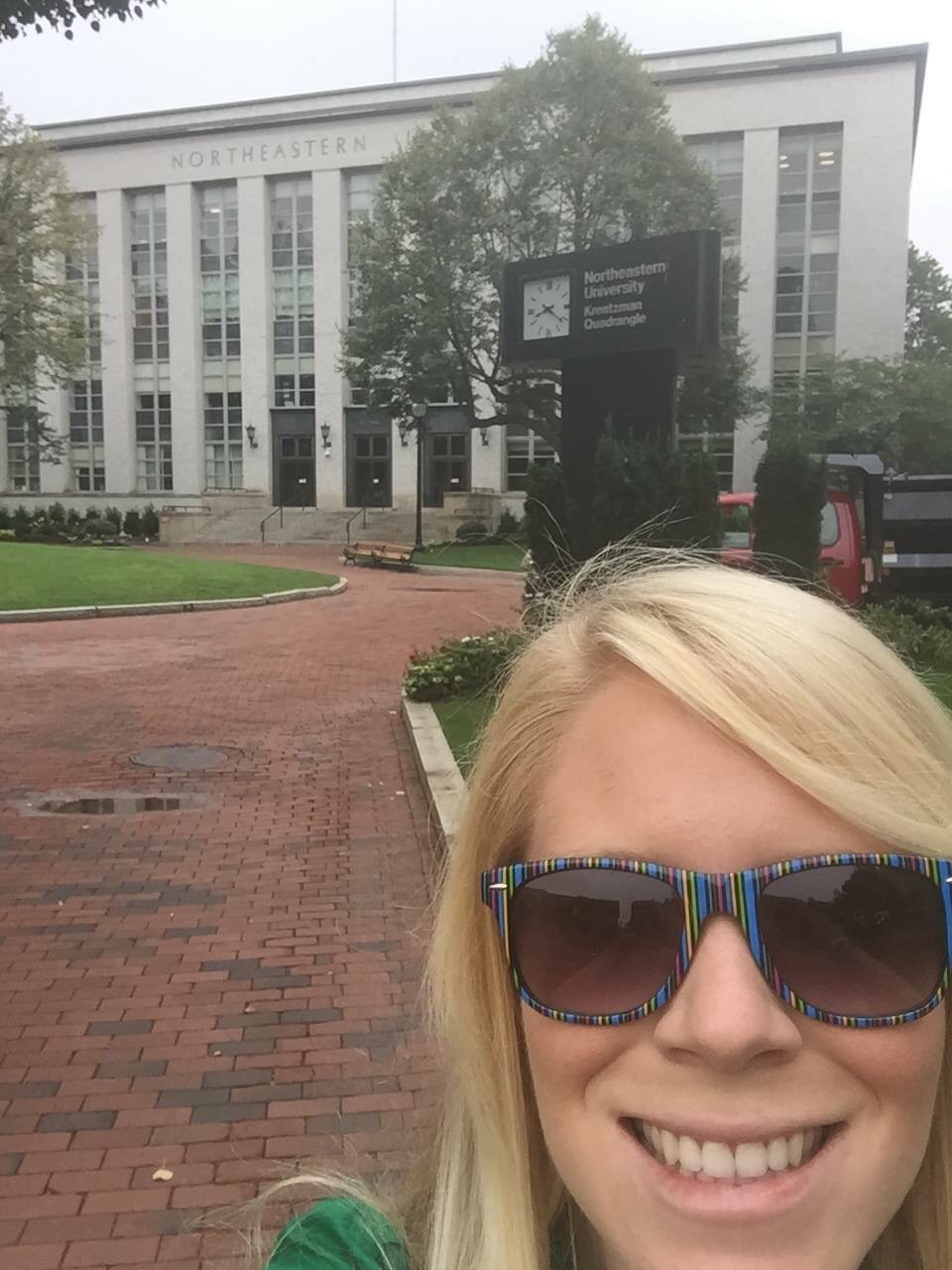
 

A week ago at my going-away gathering, I told a few anecdotes about the students and staff that have been my life for the past two years. I thought that instead of processing what it means that I won’t be sitting in the bright orange office chair on the second floor of Ell Hall, sipping coffee out of an enormous thermos, greeting students and colleagues as they drop by- I would tell some of these stories. Not for the purpose of inferring a message, just for memories. Feel free to add yours to the comments 🙂


-I remember Karin’s (co-worker, sister, co-conspirator) interview at CSDS. She was tasked with facilitating an activity that would showcase her ability to put on programs relevant to the center. In typical Karin fashion, she had us all speak out for two minutes about something we felt passionate about. Then, the audience had to give a ridiculously obnoxious round of applause for at least 30 seconds.


-Our first Spring Break, Karin and I organized a “Stay-cation” with the help of one of our graduate students. We visited several sacred sites around the Boston area. One of the days we traveled to a Thai Buddhist temple that turned out to be stunningly gorgeous- the ceilings were coated with gold. One of the monks showed us the many different quarters of the temple grounds, and was very interested in taking pictures at every turn. Each time, he would hold the camera, pause for several seconds, take a picture, and make us wait, saying, “one mooooooooore.”


-One of the best gifts I received (CSDS folks can gift give, for real!) was from Karin after Umrah. She brought me a gorgeous blue prayer rug and said, “I thought of you meditating on this and knew you had to have it.” Such a beautiful interfaith moment.


-Our first year at Renew, we had a great time performing a skit that poked fun at ourselves and some of the Spiritual Advisors. Seeing the students take on their own skit, and especially the student who wore a yellow scarf and sunglasses to play me, made me both laugh uncontrollably and almost cry because it was so well done. Side note: the talent show at Renew was the best talent show I have ever witnessed.


-Both years, I’ve been gullible enough to be surprised on my birthday. This year, Karin ran into our office, shouting that a spider had gotten in her coat and she needed help. Even though I have a crippling fear of spiders, I dashed after her to save the day (I guess?) and of course found myself in the middle of a giant chocolate cake.


I remember my first day at CSDS. I took this picture to show my mom that I actually did have a real job. I want to be honest- it wasn’t all fun and roses. Making mistakes and learning from them are hard, being vulnerable is scary, seeing people you love go through unbelievably rough times is heartbreaking. Walking with you has been incredible. Congratulations to the cheesecake bars for winning the baked goods showdown.


Full Circle

I don’t have to tell you that the world is funny, that life is not linear, that time is sometimes not a helpful tool for us- and sometimes it is.

joey-kyber-115166.jpg
PC: Joey Kyber

Just last week I was writing a short story about stepping outside my comfort zone. I wanted to talk about joining the Interfaith Council at USC after meeting Varun, the Dean of Religious Life. The story of finding Varun is a silly one, it involves pulling a newspaper out of a trash and seeing his name in the headline. “What’s a Dean of Religious Life?” was the first question that popped in my head. The article in the Daily Trojan (our university’s daily paper) described the many experiences Varun lived that led him to this role. Living in Nepal as a Buddhist Monk, finishing both a Master of Theological Studies degree from Harvard University and a law degree from UCLA, hosting a radio show, meeting His Holiness the Dalai Lama, even being an avid sports fan- all of these influenced the person he is today. Reading about them, I thought, “I want to live like this person. I should probably meet him.”

Nine years (!) later, I’m sitting at my desk at Northeastern University in Boston, where I have served in a chaplain role for almost two years. First I see the text messages from my mom and dad: “Did you see the LA Times article about Varun? I think he mentioned you.” Friends are sharing on Facebook. Varun himself emails me a link to a stunning story about his trajectory at USC, as a non-ordained Hindu attorney. It sounds just like the article I read as a lost sophomore at USC, at a time when I knew I loved studying religion, but had no idea what to do about it. This was the article that pushed me to email him in that chilly office on the second floor of the business school, that for the first time showed me I could live a life full of passion like Varun, combining so many different interests. And it’s my last week here, which feels as though a circle has been completed.

I think it’s really important to experience nostalgia sometimes, as a reminder to feel gratitude for the people who have been a constant support in our lives. I was going to post a bunch of vignettes this morning from my time at Northeastern, because there are so many wonderful and hilarious moments from these two years. I only got to tell a handful at my lovely going away party. This morning I took a Lyft to work because I baked too many treats to take on the T, and as we inched along on the 93 toward Roxbury, I looked out at the Boston skyline centered on the Prudential Center, its windows shimmering in the sunlight, and realized today is my last Monday here. Only two years ago, my mom and I attempted to navigate this ridiculous freeway and street system to move me into my tiny apartment in the North End. I remember sending Varun a picture, knowing I had made him proud. The community here has made me proud, especially after so much hardship. On the wall behind me hangs three simple letters that welcomed me on my first day: J-E-M, my name. I’m taking them with me to hang in my new office (if I get an office).

Link to the story: http://www.latimes.com/local/lanow/la-me-usc-chaplain-20170403-story.html

The Ideal is Possible

Today I did something really cool- I spoke on air about my work with the Revolutionary Love Project for L2O, a platform that organizes online communities. We talked about what Revolutionary Love means from a Buddhist perspective, how we practice in our own contexts, and most importantly, what it means to stand in love with our opponents.

jeremy-bishop-34880.jpg
PC: Jeremy Bishop

I really enjoyed thinking critically about these questions, especially when it came to calling on wisdom from faith traditions and sacred texts. I realized as I was talking that much of my faith comes from stories and written wisdom- stories take us from a place of wonder or discomfort to a new idea. They often involve learning. I feel most connected to my own practice when I think about stories of the Buddha, and the stories tucked away in the Zhuangzi and Laozi. Whether or not they are factually true, I think these stories reveal the essence of what kind of people we hope to be. They hint at values and ethics. We walk with the protagonists to learn lessons.

At the end of the interview, Sara from L2O asked, “What does an ideal world with Revolutionary Love look like?” I admit I was rolling along through the other questions, having practiced my elevator pitch several times before. The Fourth Precept of Engaged Buddhism tells us not to turn a blind eye to suffering. We must practice knowing our own innate goodness in order to know that of others. I have a sizable story bank that allows me to illustrate what I believe quite often.

This question forced me to think about my end goal in this work. What is it all about? I know that writing and reading and dialoguing give me life, especially on the topics of faith and social justice, but to what end? I admit: I don’t know what “the ideal” is.

Pause for a second. One of the ways I ground myself in love is recognizing that everyone suffers. My job is to help alleviate that suffering- but not the reality that suffering is the way of this world. I think it’s important to acknowledge that everyone holds pain and fear. I believe further that it’s important for us to sit with it for a while. Running away only further embeds these harmful emotions into our bodies and minds. So an ideal world is not one free from suffering necessarily, but one in which the suffering translates to discomfort. When we sit in a place of tension and discomfort, we are learning. When others share with us that we contribute to their discomfort, we learn how to alleviate that. I found myself saying out loud that a world grounded in Revolutionary Love isn’t one that is absent of sadness. Instead, it is one where every emotion has a purpose, and every person sees relationship as divine. It is one in which fear drives us to build bridges, not retreat.

And finally, I turned to my old friend gratitude. Gratitude for me is the acceptance that we may not have fully realized a goal or gotten exactly what we wanted, but we acknowledge that we are better off having met someone, experienced something, learned something. A world grounded in Revolutionary Love is one in which gratitude abounds. I must say, I feel very grateful to have gotten this opportunity today.

Starting Fresh

When I was 14, I moved across the country to go to boarding school. There were a few reasons for this, none of which involved discipline (what many assumed). Attending this school was a huge privilege for me, it meant studying with classmates who also wanted to immerse themselves in learning, meeting friends from around the world, and most especially spending a big chunk of my junior year studying on exchange in Japan. I even got to study two languages all four years.

margot-pandone-5628.jpg
PC: Margot Pandone

There was another reason I was excited about going to school 3000 miles away. Since kindergarten, I had attended the same small Catholic school. That’s 9 years with the same 45 people. I wasn’t popular or cool in my class, I often felt invisible. This was mostly my own fault- I spent most of my time pursuing interests that my classmates didn’t find interesting. Like learning Japanese, or reading about religion. Middle school is hard, period. I don’t know anyone that didn’t have a hard time. For me, boarding school not only meant opportunity for rich study, it meant leaving my life behind. It meant a fresh start.

Moving at 14 was hard. I actually almost didn’t make it. I called my mom every hour the first week at school, most of the time choking through tears, “I don’t think I can do this, I want to come home.” My mom listened with endless patience. “What’s next on your schedule?” she would ask, and I would tell her the next class, or sports, or dinner. “Try that, and see how you feel after.” After a while, it became, try it for a day. Try it for a week. Look- you’ve almost made it half way through the semester. And suddenly, it was time for finals, and I was flying home for winter break.

I believe a large reason why those first few months- the first year, really- were so difficult was because I had a false perception about what this experience would be like. I could be anyone I wanted, I thought. In some ways, I had no idea what to expect. But I was so sure-and wrong- about one thing: starting fresh. Starting fresh is a farce. Sure, this experience was new and unique, and I certainly changed and grew at this school. But starting fresh in place and people doesn’t mean starting fresh by forgetting who I was proved impossible. I carried with me the same pain, fear, curiosity, and love to this new place. I still carry it today.

Instead of forgetting the unpleasantness, I have learned that new experiences- entering a new community, starting a new school, a new job, leaving a life behind- actually teaches me more about who I am at the core. Interestingly, one of my most firm convictions comes from the Buddhist tenet that change is constant and inevitable. Nothing is permanent. Yet, just because change occurs does not mean we let go of the impressions made upon us. Outwardly, we can withhold anything we want and no one may have any idea what we’ve been through. The most permanence in the world is our internal truth.

A student very dear to me gave me a book, called The Shack (it’s now a movie). I don’t normally choose novels, but this one intrigued me because it’s a story of struggles with pain and faith and the image of the divine. The beginning of each chapter is marked with a quote or two. The second chapter starts with one by Paul Tournier, a Swiss physician who is well known for pastoral counseling. “Nothing makes us so lonely as our secrets.” I paused after reading that. Of course, we feel most alone when our inward truth feels dissonance with our outward environment. This is why starting fresh only really teaches us what we are already carrying.

My first year at boarding school I tried hard to re-imagine who I was by convincing others that jem was not Mary Ellen. I don’t believe I lied explicitly- but I hid the pain of being away from my family and the struggle to do well enough and be enough for this highly talented and hardworking community. I felt so lonely, even when I was surrounded by classmates who perhaps were feeling exactly the same as I was. As I slowly started to realize that my inner truths were not only accepted but embraced, my presence at this school began to feel legitimate. To be sure, I always struggled with questions of self-worth and being enough, but I found people who could walk with me. To this day I can call my best friend that I met in our freshman dorm and talk to her as if we’ve lived next door our entire lives.

As I transition to a new experience (more on that later), I’m bringing some baggage that’s tough to carry. I’m also bringing a ton of love and memories of joy. The freshness of this beginning isn’t about erasing what I’ve been through, but opening to the possibility of learning more about who I am.


The Interfaith “We”

Last week my friend Katie Gordon visited Boston so of course we had to get dinner and catch up. I showed Katie around campus, took her to the LGBTQ Resource Center to see our mutual friend and colleague Lee, and after a quick tour of our Sacred Space, we wandered over to Newbury Street. We stopped in Trident Books and mused over some titles, mainly discussing what had been happening on our respective campuses. We nerded out about a few particular books, mostly related to feminism and/or religion. Finally, we sat down to a delicious South Asian dinner.

samantha-sophia-195012.jpg
PC: Samantha Sophia

Katie is the Program Manager for the Kaufman Interfaith Institute at Grand Valley State University in Grand Valley, Michigan. She identifies as secular, but make no mistake- Katie is one of the most influential interfaith leaders of our time. She trains for the Interfaith Youth Core’s Interfaith Leadership Institutes and has introduced Krista Tippett, creator and host of the radio program On Being, because she’s that cool. I have known Katie for a while through our mutual Interfaith Youth Core affiliations. One thing I really appreciate about Katie is her ability to unapologetically be who she is without inhibiting anyone else from doing the same. She is open about her whiteness and privilege, but not guilty or frozen in working to make change.

At some point in our conversation, we both expressed concern for the interfaith movement as it exists now. What does it mean to train leaders when many people of faith live under real threat for their lives- because of their faith? Can white, secular young people train in the same spaces as black Muslim women? As queer Jews? As Hindu immigrants? As refugees who, despite looking death in the face, have held close to their devotions? How do we expect those who seem to lose power and voice every day to lead others when there is real, imminent danger?

I have been reflecting on this question for some time now. One of the reasons I feel so strongly about activist and filmmaker (among other amazing things) Valarie Kaur’s message and definition of Revolutionary Love is that I feel so strongly about Valarie herself. She represents to me the very type of leader that begins to answer this difficult question of how we as developing interfaith leaders might live into our identity as such. You see, Valarie may have several thousand Facebook friends, a database of over 100,000 subscribers via different projects she has started, and one of her recent speeches has now acquired over 16 million views on social media (that’s remarkable, just FYI), but Valarie never does her work alone. She always thinks, speaks, and acts in community because she recognizes that while her voice is essential- as a woman of color, a Sikh American, an accomplished pioneer in filmmaking and civil rights law- hers is by no means the only voice with one particular set of concerns. We need not look further than the daily news to see how many communities need more voice for dire concerns.

In this way, I think our answer begins not at the “I” that defined the previous era of interfaith leadership, the years I spent building my toolbox and story collection. Interfaith work has always been about bringing communities together, but allowing particular individuals to serve as the face of communities, to represent traditions and belief systems even if inadvertently has in the past been enough- we look around our table to see a Christian, Jew, Muslim, Hindu, Buddhist, and seeker, and we feel good about our group. We can dialogue and serve together. We might not talk at all about the intersections of our own identities, or how unequal access to this table might be.

We have reached a moment in our public landscape in which the “I” interfaith leaders will quickly feel devastatingly alone or completely exhausted, and probably both. The interfaith movement is at a true “we” moment- a time when it needs to be acceptable and encouraged for us to ask each other to do things like march on the front lines, speak publicly against bigotry, or give money to civil rights organizations. Going to prison for disorderly conduct. The reality is, we cannot all risk the same things. We need to know our limits. Focusing on “I” can help us learn these things about ourselves, but will not build networks. Right now, the fact that our different identities afford us unique privileges is an advantage if we use them in community.

As Valarie so beautifully stated recently, “We can practice Revolutionary Love for those who are in prison because they have committed great harm. This does not mean they shouldn’t be in prison. This means we free our hearts to believe they can be greater.” For some of us, practicing Revolutionary Love, just like interfaith leadership, means asking our allies to put their words and bodies on the line. At the same time, for some of us, it means being asked and saying yes.


Nightmare

I woke up screaming at 2 am after experiencing a nightmare.

This certainly was not the first time I’ve had bad dreams- often when I am stressed or anxious about a meeting, a test, even the amount of work ahead of me, my sleep has been fitful or disturbed. My dreams include strange and weird images. But this was different. This was terrifying darkness and powerlessness. This was screaming in sleep and out loud. For the life of me, I can’t figure out what this dream means.

james-stamler-153583
PC: James Stamler

I’m in a dark room, laying on a bed. Someone outside the room is keeping guard. I’m shouting to let me out- please! But the person doesn’t respond. I realize I’m dreaming within a dream, and try to wake up. I’m paralyzed, just lying on this bed. Wake up, wake up! Until finally, someone shoves me and I am, in fact, awake.

I have never been so happy to see my room in Boston, dimly lit from the moon peeping in through the curtains, my stuffed animals strewn about the sheets. After a few deep breaths, I felt a little calmer, but disoriented still. I clutched my penguin Plush and tried to fall back asleep.

This weekend I revised about 25 pages of my memoir. Revision may indeed be harder than writing in the first place. After receiving feedback from my classmates, I was forced to grapple with the questions they posed to make my narrative clearer.

“Why did the narrator (me) say she didn’t believe in God when this is a memoir about faith?”

“What made the narrator hide the fact that she was traveling by herself?”

“Why does the narrator feel so guilty about almost everything?”

I kept writing and deleting, writing and deleting. I found myself scratching my head.

I don’t know why.

Just as nightmares illuminate possible emotions we are hiding deep within, perhaps these questions led to a stir where there has long been no movement. The only way for me to understand this terrible, terrible dream is to wonder what came up as I faced these questions, trying to honestly tell the story of my life and my journey. Darkness. Paralysis. As if stirring kicks up dust we are forced to inhale, sneeze, and clear away.

Upaya in Elon, North Carolina


Even though it was 4 am, I felt joy seep through my veins as I quietly tiptoed out of my apartment. On Friday I hopped down to Elon, North Carolina to experience the 2nd Annual Ripple Interfaith Conference at Elon University. My friend Carrie graciously picked me up from the airport at 8 in the morning, coffee at the ready. That was the first of many acts of hospitality I received from everyone involved in the conference.

The theme of the Ripple Conference this year was “mindful plurality,” and I gladly accepted the invitation to share my thoughts on mindfulness, interfaith work, and Buddhism as an accessible set of values. Not because I am an expert (heh, NO) but because I have fallen in love with my faith in the past year and felt encouraged that mindfulness practices have entered the realm of activism and resistance. That’s what this blog is all about- practivism. How we sustain ourselves in the long, arduous haul against oppression, violence, bigotry.


On the opening plenary, five folks of different faiths shared what mindfulness means to them. We heard from a practitioner of Ignatian Spirituality, a Protestant with a regular mindfulness practice, a Tibetan Buddhist, A Rabbi, an Imam, and a Zen/Engaged Buddhist. I felt unworthy to speak after listening to such great wisdom. After we each shared, a member of the audience asked perhaps the most urgent question of the moment: “How do we remain mindful under threat, when I wear this (points to hijab), when people have strong negative assumptions about me just by looking at me? How can I simply work on my inner peace when others are dying without dignity every single day?” Long pause.

A version of this question has plagued me for quite a while- in fact, it has caused me nothing short of a faith crisis in the past year and a half. I do not wear hijab, and I pass easily as a “regular ole’ white woman.” So- isn’t it my job to get my behind out in the streets and be on the front lines? Yes. And how, then, do I work on my inner compassion?

As Zen Buddhism would have it, there are at least two relevant concepts to begin chipping away at this question. First, interconnectedness. We can’t hide from the world and luxuriously put our feet up in the enlightenment hot tub, for our world continues to suffer. We are still in the world. We are responsible for walking with those who suffer. The second concept is one that frankly, I hadn’t thought about in a while. Upaya: expedient means. What works for you in this present moment to walk toward enlightenment? Upaya is about our context: it puts the quest for ultimate truth aside so that we might take a step in the right direction without doing wrong. Simply put, it means we don’t need to feel frozen: try something and see if it works. More importantly, upaya recognizes that the presence of everyone around you at any given moment is necessary. All Bodhisattvas (Buddhas who opt to stay in this world to help the rest of us) offer us different skills and wisdoms- human beings do the same.


As I reconnected with this concept I realized that all of us in the room needed to struggle through this question together, in that moment and moving forward. I fell in love with each of the students and conference planners as I began to see their complex identities. Each moment I was gifted a story and inner desire over coffee, a joyful memory in the Truitt Center kitchen, even a moment of anxiety or uncertainty as is par for the course of any conference, the expedient means of each community member unfolded as the weekend pressed on. It felt so good to witness the success of this group of people, to be reminded of my time in Japan and the opportunity to travel, to talk honestly about how Buddhist communities must work for racial justice, and above all, to laugh uninhibited. Laughter surely is upaya at its best

I am grateful for this weekend as we continue to invest in interfaith leaders as the key to our future. As one of my students often tells me, “the people that needed to be in the room inevitably came to the room, and it was good.”


Flu

On Tuesday, I got up early, went to work, and noticed a tickle in my throat that was causing a teeny, pesky cough.

Four hours later, I had to admit something to myself and everyone around me that I really, really despise admitting: I was sick. Really sick. Fever, chills, head explosion, no appetite, actually got a Lyft home sick. Sick like, took an actual four hour nap sick.

nick-karvounis-156099.jpg
PC: Nick Karvounis

I don’t get sick very often. That’s a really spoiled thing to say. I pride myself on my commitment to keep my body healthy- I run, cook my own food often, and try to sleep a good amount. That’s a privilege to have time and resources. It also takes discipline and a firm no to sugar which can be very, very difficult (why confetti cake. why).

Hopefully I’ll be fine tomorrow, I told everyone at the office. Tomorrow turned into a scary trip to the Emergency Room and a doctor’s note. “If this is what I think it is, you probably won’t feel better until Saturday,” Dr. Chua said. At least I was now equipped with some medicine to fight the fever.

I did not go back to work the rest of the week. In fact, I barely looked at my email, read any of my books, or watched anything on TV. I ate some applesauce every few hours and trudged to the kitchen to fill my water bottle again. Obviously, intense physical activity was out of the question. I skipped Tuesday’s four mile run, then Wednesday’s eight mile, then Thursday’s four mile. No yoga, no strength training. Even though there was no way in heck I could have attempted to even walk down stairs not not faint, I felt guilty. And yet, I felt weirdly as if this really, really needed to happen.

Since November of 2015, I haven’t gone more than four days without running, even if for two miles. Before I started running, I don’t think I had skipped working out for more than four days in a row- and if I did, I would have worked out double on the fourth day. Working out has become part of my routine, and my routine doesn’t do well when not followed.

Yet somehow, seven days passed with no running. I let go of the guilt. Several people helped me. “Your body is telling you that you need a break,” a student said. “This is everything you’ve been stressed and anxious about coming out,” my mom wisely stated. I believe that. When others around me are sick, or fatigued, or overworked, I believe their bodies tell them, just as mine informed me. Sometimes we have to stop everything, literally everything, and just lay on the couch wrapped in a blanket like a human burrito.

I began to feel better by day six. I wondered to myself, “how much doing nothing is TOO much? What if I took another day? Should I try? What is the limit?”

That’s my question moving forward. When we take time for self-care, when do we know we’ve done enough? When are we ready to push forward? And what if we are wrong?

Today I ran ten miles because it was 59 degrees and sunny, and I needed a moving meditation. I ran slower than I have in a while, and felt parched after the first half. I could tell my body was not at 100%, but it felt good to sweat and pump my arms. I don’t know if I was ready- did it matter? Maybe there is no right answer, except that we know when we are not.


What Love Teaches Me About Rage: Spending the Day with Valarie Kaur

Snow crunched under my boots as I paced the sidewalk. Valarie was finally here! It had been 8 years since I last met her in person and up close. She gave me a great hug before we trekked back to the Curry Student Center to drop off her bag and begin her Master Class as the opening to the New England Interfaith Student Summit.

Valarie captivated everyone’s attention immediately. She also helped participants feel like they could be vulnerable in a group of 35 others-as we learned to tell our own stories for movement building, I witnessed several soul-baring moments. Moments of shame, of fear, of knowing acutely how different one felt from everyone around them because of their queer identity. We learned together how these moments blossomed into activists and teachers and interfaith leaders.

16708655_10103495157637871_6060008837786264158_n.jpg
PC: Valarie Kaur

I fell in love with the students I serve all over again. After a snow day that cancelled our planned Keynote Address with Valarie just the day before, they committed to each other to make the day a success. They treated every participant and staff person with kindness and jumped at opportunities to be helpful. A few students ate their lunch with Valarie, and offered some of the most poignant wisdom and relevant questions for leaders and activists at this time. “What is the boundary I am allowed to set when it comes to engaging with people who do not agree that my humanity is sacred?” “How do we actually take time for self-care, and what does it look like?” “Who are the MLK and Gandhi’s of OUR generation- the folx that understand the context in which we struggle?” I scribbled notes furiously.

After lunch Valarie planned to show snippets of her first film, Divided We Falland take questions. “What if instead, we show the Public Radio International video of Rana and me calling Frank Roque?” She asked me. This is a 30-minute video of Valarie and her Uncle Rana calling the man who murdered Rana’s brother Balbir Singh Sodhi four days after 9/11 in Phoenix, Arizona. This man’s act of violence is what broke Valarie’s heart and made her an activist and filmmaker- the first hate crime against Muslims or Sikhs after the towers fell. Balbir was killed because of the turban he wore on his head, and the beard he kept long as a sign of his faith. The murderer’s name is Frank Roque. He has been sentenced to life in prison.

“I want to know the audience’s reactions. I’ve never seen the video in full.”

I loaded up the video in the crowded workshop room. About 20 of us watched Valarie and Uncle Rana sitting in Rana’s kitchen, speaking to Frank. Valarie holds the cellphone so Rana can listen and respond. I hear Frank say he “couldn’t help” what happened, that he had experienced a mental breakdown. I watch Valarie’s frustration but miraculous ability to stay calm. Rana listens politely, and when he does speak, pours love out from his heart into the phone. He tells Frank that he, Rana, already forgave him, that he sends love to Frank’s wife and daughter, that if he had the power- he would release him from prison. I have watched this video three times, and each time my eyes cannot help but respond to this with tears, in awe of the grace Rana bestows on Frank.

About halfway through the video, Frank tells Rana that he never forgot Balbir’s name. But it isn’t until almost the end that Frank addresses Rana using his name instead of “his brother.” “Rana,” he says, “I am sorry.” Finally, I thought. A tiny transformation. Frank has finally started to humanize the person whose life he destroyed, who still lives in pain and suffering yet loves without chains.

One audience member spoke about feeling dissatisfied with the conversation. “Frank isn’t there,” he said. “He didn’t ask you (Valarie) or Rana any questions, and he didn’t seem to fully admit his harm.” We agreed. In my reflecting on NEISS as a whole, I believe it is necessary that we remain deeply dissatisfied AND recognize the tiny transformations. This is Practivism, the ability to believe our work, our suffering, our struggle is working even when we cannot see it.

Don’t tell us to calm down, for we are angry.

Don’t ignore our rage, for we are outraged.

Let us ask one another and ourselves WHERE the outrage comes from, and understand that the root is love.

As I walked with Valarie back to our office so she could prepare for the closing, with tears in her eyes she stopped to hug one of the participants who watched the video. “My grandfather was killed in a hate crime,” he told us all. “Please write me,” she said. “You are not alone.”


“When you let rage fester in isolation, this is when it becomes violence,” Valarie said as she closed her Keynote Address. “Love is a choice, an act of faith and courage.” I knew at that moment that the dissatisfaction we all felt with Frank’s response is rooted in faith- faith that Frank has more to change, more tiny transformations to experience, and much more love to choose to put out in the world. We all have this capacity. And we are not alone.


Aliveness

I, like almost everyone around me, am a mess.

I feel exhausted.

I feel exasperated.

I feel anxious. SO anxious.

Every morning, I wake up much before I hope to and feel awake. Not awake in a refreshed sense, but in a nervous, jittery, need to run off the energy awake. My stomach feels upset, my neck aches, even my breathing feels shallow. I end up reading or scrolling through Instagram in bed, which only entertains for so long. Sometimes after literal hours of tossing and turning, I get out of bed, rush through my morning ritual, and head to work on a crowded sweaty train.

I remember Thich Nhat Hanh’s wisdom: When you are in a rush, slow down. Seriously, we need to slow down.

In the past couple of weeks as this sleeplessness and anxiety has really started to affect me, I have noticed another feeling creeping up. It directly relates to anxiety: it’s called helplessness.

Helplessness, as if losing agency, power, the ability to control anything in a situation. That causes anxiety. I have been in several situations this year that felt completely out of my control. In these situations, I find myself wishing things, like, “I wish this person wasn’t here.” Or, “I wish I knew more than I do.” I find myself begging. Who, I’m not sure.

In my sleepless mornings I have sped through several books. My “to read” pile is diminishing. This past week I finished Brian McLaren’s We Make the Road by Walking: A Year-Long Quest for Spiritual Formation, Reorientation, and Activation. The book offers 52 chapters of “lessons” for spiritual formation, to be divided up into each week of the year. As an instant gratificationist, of course I couldn’t save the lessons, I wanted them now. So I read the book in 2 days, and learned some fascinating perspectives on biblical narrative and how McLaren defines spirituality, calling it “the quest for aliveness.” I began to think about how I cultivate aliveness- running, writing, reading, and resisting. These activities bring me joy, challenge me, and allow me to see growth in myself. Aliveness. Perhaps the opposite of anxiety.

j4pae7e2_ws-jared-erondu
PC: Jared Erondu

As I continued through the lessons, toward the end of the book I read this:

My anxiety is more dangerous to me than whatever I am anxious about. My own habit of condemning is more dangerous to me than what I condemn in others. My misery is unnecessary because I am truly, truly loved. (McLaren 143)

And suddenly it was clear: I have been my own worst enemy. I have been completely in my own head, and frightened myself to the point of insomnia. I have blamed others. I have felt miserable. I am miserable, and there is absolutely no reason for me to do nothing about this misery.

I am a mess. But I don’t need to sit in filth forever. In fact, I could do one thing today that would make me feel empowered. And celebrate that empowerment. I could be more congratulatory about finishing a run- not just feeling like I had to. I could write for the pure joy of writing, and not worry about it being terrible. And I could start thinking along the lines of what I can control, and focus on those things.

It sounds SO simple and easy, but it’s so easy to feel frozen in anxiety and misery. It’s hard to name for ourselves what we can’t control. I think aliveness is making peace with this, and learning to hold the things that give us our uniqueness. I’m done being a mess, at least, in my own head. It’s time to start assessing what needs to float there, and what can drift away.