Represent: A Listicle.

Another week of reading and writing and pretending I know what I’m talking about! The third week of the quarter floats away into the distance, drawing the looming final papers, conference presentations, book reviews, grant proposals and other exciting checklist items menacingly closer. At least the sun stays out longer.

patrick-tomasso-71909
Photo by Patrick Tomasso on Unsplash

As a first year PhD student, one of my constant learning goals is how to design strong syllabi for courses I would like to teach one day (could be next quarter, could be next year, could be in thirty years). I enjoy pouring over potential books and articles. The experience throttles me back to my favorite classes at USC. It’s easy enough to google syllabi for similar courses, but in order to really hone a spectacular combination of readings, assignments, and learning outcomes, I have to pay attention to detail. Campus cultures are very different. Students learn in different ways. Heck, the quarter system creates a storm of issues- you only get ten weeks, minus intro week one and wrap-up week ten. What if a holiday falls on class day? All questions to consider. In this recent quest, one question yanks at me with every reading I assign. Representation.

By representation, I mean who gets to speak via the texts listed under each weekly heading. As the curator, I hold a substantial amount of power in my pen (ok, keyboard) to introduce students to material that will assist them in discussion, dialogue, even debate. Of course, not every source makes it to the homework section (that’s an understatement. Ask my older colleagues about paring, paring more, paring even more). Our vast knowledge proves too much for a semester-long course. It should. We work for years to make it that way. But with power comes responsibility and for me that responsibility is to represent identities that often don’t have a voice. I’ll use gender here, because inserting more texts written, edited, and translated by non-males has been my focus this week. Recognizing that every discipline splits into sub-disciplines and subsequent areas of focus, some folx might have more difficulties than others. I’m not a listicle writer (though I love a good one that features gifs of sassy animals), but I think this merits some bullet points for suggestions that have helped me. And while I focus on syllabi design because of my profession, I think this question expands to many different fields. Who is in the room, at the table, has the mic? Who makes those decisions?

So. How do we think about better representation on our syllabi?


Do a LITTLE research. Think Creatively about Where You Find Your Sources.

Ahem, pardon my sarcasm. Of course we do research. But are we keeping a critical eye out for authors and speakers who may have been passed over because they aren’t white men? Someone once trashed a book I chose for a week on Muslim experiences in the United States because it was a memoir, ie, not academic. The thing is, academic books about “the” Muslim experience tend to be written by non-Muslims. There is nothing wrong with this. But there is a difference in someone’s own story- we get vulnerability and the chance to make connections with someone who might be different from us. Pro-tip: working at a university is great because we have colleagues who may study very different subjects but these subjects intersect at points. I remember reading a theological text in my Arabic class during my master’s program, for example. If you can’t think of any sources written by women, pop over to a colleague’s office and ask for suggestions. Ask for a translation. Ask them to lunch. Hey, lunch date!

Change Unit Weekly Topics or Themes to Make Sources Relevant.

But the quarter is only ten weeks! We have to get through units 1, 2, and 3 and that’s pushing it in ten weeks! Putting in a source written by a woman throws a wrench in my WHOLE jam here! Ok, I hear you- learning goals and outcomes are important. We usually write them for administrators because students don’t read them (why should they? They’re usually bland!). Maybe you can’t change these outcomes/goals. You can change the topic of Week 5 instead (NOT to “women/females/anyone not male in ___ subject. See point below.) and make it work with the source. Use a source that reveals a kind of methodology in the field. I might have trouble finding a source about a religious community that doesn’t allow women (or maybe we just don’t know) in a specific place and time period. Think classical Taoist texts, for example. I have this other text that dates later, but comes from the same general area and falls under the general theme of the course. Instead of “Classical Taoism” Week, I get rid of the word classical and say “early.” Or I find a secondary source that talks about the Daode Jing as a potentially feminist text. I have the students debate whether this makes sense after they read some sections.

Don’t Pigeonhole Gender to One Day/Week/Topic.

Please don’t do this. I can just see the sense of accomplishment. Alright, I found not one but TWO sources written by women about women in ____ field. I organized a WHOLE class period to discuss it. I even invited a women SPEAKER to come talk about women! I’m amazing. Ok, you know what this feels like? It feels like pity. It feels like when you leave the food waste out for the raccoons (no offense raccoons. Y’all are cute.). It feels like the only time women get to be represented is when we are talking specifically about gender and that in any other theme, women just aren’t allowed or important. Representation matters on every.single.level. I’m not saying all the sources need to be written by women. I’m saying think about who speaks through the sources every single week. Looking further than the usual suspects means I get to have more innovative discussions with my students. I might even learn something new. Learning? That’s not…that’s literally my job. Yay.

If You Really Can’t Find Any Authors, at Least Look for Texts Written about Non-Males. 

I’ve looked EVERYWHERE, taken my colleagues to lunch, poured over other syllabi, picked through the archives. There just aren’t any women who have written about _____. Unfortunately, given the history of oppression and gatekeeping for non-male scholars, writers, thinkers-anyone with a voice, really-sometimes the sources don’t exist. It’s not acceptable to just revert back to the all-male cast. Are there any texts written about women? And they don’t have to be about a superhero. I fell into the trap earlier of getting frustrated because I couldn’t find a “strong” female character in a set of texts. That doesn’t mean there weren’t any. That means my students should learn to engage with how writers depicted women and not just label them “sexist” without further examination of context. Let’s be honest (as honest as we can, given the limited material we have) about experiences that run the spectrum of heroic to traumatic to “mundane.” The point is my students learn to ask questions, not assert unfair judgments about cultures they do not know.

Thanks for your consideration. Now go out to lunch so you can grade those midterms.

Wrath

This weekend marked one year. Women swarmed the streets again. We aren’t finished here.

chris-slupski-433343
Photo by Chris Slupski on Unsplash

This year felt slightly different, in my book. The marches focused on increasing voter turnout and encouraging potential candidates to run for political office. Toxic feminism still reared its ugly head, excluding trans women and centering whiteness, in some instances. But some organizers intentionally welcomed non-cis marchers and centered stories from women of color. We can recognize good practices and confront where xenophobia still dictate who holds the microphone.

The county still feels more divided than ever. The government shut down illustrates how impossible and frankly, how oppressive “compromise” is. The people continue to organize. The artists keep creating. The musicians imagine lyrics. The scholars continue to interrogate, analyze and hopefully disseminate their findings in a way that reaches beyond the academy. We need work in all disciplines.

Today I found myself at an interfaith panel put on by the Islamic Networks Group, an organization whose main purpose is to educate the American public about Islam. The panel featured five women who shared some beautiful stories about women leaders of their faith traditions.They also acknowledged how scriptures and practices have held women back. In some instances, religious communities perpetrated violence or legitimized oppression. I appreciated the critical yet appreciative flavor to the conversation. It’s a flavor I’ve been trying to apply to my research.

One of the panelists was a bada** Buddhist feminist who reminded me that we must be endlessly compassionate while taking the firmest stand against bigotry, racism, and xenophobia. She told a story about losing it when one of her students wouldn’t read her work any longer because his friend convinced him that it wasn’t worthy. Or when she wasn’t allowed in the “monks only” lecture because of her gender. I fell in love with her honesty. In my practice, I often feel guilty about allowing anger or frustration to permeate my body and thoughts. But she is absolutely right- we can and should practice compassion by speaking up when possible (and safe- it is NOT the obligation of marginalized people to educate others about their oppression).

This past week I felt frustrated by a few incidents that demonstrated a clear prioritization of maleness where I study. It made me exhausted. Thankfully, I had a willing sounding board after a long week, and decided to inflict some wrathful compassion and speak up for myself. I don’t always feel safe doing this, but I’m willing to push my limits because I also live with several privileged identities.

Sitting in a room full of women who understand faith as complicated and helpful reminded me how sacred these spaces are. The first ever ordained woman Conservative rabbi extolled us to take this sacred with us, even in a world that feels unwelcoming. I held her words as I reflected on the weekend while driving home, at the same time comparing the ideas of Revolutionary Love to wrathful compassion. At the core of both is radical joy, the pursuit of happiness despite a plethora of suffering.


Forgiveness is Futile

I’m slogging through assignment after assignment this week as the end of the quarter creeps (RACES) closer and the news and its subsequent commentary causes some blood-boiling. Some people are surprised by the slew of allegations going public around sexual harassment and assault committed by men in power. And some people will continue to defend these men, even when multiple women come forward and have been coming forward for decades.

robert-zunikoff-53898
Photo by Robert Zunikoff on Unsplash

I have been noticing some argument around backing some of these men because they apologized, or because they stand for good values, despite their actions. Louis CK wrote a whole apology, so he is redeemed, right? No *expletive* way. I’ll continue to be enraged. And I’m struggling with two things. The first is, the men on the news are men already in the public eye. They’re scum, but there’s plenty of scum to go around in any old circle. I’m not trying to say I think all men are scum. I am saying that the way our society treats women teaches men that harassment and assault are ok, and worse, it doesn’t teach them what is terribly wrong. My mom was shaking her head the other day while we were walking because she felt confused as to why men would reveal their privates to young women in their offices- “didn’t they think eventually this would get out?” Here’s the horror- I would guess that most of these men had no conscious thoughts that what they were doing was wrong. Thus, they wouldn’t worry about their behavior “getting out.”

The second thing I have been questioning is forgiveness. Now, it is not my place to forgive the men who committed harassment and assault to other women. I can only choose to forgive those who hurt me. I will say that the “apology” letter is meaningless to me, because it doesn’t change what happened and demonstrates no attempt to change in the future. But what does it mean that the majority of men in our culture have committed some form of harassment or assault? Does this mean we feel disgusted by everyone? I’m not going to lie, I feel very privileged when I get to be in women-only spaces, and much less exhausted than during a typical day. I live with the incredible privilege to actually be able to call men out when they contribute to rape culture (commenting on my body is never ok. Don’t do it.), and to have resources to help me do this. So I believe I should ask where we go from here.

It is not the responsibility of women and non-male folx to educate men on any of this. If they choose to, it is their gift. I think we should forget the apologies for now. You’re not sorry unless you do something to change not only your behavior, but the behavior of the men around you. And you keep at it. Talk to other men. Tell them when they’re contributing to rape culture. Ask others to do that to you. Non-men cannot change this no matter how much outrage we preach.

I am in awe of the women who have come forward, and in further awe of the millions of women who can’t. As the allegations continue to come out (they should), I firmly hope we believe them.

Me Too

Me too. Of course.

The patriarchy runs deep. So deep. How many of us hesitated to post the hashtag because a) we felt ashamed, b) we felt triggered, c) we felt invalidated (I “only”…”just”…”not a big deal”…) or d) all of the above? No victim or survivor owes social media any indication that they, too, have suffered. But the problem is a tangled web, not a straight line of perpetrator- victim.

mihai-surdu-415698
Photo by Mihai Surdu on Unsplash

Who is “us”? We can’t just include women, here. Not only does that invalidate the experience of queer, non-binary, non-conforming, and others who have born witness via their own bodies to sexual harassment and/or assault, but by ignoring anyone except women, we take away agency from everyone. Survivors live every single day, and that takes agency. As little as it might feel we have.

Something else that bothers me about the past two days’ worth of posts on this hashtag: it is so easy to sympathize without owning one’s role in the abuse. This doesn’t just go for men. The first time I grappled with the truth that I experienced assault, I was not much younger than I am now. Not only did I have to relearn that what I experienced wasn’t “meant to be flattering” or “because of what I was wearing,” I began to realize that I had said those things about other people. I questioned women who wore short dresses and high heels and layers of makeup. What did they think would happen? By thinking these things, I participated in the patriarchy. Even as a survivor, I can still uphold misogyny.

Dismantling is not a one-and-done experience, either. Even now, I catch myself feeling irritated by a student who speaks too much in class- but would I feel as annoyed if the student were a man? Subconsciously, I felt more comfortable calling a female professor by her first name than a male professor with the same qualifications. Why? I’m disgusted with my subconscious. This is the problem with categorizing “assault” and “harassment” as different from “microaggressions” or “casual sexism.” While one may involve physical violence, and each experience brings a different kind of trauma and need for subsequent processing, the idea that one can’t participate in the hashtag campaign because the only real experience they have was “just” when their boss interrupted them constantly, or they’ve “only” been catcalled by strangers, not raped after drinking at a party, so blatantly hides the existence of misogyny everywhere, among all people. These “small, meaningless” gestures are the most dangerous because they are so hard to call out, and further, to explain to the perpetrator- the burden of course falls on the oppressed. Yet these acts uphold rape culture. As harmful as this has been to me, I cannot help to dismantle unless I examine my own interactions with it.

I am in awe of the friends who have shared their voices and stories these past few days. I couldn’t do it. It is so common to internalize our shame. Me too: I am a survivor. Me too: I am complicit. Me too: I pledge to bring my subconscious participation into the conscious, stomp on it, and work to liberate my fellow survivors.

I am a Writer

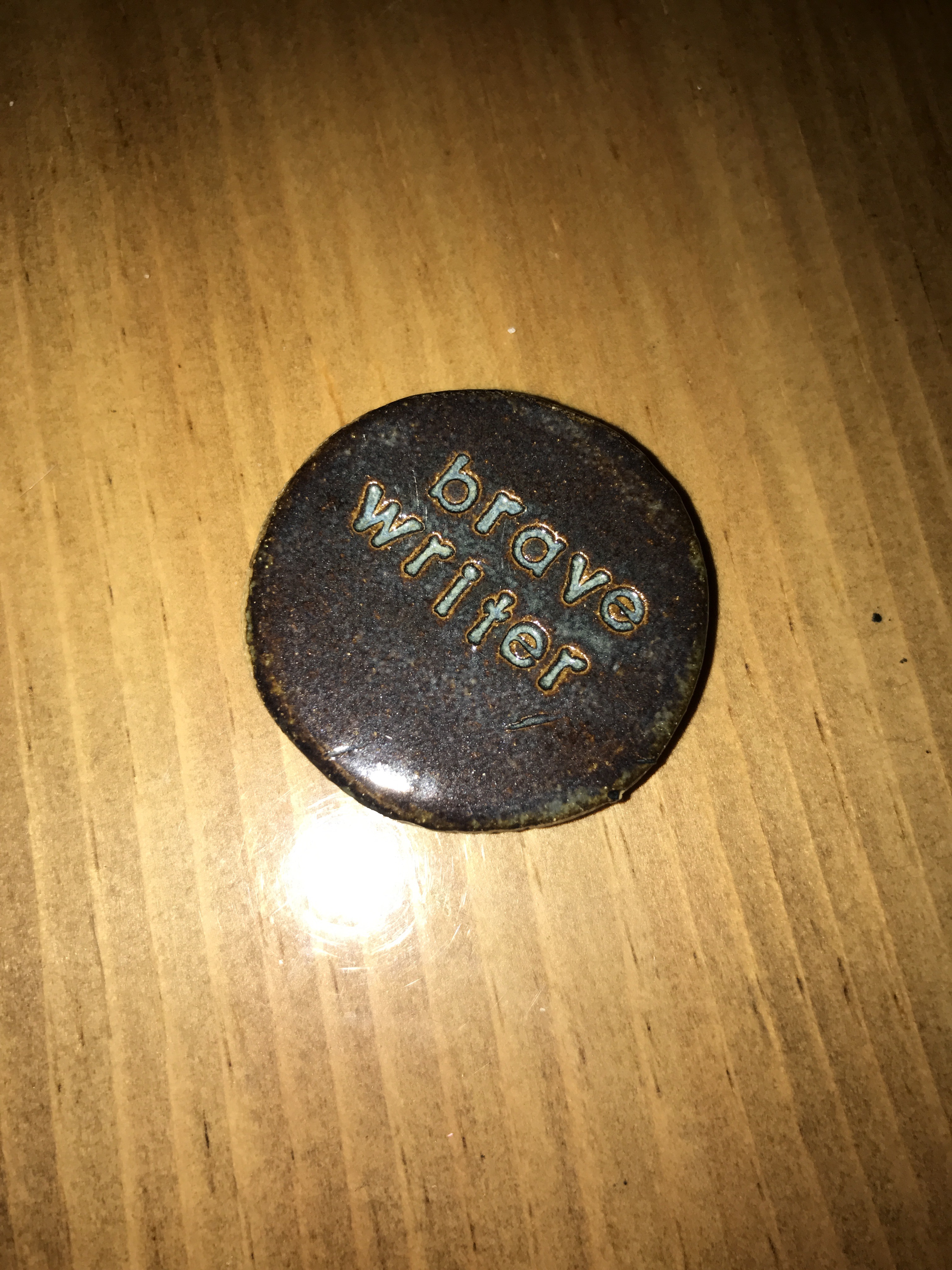
A token from Jennifer Louden, our retreat leader

I am a writer, and I am writing.

I come from a strong line of female writers. My grandmother liked to write historical fiction and romance novels. My mom is writing a memoir about being the parent of a medical school student. We are writers, and we write.

I spent the last week on retreat in Taos, New Mexico with 22 brilliant women writers. Every day we listened and shared, wrote and read, moved and found stillness. Every day the rain came and brought with it the scent of fresh lavender and mountain air. As our time together went on, I heard an echo from several of the women at lunch, in our small groups, even after morning dance: You are brave. You are so brave.

Every time I heard this my gut reaction was to correct. “Oh no, I am not brave. I may hide it well but inside I am terrified, nervous, anxious, and completely unsure. My mother is brave- a cancer survivor. My grandmother was brave, she was a mother of six. But I am not like them.” In one of the afternoon sessions, our assignment was not only to name our inner critic but to personify them. These are the people or experiences we internalize that tell us we can’t write because we’re not creative, or edgy, or we might offend someone. What if they could help us, we mused.

My inner critic turned out to be an old man sitting at an antique wooden desk, looking sternly at me over his glasses. In his hand he holds a rejection letter. All it says is, “no.” The man couldn’t be expected to waste his time telling me why or what I might do better, he just laughs and shakes his head. “You really thought your story belongs in our prestigious publication? HA!” He shoos me out with a lazy wave. This critic comes from something I wrote about last week, which is an obsession with perfection and a deep hesitance to show anyone my work unless it’s absolutely stunning. I can write all day, never stopping for a minute to consider how scary it is, until it comes time to share. I can practically feel my face fall when the email comes in, something about dear writer, we regret…it’s hard to read past that part. Sometimes you don’t even get an email, just silence. Ghosting, as the dating world calls it.

I read a few books this week, really living in to the question “What do you want in this moment?” Reading is always one answer. In the book The Spirituality of Imperfection, the authors tell us that admitting our imperfection is quite a profound step as humans, but one that ultimately leads us to healing. In one chapter, they consider the woes of perfectionists by considering a particular point: “We may not be able to do anything completely perfectly. But what that means is that we cannot do anything entirely imperfectly. Consider a bad day: we wake up late, spill our coffee, give a terrible presentation at work. But we complete a few tasks and commiserate with our spouse in the evening, and not everything has gone wrong.”

I thought about all the writing I have ever read. What a spectrum from mind-blowing to absolutely horrifying. Yet, the mind-blowing could always be tweaked just a little more. The absolutely horrifying still has one tiny piece of merit. My work will never be perfect, and never completely useless. Bravery is knowing this and not letting it stop you.

I am a writer and I am writing. I come from a strong line of female writers- my grandmother, my mom, and now 22 new sisters. None of us perfect, all of us alive with stories. We are writers and we write. We are brave- fear exists within us, but we do not entertain the possibility that this fear would stop us from doing what we love and what is right. And what is right, is to write.


Freedom

Today is a day to celebrate.

…But what are we celebrating? I’ve been thinking about that question all week as the flags have come out, the barbecue grill tops scraped off, red white and blue cupcakes to car decals .

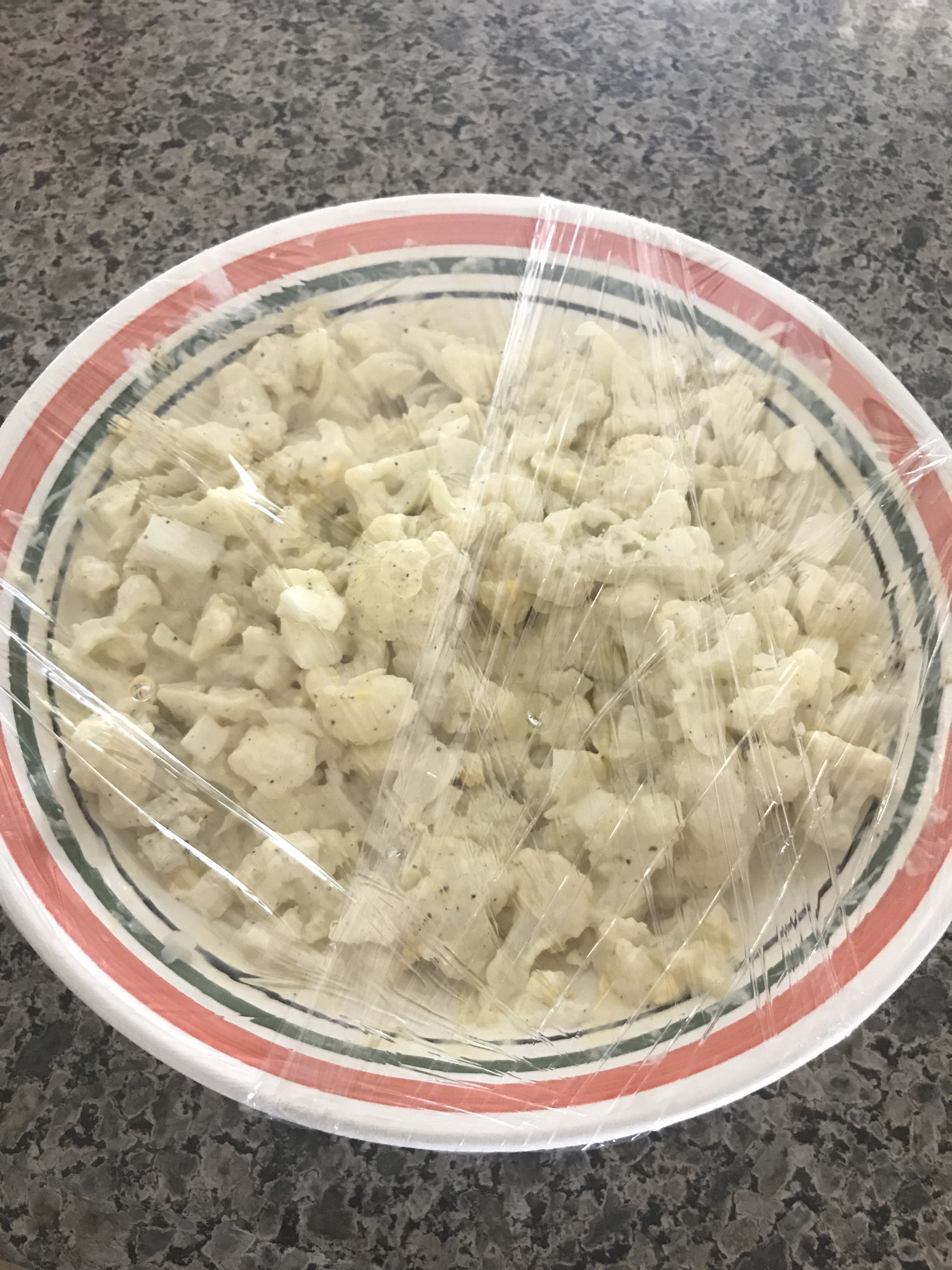
My not so famous (yet) cauliflower “potato” salad

This past May I got a unique opportunity to drive across the country on the way home from Boston to LA. As you can imagine, I saw plenty of landscapes and moreover, significantly distinct ways of life from farms to fabulous mansions across the street from national art museums. The trip felt like a giant learning expedition, helping me understand just slightly better what “divided” means in our country. Maybe the one thing each place had in common was that it rained. And fast food. I cannot soften how apparent it is that we are not a unified nation, because that would gloss over so many struggles and injustices I saw right outside the car door window.

Today is a day to celebrate, not despite these struggles, but because of them. Sojourner Truth, a suffragette and influential fighter for women’s rights during and after slavery, once said: “I will not allow the light of my life to be determined by the darkness around me.” Joy is an act of resistance. We all agree on this as we fight for justice, a path often surrounded by strife and mourning and wondering when, how, what.

I was in Las Vegas this past weekend with one of my best friends from USC and her sister. We sat around a shisha pipe (my request) as I fired off life questions. “What is your greatest fear? What are you most proud of? Who is someone you let go of too soon? What is one thing you want to see for yourself in five years?” I don’t remember exactly which question we began discussing, but our parents came up as a subject of both respect and recognition of imperfection. We all confessed that one thing our parents have given us is a safety net: an ability to take risks and even make pretty terrible mistakes without letting us fall completely to our demise. Maybe it’s money, maybe a place to stay, maybe simply a listening ear, but we could not downplay the sacrifices of our parents and grandparents who worked and still work to give us what this country is supposed to provide for everyone: freedom.

Freedom is a big word, and as someone who practices Buddhism most humbly and often in a state of questioning, I think about freedom from suffering as a goal for which to strive. Help to free others from suffering,  free my own mind of craving and desire that causes suffering. Today I firmly believe we are celebrating the people who have risked their own suffering to free others from it. Immigrants who settled here 50 years ago or yesterday to transform their rootedness into the branches for their children and grandchildren. Women who persist, nevertheless. Queer folx who selflessly write and speak and talk to the people around them and the world to educate us, even though that is exhausting and by no means a requirement of them or their bodies. People of color who tear down “normal” behavior, speech, culture, bound up in whiteness. Dreamers, teachers, the friends who gently push us to think about how our words and actions affect everyone around us, sometimes in causing pain. These are the people who take on greater binds of suffering every day, under the star-spangled banner,  believing we can be better.

These are the people who fight to bring joy, making the fight worth it. Today as I am blessed to have dinner with my family around a nourishing meal, I am grateful for the unheard and unseen who work tirelessly without an ounce of recognition except the unflagging hope for all of us.

An Almost Accident

My mom picked me up for the millionth time at LAX a few months ago. It was dusk, and I lugged over-sized bag and greasy hair into the car amidst honking and traffic jams. We know this route well- darting around buses to get on the 105, carpool lane to 110, Pasadena Freeway to Orange Grove, and finally on to the 210. Home.

381225_10150370268945878_540744625_n
My mom (Liz) and friend Liz’s mom (Louise)
The Pasadena Freeway is the oldest in California. Three lanes wide, it winds around Highland Park and South Pasadena until it ends right on Arroyo Boulevard. What was once an easy Sunday drive in the 1940s is now a treacherous road. It’s hard to see around the twists, and because the lanes are so narrow, easy to hit the center divider or another vehicle. When accidents happen, often they cause domino crashes because of the visibility issue. In addition to all of this, in order to get on the freeway, cars must wait at stop signs to merge into the furthest lane while vehicles fly by at 65+ MPH (the speed limit is 55, but who are we kidding, Angelinos).

Each member of my family boasts their own strategy for driving this freeway to avoid an accident. My mom says to drive in the middle lane, so as to have options if you need to swerve quickly. My sister, on the other hand, likes the lane closest to the center divider because people can only drift into one side of that lane, unlike the center. My dad likes the outside lane. I’m not sure why, but perhaps neither is he. I avoid the freeway altogether- for me, it’s all about the 5 to the 134.

On this particular evening, Dodger fans caused twice the congestion at the start of the Pasadena Freeway. We inched forward and stopped every five seconds. Finally after forty minutes, we started to move. Because of the traffic my mom had managed to move into the right lane, she kept a watchful eye on the right side as cars pulled to stop signs, waiting to merge. As we rounded a curve, a mini van pulled right in front of us- we were less than a second from rear ending it that would surely have ended in totaled cars and perhaps fatal injury.

My mom did something miraculous. Just before she rear-ended the minivan, she swerved left, avoiding the van just enough to sneak by without collision. She didn’t have time to check on her side to see if another car was in the middle lane- but her instinct told her to save me before herself. Thankfully, there was enough space for her to avoid accident entirely. “What the FUCK was that guy doing!?” she exclaimed. I took a few breaths. A vision of the car accident I experienced came right at me, causing my forehead to sweat instantly. My mom didn’t mention the incident for the rest of the car ride, as if it happened to her every day. I know it doesn’t.

For the next few days I wondered if my instinct would have caused me to swerve left. Would I have saved myself, or my passenger? Perhaps I would have frozen like the last time, and totaled my car. I’m not a mother, but in that moment I knew my mom had made a commitment to sacrifice for us even in the most rapid moments.

I was remembering one of my teachers in elementary school the other day because she, also a mother, did something remarkable for our family. When my mom was diagnosed with breast cancer and chose to remove her breast because she wanted no uncertainty that she would live (“she had a family to take care of”), this teacher would take my sister and me to breakfast at IHOP before school. It was a great day when we got to go to IHOP. Only in the past few years have I realized how much more this woman has been to me than a teacher.

Happy Mother’s Day to all those who sacrifice their time and comfort for others. Motherhood may be beautiful, but it is just as much no-frills, unsung work that keeps us all alive.


Womens’ March: How Art Will Save Us

On Thursday evening, my writing class got real. We talked about self-care through the arduous process. The craft of writing, especially memoir and personal non-fiction, is wrought with danger. We bring our most vulnerable pieces forward, public: here is my brokenness. Of course, we couldn’t help talking about what would happen the next day.

I’ve never considered myself an artist. My sister, yes- at age 10, people asked to buy her paintings. She has that unique ability to make animals (her favorite subject) look real on the canvas. The closest I’ve come to pursuing a career in fine art is my wearing wild clothing in many different colors. Regardless, my appreciation for art has never waned. I find art soothing, a reminder that there are myriad ways to express our pain, joy, and everything in between. Words are my “art,” and sometimes words fall short. Nevertheless, I find myself consumed in books much of the time, looking for inspiration in my own craft.

Running for me has also become an art. Yesterday I joined a marathon running group and headed to Riverside for an 11-mile run. We faced the notorious Newton Hills: miles 17-21 on the Boston Marathon course. The final uphill portion has earned the name “Heartbreak Hill”, on which runners have struggled since the beginning of time (ok, no. But since the beginning of the Boston Marathon, yes) after some intense downhill for the first half of the course. For the last year, I’ve run alone the majority of training, but this time I was transformed by the power of running with others.

Yesterday I learned that running is so personal, of course, but requires the art of community building. Thousands of people climbed the hills yesterday, and as I clomped by Boston College’s campus I marveled at the pleasantries exchanged between strangers, even though we all must have felt exhausted (my knees were screaming at me).

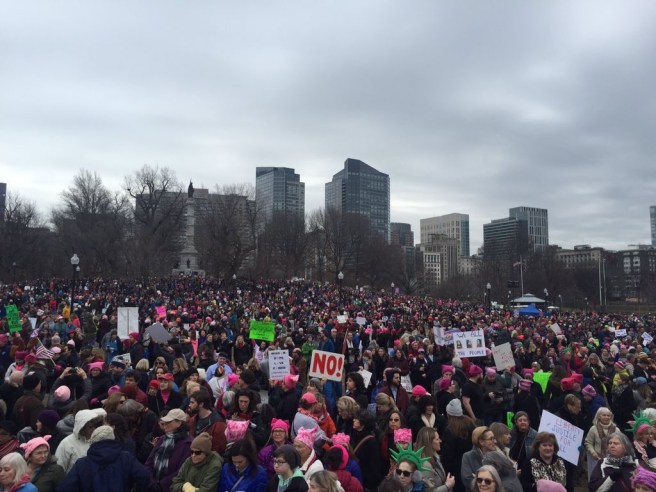
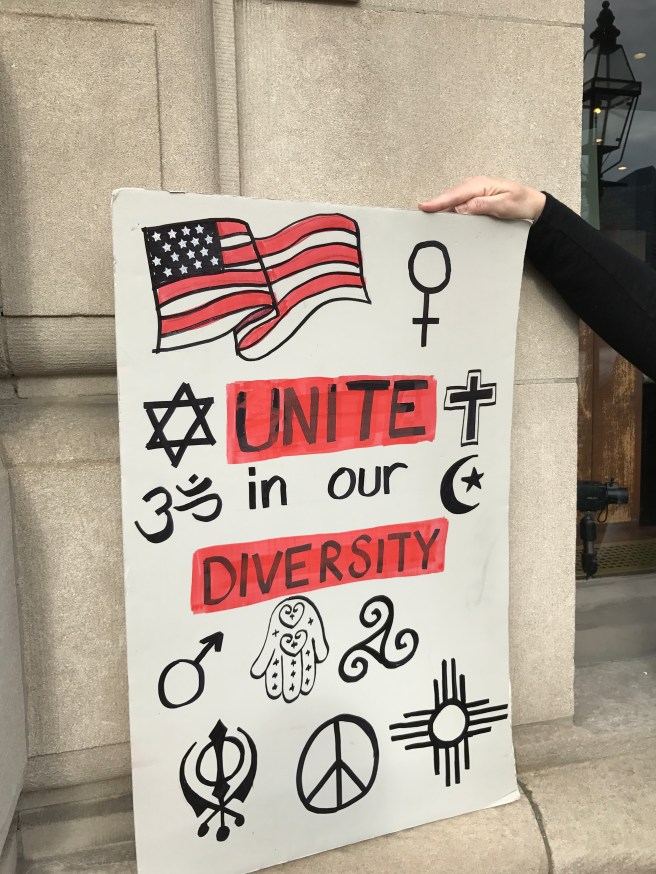
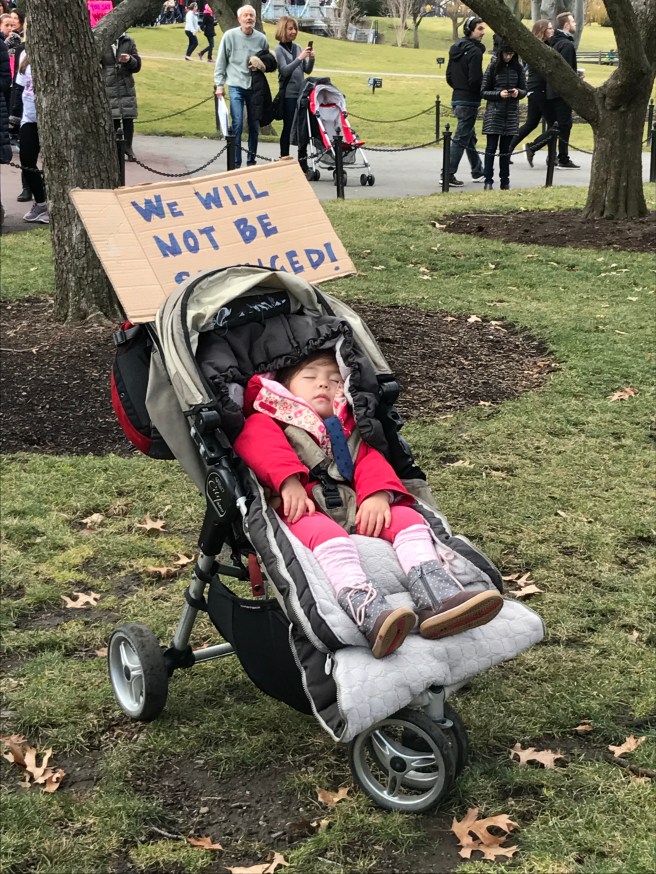
As I neared the end of the run at Fenway Park, I started to see the signs. I mean the actual signs people were carrying to the march. Some were bigger than me! And the sass, oh the sass. It dawned on me: In this time of great divide, Art will save us.

img_0203

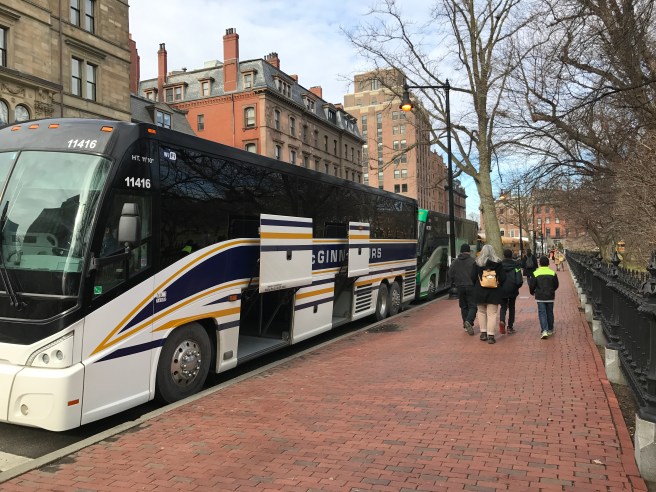
Because the trains were packed, I decided walking another mile and a half wouldn’t kill me. There were more and more signs as the crowd neared Boston Common. Then I saw the buses.

IMG_0199.JPG

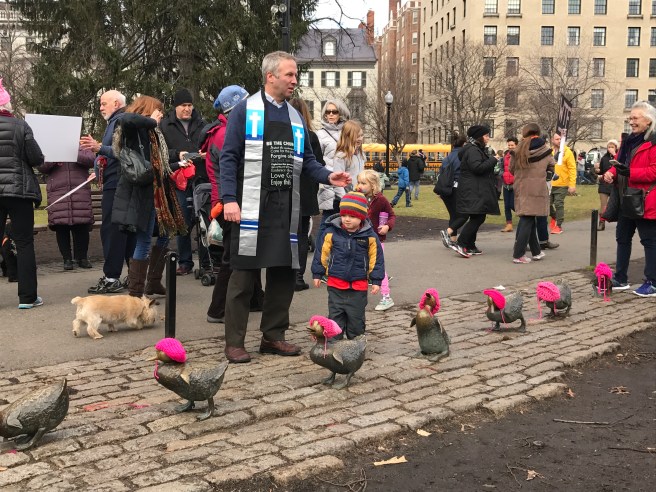
Buses and buses and BUSES. And beyond the buses, a sea of pink hats. The entire Boston Common, the same park I had run through only days before, was entirely covered in bodies. I had never seen anything like it.

img_0215

I admit to feeling a bit disappointed the previous day. Many of my students, colleagues, and friends had made the trek to our nation’s capitol to literally March on Washington. Why didn’t I get my act together to witness history? Looking before this very crowd, I knew this was where I was meant to be. Boston: the runner’s city, the home of some of the first abolitionists, the site of the first siege that began the Revolution. Scrolling through Facebook and Twitter my heart leaped again: my beloved Chicago, home for three years, the place I met my love, the city of incredible hospitality, had SHUT DOWN THEIR OWN MARCH BECAUSE SO MANY PEOPLE CAME OUT. BOOM. And THEN- my one and only home, the place my heart stays, the City of Angels, rocked the entirety of downtown with signs in multiple languages. My partner and I exchanged pictures of the best signs and posters around us. Sister marches around the world (yes, the world!) all the way to Antarctica popped up in my newsfeeds.

img_0213


Art will save us. Not the paper, the glitter, or the sass (though the humor really enlivened us) but the creativity. You cannot regulate art, you cannot control the visions of the innovative. And in these days, I believe that the creativity we witnessed this past week gives us fire to keep finding alternative ways of action. I’m claiming myself an artist. I will strive to be creative and think big. I’m so thrilled by the showing up for each other yesterday- it’s one day, and we’ve got quite a few more. Blessings to the artists, you are leading us.

IMG_0212.JPG

img_0200

img_0210


Is Gratitude a Privilege?

…the short answer to the above question is yes, insofar as it concerns me and the following response.

photo-1445098516063-9b0b2e4206e9
PC: Ian Schneider

I have been feeling a need to express more gratitude lately. Perhaps this is natural, given the climate, or the weather, or just exhaustion beyond explanation. Endorphins? Maybe the fact that Thanksgiving is this week? I’m not sure, but at the same time have been feeling a sense of frozenness, an inability to make decisions or take action. For the longest time, it felt like my perfectionism was acting up and I kept telling myself I would finish certain tasks (including emailing important people back, ehem) once I had drafted a thorough, complete response read over several times. The problem is, what does complete look like? What happens when we are never “ready?”

I was thinking about this question particularly in regard to learning allyship. At my university, we’ve been talking about best practices and how we can support students who are threatened and afraid. Do we wear the safety pins? Do we make public statements? How do we show up for each other in meaningful ways? So many uncertainties and yet, there is no time to seek the answer before something needs to be done. The time is NOW. Attempting perfection inhibits change and has encumbered me from supporting those who need to be held the most. So, as a white woman, I’m going to throw perfection out the window and trying to learn as I go. Is this dangerous? Yes. My “learning opportunities” can certainly be harmful. The damage is real. Taking action can, however, take the pressure off those I’d like to support, because waiting for complete knowledge around the “how” means the oppressed are tasked with figuring it out, and I sit and wait. We, human beings, are not perfect. We are inchoate. We are unfinished. And yet, we love and are loved.

This rambling comes in thinking about gratitude, to return full circle. One of my students challenged me about a month ago to do something every night: name one thing I appreciate about someone who otherwise gives me trouble, and name three things I love about myself. Can you guess which one is harder? In reality, it depends on the day. Every night, she has consistently reminded me to report my 1 and 3 to her, and in turn I ask her back. At first this practice seemed impossible. “He just makes me SO mad!” I thought, “How can I appreciate anything?” Moreover, putting aside self-loathing sounds simple but, of course the loathing is complicated. Slowly but surely, we have made progress together. Sure, some days still seem untenable- you know the ones. This past Friday, this student was in my office and we had a lengthy conversation about gratitude and what it really means.

As I understand now, gratitude requires faith in the imperfect. It means feeling thankful despite the suffering present in the world, in my life. It also requires mindfulness: a sense of feeling genuine in the present. When I feel grateful, I am not taking a backseat and determining that everything “will work itself out.” I am acknowledging that there are in fact slivers of hope, pieces of love to hold as we march into the darkness. I am grateful for the challenges, even if on certain days, they feel insurmountable to address. Gratitude is a call to action, not complacency- this is the difference between ignoring privilege and acknowledging it.


On November 9th

photo-1454535524385-496c92f1f4b9.jpg
PC: Brandon Day

In the wee hours of Tuesday, November 8th, 2016 the world either ends or begins. This is the rhetoric I hear, the anxiety my friends feel, the way we as a country have been visioning our future for the past couple of weeks. What will be our new national narrative?

The world goes on, simply. Nothing really changes overnight, and yet everything changes in our minds: we either lose everything or make history in whatever way our nation decides. This has been a long, grueling, terrifying election season for many. What will we do, who will we be on November 9th?

The past few months I have witnessed some awful events. Recently I wrote about why Donald Trump’s comments around sexual assault and objectifying women hurt me personally, and cause much deeper harm to the marginalized and oppressed. I cannot claim that any presidential candidate has not made worrisome or downright damaging decisions. And, I can say that in these past few months, wondrous moments have also shaken me and made me believe in love as a human act, indeed an extremely courageous one.

Moving to Boston I have struggled to find and maintain community. Being alone is a part of who I am. Yet this time of great fear and hurt has given me a window into the true importance of community and dedicating everything I can to the ones that hold me and keep me. Let me give you some examples.

The Revolutionary Love Project launched in early September and we, 17 fellows, 250 ambassadors and one fearless leader, quickly got down to business. In the course of only eight weeks, we completed three huge goals (one of which will be completed this Tuesday). We took grassroots action and organized over 100 people across the country to host screenings of Divided We Fall, a documentary by our project leader Valarie Kaur about violence against Sikhs and Muslims in the aftermath of 9/11. Some of these screenings happened in living rooms (like mine), and some on college campuses. Just as we reached our targeted 100 screenings, our leader Valarie went on tour with the Together Tour and reached over 20,000 people in 6 cities: Portland, Los Angeles, Chicago, Brooklyn, Atlanta, and Denver. Though I couldn’t attend any of the actual tour dates, I felt a surge of hope every time someone new felt inspired to take action after one of the evenings and posted about it on Facebook or Twitter. So many new Love Ambassadors spoke openly for the first time about their pain and how they have healed, and helped others to do the same. Now, each of us have been making calls (and encouraging others to make calls) to Get Out The Vote, especially in key states like Florida. We have felt the urgency to build bridges and acted upon it through love, not hate.

A few weeks ago I passed by one of the main quads on campus to find almost 50 students occupying a large sector of the grass with tents and signs seeking divestment from fossil fuels at my university. The students demonstrated a deep commitment to our earth and each other as they educated passersby on their way to class. They showed us that climate change is not an issue by itself, but a gender issue, a faith issue, a human rights issue. Hundreds of students showed their support by wearing orange. Just this past Wednesday, several student leaders of faith engaged with members of HEAT (the Husky Environmental Action Team) in an essential conversation about how our faith calls us to care for the earth and take action on climate change. We expanded the boundaries of our own communities that night, welcoming each other among ourselves.

Besides election day, November also hosts National Novel Writing Month. Writing 50,000 words in one month always seemed downright impossible to me- the time and moreover, the content pose a large obstacle. This year, an interfaith activist and professor at Cal Lutheran University started an online group for professors and chaplains in which to participate. My writing class also created a joint account, so we could all contribute to the word count. Both communities in the past five days have been ruthlessly encouraging to every member, posting inspirations on Facebook and checking in with each other individually. So far, I’m on track: it’s November 7th and I’ve written almost 10,000 words. Without these two communities I could barely write this blog post. Though unspoken, there seems to be a deep understanding that though the world feels dark and scary, we have our team and we are writing for each other. Every time someone posts that they have achieved their daily goal, I send them a silent high five. “You DID IT!” I want to scream.

Late on a Friday afternoon, several women leaders of faith crowd in my office, sitting on the floor and watching YouTube videos. We don’t speak about our fears or hopes, but we hold each other’s company. We keep each other safe simply by listening and laughing. I smile, packing my bag to head home for the weekend. We hug good bye, and implore each other to make good choices.

On November 9th, I hope we maintain the urgency that each of these communities has utilized to turn love into action. My fingernails are gone, my eyes are puffy. My heart feels weary, but not closed. The world goes on, and no matter what happens, we can care for each other if we find the courage.

On November 9th, I will recommit to practicing love with optimism and honesty. I will keep writing. I will keep imploring my students to make good choices.