Jesus the Teacher

As traditions abound this time of year, my family hastily put up a tree, wrapped gifts, and cooked all kinds of complex dishes, culminating last night with Christmas Dinner. My dad and I always attend Midnight Mass on Christmas Eve, and this year was no different. I could see my breathe walking up the hill in Sierra Madre to St. Rita’s Parish, perhaps the greatest sign of winter that will come to Southern California. My dad and I found a seat in a pew almost in the very last row, off to the side. Normally, my dad sits front and center. As we sat down, he muttered something about the people who only come on Christmas and Easter. “But they’re here,” he corrected himself. “That’s good.”

Midnight Mass at St. Rita’s looks the same every year. I mean, exactly the same. The same carols welcome everyone to their seats. About 15 minutes late, we all stand as the procession of altar servers, deacon, and priest come down the center aisle to the altar, where they bow and take their places. The priest and deacon “visit” the nativity scene off to the left side, sprinkling the scene with incense. The first and second readings remain: Isiah (the people who walked in darkness have seen a great light) and the letter of Paul to Titus (the grace of God has appeared). The gospel rotates from Luke to Matthew to John each year. In elementary school I learned to remember: Luke= shepherds, Matthew= wise men, John= The Word. Everything else, down to the beginning of the priest’s homily, remains the same. Tradition, ritual. Sometimes, we find relief in the expected. Truthfully, I fought sleepiness the whole time.

There was one essential difference that woke me up. During the homily, the time when the one who says mass teaches the congregation about the readings and offers lessons, the priest acknowledged that our brothers and sisters of another faith were also celebrating: our Jewish neighbors were celebrating Chanukah, the festival of light and rededication. “We must pray for them, and for people of all faiths that they experience peace, enjoy relaxation, and welcome a new year just as we hope to,” he said. 1000 people heard that message, a message of interfaith cooperation in the form of prayer. The priest, our teacher, offered us an important lesson. I believe one of the most important teachers, Jesus, taught that lesson over and over.

9hsvmg6nshe-ben-white
PC: Ben White

Yesterday among the cinnamon rolls and piles of gift wrap scattered around the family room, I reflected on the importance of teachers and the gift of learning. Teachers come in many forms: people, sacred texts, books, stories, experiences…anything can be a teacher if our persons are open to learning. One of the most powerful things about Jesus as I see is that his teachings transcended a particular time and place, and often related to the divine potential of each human being as a steward of resources. Many of the prophets and founders of great traditions of wisdom were also first and foremost teachers, and they were concerned with the flourishing of humanity. The Buddha traveled across Southeast Asia, teaching crowds of hundreds about suffering and liberation. I concluded that teaching is one of the highest forms serving human kind, especially because in teaching, we learn continuously.

Many of us will admit to spending too much money on something in particular: fancy food, clothes, alcohol, sporting events, you name it. I have much to work on in this regard. In particular, books are my downfall. The last time I walked in to a bookstore, there was a table with a “sale” sign, and I walked out with four new paperbacks. In this moment in time, memoirs and books dealing with race, gender, and religion are stacked in my “to read” pile. Besides my students who always prove to be my best teachers, books offer me a constant window into learning, the process that makes me feel most alive. Over my lifetime, the people who have most impacted me have been teachers: they have challenged me, believed in me, journeyed with me.

I closed my eyes with everyone else as we prayed for our neighbors celebrating Chanukah. I remembered something my friend Steven, an Orthodox Jew, taught me while we were on the Interfaith Council at USC: “When we light the Menorah, we take the first candle and light the others with it. Lighting one candle with another does not diminish the light in either.” Such is the case with great teachers, the more we learn from one another does not diminish the vast capacity we have to continue.
Santa, Interrupted

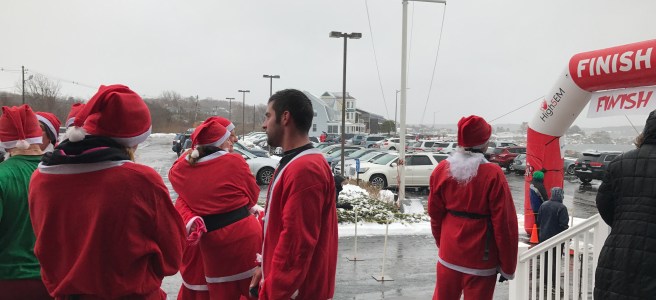
The snow finally came (and went, mostly). They say in Boston proper, we got about 3-4 inches. Do you know what I did as the snow pelted from the sky Saturday morning? That’s right. I drove 49 miles to Gloucester to run a 5-mile Santa suit road race because I wasn’t going to miss it. As I walked to pick up the Zipcar, I looked out onto the ocean. Usually I can see all the way to downtown Boston and the skyscrapers. I could barely see the water, let alone across it.

You know how when it snows, the air is quiet? There’s no wind. Especially on a Saturday morning when most people would look out the window and rationally go, “nope.” My running shoes, now soaking wet of course, crunched through the snow until I reached the car. As a Californian, driving in the snow seems ludicrous. What I also didn’t remember is that when cars are parked outside, they require brushing off because there’s a giant white mound of frozen water on top, and one cannot see out the windows if it’s there. I grabbed the brush from the trunk and proceeded to wipe the front windshield. My hand froze almost immediately as the brush slipped around, scattering the snow everywhere. It even got in my shirt. Finally I was ready to begin the treacherous drive to Gloucester for the most ridiculous race I have ever run.

Cars crawled along all the way up the 128. Trucks spewing salt passed me, then plows, then this sand-dirt business. Some vehicles pulled over to the side of the road when they skidded, perhaps deciding carrying on was not smart. In my Honda CR-V, I muscled along behind a pickup truck, then a Cadillac, then a Mercedes. I admit- my mind did question why a Mercedes was out on the freeway. Half-heartedly singing along to the faint 90s music playing on the radio, I shook my head at the ridiculousness of this decision to drive an hour and some to run a race. Not just any race- a 5 mile race. Dressed as Santa. In the sleet. I thought about the other cars on the road, and the effort it took merely to make the roads drivable. The EFFORT. Salt, plow, sand, chains, windshield wipers, brushes, defrosters, 4-wheel drive. We defy nature so well, as if we feel called by anxiety to prove that nature will never fully be greater than we, that it may inconvenience us, but never stop us. Even in the most dire blizzards, the airport reopens.


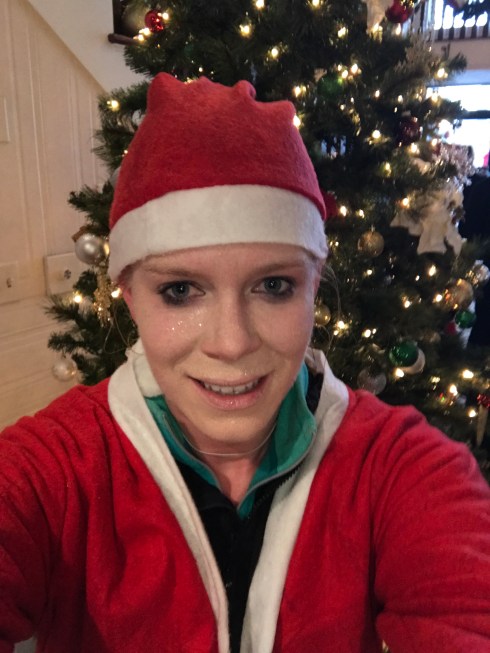
The race was as silly as you would expect. 250 people, aged 15-74, donned red felt pants, jackets, belts, and hats, and complete with elastic beards, rushed down the road as the ice hit our faces every second. We hung right onto a bridge, then hiked (yes) basically a mile until we turned around and hiked back on the sand/snow. I couldn’t even feel tired. The whole way, I laughed uncontrollably as my pants ripped, beard soggily clung to my chin, and the Santa jacket slipped off my shoulders so I was basically running with a shawl.

img_0064
What disruption, I thought. It took me longer to get here than expected. The conditions were brutal. Yet, if I had succumbed to staying in bed and snuggling with a cup of coffee, I would have regretted not going much, much more. Disruption is usually the first sign that an opportunity is around the corner- are we willing to hike for it?

New Year’s Resolution

Wow, there are 19 days left in December. 19 days left in 2016. The “Me in 2016” memes have been keeping me going- though truthfully, the passage of 2016 to 2017 is merely night into day, a rotation of the earth, nothing more. Hope is important, and so is integrity. Lots of work and struggle ahead.

Have you started thinking about your New Year’s Resolution? I’ve thumbed through the usual: drink more water, go to the gym more, lose weight, eat more vegetables. All good ideas and things to work on, speaking for myself. I see a pattern in the popular resolutions: they all identify a deficit. They all require discipline and motivation. Time and again, I have made resolutions like this, and I can’t remember a year in which I successfully went more than a month in keeping the habit. Something is missing in our resolutions, and that is mercy.

9ztafgvsv-c-jay-ruzesky.jpg
PC: Jay Ruzesky

The reason I’ve been thinking about mercy is because I hoard books and two of the books on my nightstand have the word “mercy” in the title. Traveling Mercies, by Ann Lamott, and Just Mercy: A Story of Justice and Redemption, by Bryan Stevenson. I actually had to look up the definition of mercy, and according to google, means something between forgiveness and compassion. When we practice mercy, we actively harness our power to condone those who have harmed, rather than punish them. Action, power. Mercy requires agency, it’s a choice. The way I see it, forgiveness is self-practice primarily. I can forgive someone without their knowledge. I let go of anger and resentment not for the purpose of forgetting, but for the purpose of freeing myself from the suffering. Mercy changes the plan- it’s active compassion in the face of pain. Teasing out these differences, I remember something my writing professor said to us the first day of class: “To be a successful memoir, the narrator (you) must be compassionate toward the younger self.” I thought to myself, “Uh, why? I was the worst back then. I deserved to be thrown in jail and rot.”

And there it was, my New Year’s Resolution: Be Merciful. First and foremost to MYSELF! How can one understand the freedom from resentment, anger, disappointment, failure and actively change behavior toward it when we are not merciful toward our own selves? Pfffft. That’s a rhetorical question, but an important one nonetheless. Maybe mercy is about mindfulness. Everything is about mindfulness. But let me explain.

Thinking back on my 2016, it was a hard year. That’s an understatement: it was an excruciating year for me and so many of my friends, my students, and my colleagues. Some days getting to work on public transportation felt like the final battle in Lord of the Rings. But if I’m really honest with myself and what I accomplished, it was not nothing. I ran two half marathons and made a decision to run a full one. I wrote over 70,000 words for a memoir in progress- it’s no where near done, but I’m not giving up on it. Beginning in June I published an average of a blog post a week on this site and some others. I started therapy, took charge of my health, and spoke up about being a white woman. None of these processes has been perfect- there were days I didn’t run because I wanted to sit on the couch and eat pizza instead. There were days I didn’t write because my mind was uninspired. I gained some weight, skipped some therapy sessions, and missed a SHIT ton of opportunities to speak up about oppression. What does it all mean?

One of my students highly suggested (borderline demanded) that I try Forrest Yoga recently. Truth time: yoga freaks me out. It’s boring and slow and I have to sit with myself and my terrible flexibility for far too long. But I did it, and as our instructor repeated several times, I noticed where the struggle was. My mind really wanted to yell at my stiff body for using a block in pigeon pose. Mercy itself is the block- it’s an act of mindfulness as the world hurls crap at you over and over. it’s acknowledging that imperfection is better than not doing something at all- the end justifies the means. No, wait- the means get messed up sometimes, but you can still get to the end. That’s mercy: finding compassion and changing course. It’s acting on love that has been buried but not extinguished.

I don’t mean to pat myself on the back. That action is extremely dangerous- congratulating ourselves too often lulls us into complacency. The reason I started this blog was to think about how we sustain ourselves as activists when justice fatigue is real. Though I don’t practice in the Pure Land tradition, the Boddhisatva Kannon has always inspired me. She’s known as the Goddess of Mercy, the one who listens when we cry out in suffering. As a Boddhisatva she has embodied the ultimate mercy by forgoing her ultimate attainment to help us out. In the journey rife with suffering mercy is about taking our power we could use to get even with others or ourselves who have caused harm, and instead applying it to change course, focusing on the goal and being mindful that we can still find a way to get there.


The Feast

I have been feasting for two weeks. It started with Thanksgiving, understandably, but since then I have been enjoying time with my family, and quite often that includes food. What I mean by feasting; however, is not solely about a buffet of delectable dishes from various cuisines. My time in LA has been a cornucopia of meetings and greetings with friends and mentors, and even new colleagues. I visited five campuses this week across California for a few reasons. First, when would I not take a chance to go back to USC’s campus? I also wanted to get a pulse for interfaith efforts around the election and the #NoDAPL movement at Standing Rock. Visiting these campuses also gave me the chance to road trip up the coast listening to tapes of Grateful Dead shows all the way up (another post on that coming up). A feast for the belly, the eyes, and the ears, yes. This week I also enjoyed a feast for the heart.

On Tuesday I drove to Claremont to have lunch with an esteemed and beloved professor, someone who has mentored me since college. She consistently bridges the scholarly study of religion with spiritual practices with activism, which we desperately need right now. We caught up on projects and our families and the latest American Academy of Religion Annual Meeting. After lunch, I got to sit in on a class with one of her closest colleagues, Dr. Frank Rogers, who studies narrative pedagogies, religious education and engaged compassion practices. In class we discussed several paradigms of religious education and even played a riveting game akin to “Who Wants to Be a Millionaire,” a popular game show. The students welcomed me warmly, and we laughed about our struggle to put historical events in order. At the end of class, Dr. Rogers sent us with a sending question: What metaphor would you use to describe education? At first consideration, my mind thought “prism,” but after reflecting on this week, I think “feast,” and perhaps more accurately, “potluck.” Mmmm, potato salad.

fw6noteso4c-sweet-ice-cream-photography.jpg
PC: Sweet Ice Cream Photography

On Saturday, two Revolutionary Love Fellows Meha and Simran and I met up for brunch and to finally see each other in person after working closely together for months having never done so (technology is great, but so strange sometimes). As we shared updates on our personal lives and then planned for our upcoming retreat, we commented on the remarkability of the unique gifts each fellow possesses. On our team, we’ve got doctors with facilitation skills. We’ve got lawyers who also do graphic design, and writers who are expert marketers. You could say our group is “stacked.” Meha noted something I’ve been thinking for a while. “I get excited to come home and do RevLove stuff,” she said. “Not only is it so important, but the fact that we all get it, there’s 15 other people who are giving their time for something they feel passionate about is really motivating.” Returning to the question of a metaphor for education, let me explain my choice in “potluck.”

I never would have met Meha and Simran had I not joined this team- Meha has a background in health care and is working toward an MBA, and Simran works at UCLA as a Project Manager. Their background alone brings a different kind of dish to the potluck, and no one likes a potluck with the same dish. Education for me is about bringing great minds with distinct experiences and beliefs, unique ingredients, together to learn from each other at a common table. If too many people with the same identity crowd the gathering, we lose other important perspectives. We need appetizers, main dishes, desserts, and drinks. At the same time, we’ve got to be prepared for the unexpected. The potlucks I remember from the Japanese Community Center where we played basketball often included pizza, spam musubi, and chocolate milk. While this might not represent a conventional meal, educational spaces are enriched by new epistemologies, new ways of learning. On the #RevolutionaryLove Team, I especially see how this happens. My understanding of the legal field and even what motivates teams has increased dramatically. Most of all, a potluck is never successful without a vibrant community committed to maintaining the space, and education is definitely most especially about community. As social creatures, we learn most effectively among others.

My sending question then, is: what will you bring to the potluck? What ingredients and textures will set your dish apart for others to enjoy? Are we hungry yet?


Keep it Simple, Silly.

hdnslau35ky-jeffrey-wegrzyn
PC: Jeffrey Wegrzyn
Ever heard of the k.i.s.s. principle? Keep it simple, stupid, is how it’s usually read. I’m trying to avoid words that degrade or demean people. Ask me how that’s working out later. Anyway, simplicity. Sometimes it’s nice, and sometimes it’s annoying. I want to make a case for it because right now, there are many things in the world that are so far from simple that everyone feels exhausted. So here’s a story I love that I’ve used often in writings and speeches that is simple, yet meaningful.

There is an ancient Chinese parable about an old man who knew he would die soon. He wanted to know what Heaven and hell were like. He visited a wise man in his village to ask “Can you tell me what Heaven and hell are like?” The wise man led him down a strange path, deep into the countryside. Finally they came upon a large house with many rooms and went inside. Inside they found lots of people and many enormous tables with an incredible array of food. Then the old man noticed a strange thing, the people, all thin and hungry were holding chopsticks 12 feet long. They tried to feed themselves, but of course could not get the food to their mouths with such long chopsticks. The old man then said to the wise man “Now I know what hell looks like, will you please show me what Heaven looks like?” The wise man led him down the same path a little further until they came upon another large house similar to the first. They went inside and saw many people well fed and happy, they too had chopsticks 12 feet long. This puzzled the old man and he asked, “I see all of these people have 12 feet chopsticks too, yet they are well fed and happy, please explain this to me.The wise man replied, “in Heaven we feed each other.”

From wisdomcommons.org

The message is clear, paradise cannot be achieved or maintained alone. We remember parables like this from many different sources of wisdom, including sacred texts because they are simple, yet speak to our humanity in powerful ways.

Last week I admitted something to some of my colleagues: I was not giving interfaith circles enough credit. I lambasted a conference I attended around interreligious dialogue for being too simple, too naive, for patting ourselves on the back when we’ve barely scratched the surface of what needs to be done. I feel silly for saying that today, for not lifting up the everyday miracles that we need now in this time of darkness and uncertainty.

As a scholar it’s my job to complicate concepts and ideas, to dig deeper into beliefs and convictions that many times we accept without further consideration. Yet- the story above reminds me that living in tension and accepting that the world is a complicated place can be a cop-out. How many times have I responded to someone calling me out with, “well, it’s complicated?” Simplicity is powerful and gives us footing. Does that mean we can congratulate ourselves and stop working for justice? Absolutely not. Witnessing milestones along the way pushes us further and allows us to build our teams. As the story shows us so clearly, Heaven and Hell don’t look so different. The difference is simple: in Heaven, we live in the exigency of others, just as we are needed.

PS: Shameless plug. I’m so honored to be part of the Trinity Foundation’s Boston Marathon Team and am asking for support from friends, family, and anyone who digs the mission. Check it out here: https://www.crowdrise.com/TrinityBoston2017/fundraiser/jemjebbia


On November 9th

photo-1454535524385-496c92f1f4b9.jpg
PC: Brandon Day

In the wee hours of Tuesday, November 8th, 2016 the world either ends or begins. This is the rhetoric I hear, the anxiety my friends feel, the way we as a country have been visioning our future for the past couple of weeks. What will be our new national narrative?

The world goes on, simply. Nothing really changes overnight, and yet everything changes in our minds: we either lose everything or make history in whatever way our nation decides. This has been a long, grueling, terrifying election season for many. What will we do, who will we be on November 9th?

The past few months I have witnessed some awful events. Recently I wrote about why Donald Trump’s comments around sexual assault and objectifying women hurt me personally, and cause much deeper harm to the marginalized and oppressed. I cannot claim that any presidential candidate has not made worrisome or downright damaging decisions. And, I can say that in these past few months, wondrous moments have also shaken me and made me believe in love as a human act, indeed an extremely courageous one.

Moving to Boston I have struggled to find and maintain community. Being alone is a part of who I am. Yet this time of great fear and hurt has given me a window into the true importance of community and dedicating everything I can to the ones that hold me and keep me. Let me give you some examples.

The Revolutionary Love Project launched in early September and we, 17 fellows, 250 ambassadors and one fearless leader, quickly got down to business. In the course of only eight weeks, we completed three huge goals (one of which will be completed this Tuesday). We took grassroots action and organized over 100 people across the country to host screenings of Divided We Fall, a documentary by our project leader Valarie Kaur about violence against Sikhs and Muslims in the aftermath of 9/11. Some of these screenings happened in living rooms (like mine), and some on college campuses. Just as we reached our targeted 100 screenings, our leader Valarie went on tour with the Together Tour and reached over 20,000 people in 6 cities: Portland, Los Angeles, Chicago, Brooklyn, Atlanta, and Denver. Though I couldn’t attend any of the actual tour dates, I felt a surge of hope every time someone new felt inspired to take action after one of the evenings and posted about it on Facebook or Twitter. So many new Love Ambassadors spoke openly for the first time about their pain and how they have healed, and helped others to do the same. Now, each of us have been making calls (and encouraging others to make calls) to Get Out The Vote, especially in key states like Florida. We have felt the urgency to build bridges and acted upon it through love, not hate.

A few weeks ago I passed by one of the main quads on campus to find almost 50 students occupying a large sector of the grass with tents and signs seeking divestment from fossil fuels at my university. The students demonstrated a deep commitment to our earth and each other as they educated passersby on their way to class. They showed us that climate change is not an issue by itself, but a gender issue, a faith issue, a human rights issue. Hundreds of students showed their support by wearing orange. Just this past Wednesday, several student leaders of faith engaged with members of HEAT (the Husky Environmental Action Team) in an essential conversation about how our faith calls us to care for the earth and take action on climate change. We expanded the boundaries of our own communities that night, welcoming each other among ourselves.

Besides election day, November also hosts National Novel Writing Month. Writing 50,000 words in one month always seemed downright impossible to me- the time and moreover, the content pose a large obstacle. This year, an interfaith activist and professor at Cal Lutheran University started an online group for professors and chaplains in which to participate. My writing class also created a joint account, so we could all contribute to the word count. Both communities in the past five days have been ruthlessly encouraging to every member, posting inspirations on Facebook and checking in with each other individually. So far, I’m on track: it’s November 7th and I’ve written almost 10,000 words. Without these two communities I could barely write this blog post. Though unspoken, there seems to be a deep understanding that though the world feels dark and scary, we have our team and we are writing for each other. Every time someone posts that they have achieved their daily goal, I send them a silent high five. “You DID IT!” I want to scream.

Late on a Friday afternoon, several women leaders of faith crowd in my office, sitting on the floor and watching YouTube videos. We don’t speak about our fears or hopes, but we hold each other’s company. We keep each other safe simply by listening and laughing. I smile, packing my bag to head home for the weekend. We hug good bye, and implore each other to make good choices.

On November 9th, I hope we maintain the urgency that each of these communities has utilized to turn love into action. My fingernails are gone, my eyes are puffy. My heart feels weary, but not closed. The world goes on, and no matter what happens, we can care for each other if we find the courage.

On November 9th, I will recommit to practicing love with optimism and honesty. I will keep writing. I will keep imploring my students to make good choices.

A Halloween Recipe (Try it, it’s yummy)

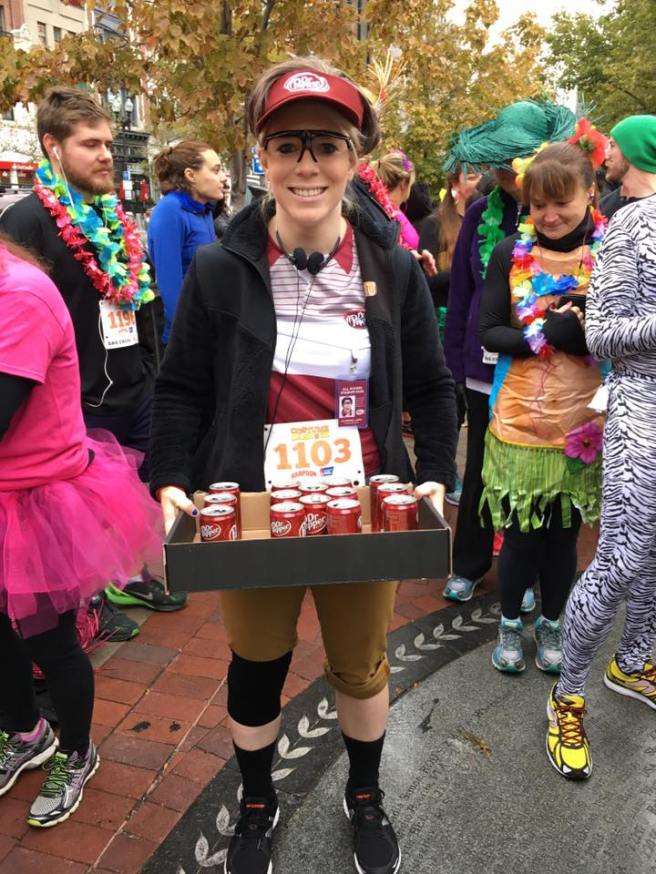
Halloween has always been one of my favorite days of the year. As I get older and feel less enthused about staying out all night and wearing a t-shirt and shorts in cool fall weather, the part that excites me more now is really celebrating the fall season. The pumpkins, gourds, apple cider, and earthy colors ease the looming anxiety that winter is coming, and the days will offer little daylight. I still enjoy dressing up- this year, I ran in a costume dash and baked several pies after finishing.

14906985_10207569043487354_3168132122801290548_n
Dr. Pepper, anyone?

Halloween also reminds me that fall is a season of dying. In many ways, death looks glamorous in the fall. The splendid leaves that burst in reds, yellows, and oranges on the trees that were lush green only weeks before are indeed dying, and eventually will fall to the ground. Once the harvest concludes, we face the end of outside activities- for the next few months, most everything we do will be inside in the warmth. The month of November in particular reminds me to be mindful of those I and the people close to me have lost. Every year, one of my friends has lost a loved one in November. Given the end of light and many crops, it makes sense that naturally, November would be a month of ends of lives as well.

In honor of Halloween and remembering my Grandma Mary, who passed away four years ago in early fall, here is a recipe for a decadent dessert you can make any time of the year, but is particularly special with a warm cup of Mexican hot chocolate (which really, is hot chocolate) and some warm socks. A Blessed Halloween and Dia de Los Muertos to everyone!

Pumpkin Chocolate Tres Leches Cake with Maple Syrup Frosting

  • Difficulty: easy
  • Print

Ingredients

  • 1/2 cup butter, softened
  • 1-3/4 cups sugar
  • 2 eggs
  • 2 cups all-purpose flour
  • 2 tablespoons Hersheys Special Dark cocoa powder
  • 1-1/2 teaspoons baking soda
  • 1/2 teaspoon salt
  • 2 teaspoons pumpkin pie spice
  • 1 14-oz can pumpkin puree
  • 3/4 cup evaporated milk
  • 3/4 sweetened condensed milk
  • 3/4 cup heavy cream
  • 1/2 teaspoon maple extract
  • 3/4 cup butter, softened
  • 3/4 cup vegetable shortening
  • 4-5 cups powdered sugar
  • 1/2 cup maple syrup
  • 1 teaspoon vanilla extract

Directions

  1. Preheat oven to 350 F and grease a 13×9 in. pan.
  2. In the bowl of an electric mixer, beat the butter and sugar on medium speed until light and fluffy.
  3. In a medium bowl, sift together the flour, cocoa powder, baking soda, salt, and pumpkin pie spice.
  4. Add the eggs one at a time to the butter and sugar mixture, mix until combined.
  5. Now, alternate adding the flour mixture with the pumpkin puree to the mixer in 3 increments.
  6. Pour cake batter into greased pan. Bake for 30 minutes.
  7. Let cake cool for at least 30 min. Once cool enough, poke several holes with a straw or anything that will make enough space for the leches.
  8. Mix together the evaporated milk, condensed milk, heavy cream, and maple extract.
  9. Pour mixture over the cake and let sit for at least 30 minutes.
  10. To make icing, cream together butter and shortening on medium speed.
  11. Add 4 cups of the powdered sugar gradually, one cup at a time.
  12. Add the maple syrup. If needed for consistency, add the last cup of powdered sugar.
  13. Mix in the vanilla extract.
  14. Once the leches have settled, frost the cake.
  15. Garnish with chopped pecans, if you like!

Why Honesty is Risky, Sometimes

I started my Memoir Generator class. There are 12 of us aspiring memoirists. All women identified, all pretty quirky. I have decided after our first meeting we are all hiding something. That’s why we want to write. We are trying to figure out how to unhide. 

PC: Hauke Morgenthau

We read two memoirs before the class so we could tear them apart. I don’t mean in a bad way, like a really tough movie critic- I mean we dissected them, made lists of characters and objects and places, and honed in on the authors’ strategies for effective writing. The books we read were When Breath Becomes Air by Paul Kalanithi (which I wrote about a few months ago) and The Suicide Index by Joan Wickersham. These memoirs are both about death- the first is about the author’s battle with cancer and his understanding, as a surgeon, of exactly what is happening inside him, and the second is about the author’s father committing suicide and her family’s quest to pick up the pieces for years. Literally, years- Wickersham worked on this book for 14 years. Kalanithi died about a year after he started writing the book. 
I felt so alive in our first class, even after a long day of work, even as the sun set and the bands of gold light turned pink and purple and then darkness flooded the window outside. I love learning, and what’s more, I loved being in a room with writers interested in understanding writing as a deep spiritual, artistic process. We agreed that writing a memoir takes time, reflection, and the final product will leave out quite a lot of what we write. “Don’t think every scene you write isn’t sacred,” our instructor told us. “But don’t think it’ll all be publishable either.” I admit, that statement scares me. But I’m still willing to try the process. I have stories and people and pain to unhide. 
In this first class, I learned something crucial about telling the truth amongst my new classmates. As we delved into the character list for Wickersham’s memoir, someone asked, “Why do you think she only mentions her sister once in the whole book? That seems strange to me. We don’t even know her name.”
It did seem strange- I suddenly wondered if the author was trying to tell us that her sister wasn’t very important to this whole experience, which I found unbelievable. My sister would be, if that ever happened in my family. Before that train of thought could spiral out of control, another student responded, “her sister probably asked not to be in the book. She probably wanted to be private.”
Oh. Yes, that makes sense. I realized in my quest to begin telling my own story how difficult telling the truth is, especially to the world who doesn’t know you and the people you love. Because “the” truth is actually your own truth. We have great power in our hands (literally) when we write down the stories we tell ourselves and share them. We are exposing brokenness and pain and memory that may be locked away for good reason. Someone in my class mused, “you’ll never please everyone when you tell the truth. The truth hurts. And usually we are writing because we are hurt, or we hurt others, and we write about the people who have caused us pain or for whom we have caused pain.”
I thought about my family and our collective secrets. What will happen if I write them down and share them? Even the stories we have exposed are told in a way that everyone feels they have agency. We’ve told these stories over and over, and drafted them in a way that confirms and contributes to the greater narrative of who we are. What if my writing challenges this narrative, shatters our story of “us”?
So I begin by asking “why.” Why do I feel such an ache to tell my story, even though I risk upsetting the people closest to me? For now, the answer is that sharing my story could also put forth the beginning of an honest conversation about our shared family pain that we’ve never addressed before. Telling the truth is risky- and maybe it’s a way for me to build stronger relationships with my family. I hope the memoir process helps me unhide from my own truth, and that I learn to listen for others’ struggles in sharing theirs. 

The Longest Loneliness

PC: Nathan Anderson

I have felt lonely all my life. Lonely as an objective feeling, not necessarily good or bad, happy or sad. Loneliness is a part of who I am and will be, perhaps forever. I decided to reflect on my loneliness this week because it has been contributing to some deep depression and anxiety, and writing usually helps me practice mindfulness toward my own experience. So I write this week not to complain or whine (though I apologize if it seems that way) but to contemplate what loneliness really is, and wonder when we might use it to help ourselves and others. 

Yes, there have been times in my life when loneliness dug at me like a metal spoon scraping the bottom of an empty ice cream tub. I saw my classmates, teammates, and peers develop close relationships with people whom they could essentially treat like siblings. My own sister has been best friends with 3 people since middle school, one since kindergarten. I certainly have experienced deep friendship at times, yet have never truly shaken the feeling of being alone, isolated. 

There have also been moments when loneliness has made me feel special and distinct. When I was little, my parents worried that I wouldn’t recognize how smart I was. They feared I would fall into complacency with school work and sports and Girl Scouts and whatever else was on the docket, only to find myself in the throws of mediocrity. So they reminded me constantly of how smart and talented I was, compared to my classmates. They spoke about me being the best softball player on the team as if it were fact. I began to believe that my loneliness was a sign of greatness: if I were so much more talented, intelligent, and “better” than everyone around me, no wonder they didn’t understand me! I was too much for them. 

As I grew this constant distinguishing caused some deep harm. I became a perfectionist. Anytime I performed below expected on a test or in a game, my instinct was to find an excuse. My parents helped me assuage the feelings of failure. “You weren’t feeling well today,” “that was a fluke,” “its because she’s jealous of you, that’s why she graded you harder.” I found my middle school self drowning from feeling both extremely confident that I was smarter, more talented, more perfect, and terrified that I would mess up and someone else would experience the glory of getting the highest grade on a history test. And I was lonely. So unbelievably lonely. 

I used to dream that one of the most popular boys in our class would talk to me. It wasn’t a particularly sensual fantasy- in fact, what I wanted most was to be welcomed in to his friend group by association. I imagined myself standing next to him, listening to one of his friends tell a joke, and laughing, really laughing. That fantasy has never completely left my consciousness. In my quest to constantly prove my parents’ opinions of me (and my own) as a unique, brilliant young person, I found deep down a desire to simply be the same as everyone else. 

I believe everyone experiences some form of loneliness throughout our lives. The popular movie motif of the “nerd” sitting by themselves eating lunch in the bathroom feels relatable to most of us in one way or another. And yet, I believe loneliness differs from feeling “alone.”

We combat loneliness by connecting with other people. We join clubs, play on sports teams, go to church or temple or the YMCA. We join a community. Feeling alone, even among members of a community, is not so easily shaken. The “aloneness”, I believe, stems from a fear or uncertainty about one’s purpose, namely, that perhaps there isn’t one. 

Have you ever felt as thought the more accomplishments you add to your resume, the more limited you are in your ability to find purpose? That sounds and is coming from a very privileged position, one I feel the need to honestly assert. Feeling alone has driven me toward the work I do now, supporting students in their quest to find community and to state their purpose in this world (hopefully combining their skills and interests). If I’m honest, I myself have not yet fully realized my own purpose. Feeling alone in the world may posit a real challenge, but the benefit is the motivation it sustains in me to keep working. I may not demonstrate my appreciation for every person I meet that teaches me something extremely well (and given the right mindset, this can be every person), but I do appreciate them inside. I cherish connection because it does help me feel the slightest bit less lonely and for a moment, not completely alone in the world.

I know many of us feel alone, and it can be near impossible to discuss, given our circumstances. It is my hope that the quest to end loneliness by seeking out community also moves us toward recognizing how not to be alone, or at least, that being alone does not have to freeze us.

Why Writing Brings Me Joy

It seems like all I can talk about these days, besides my moving woes and the storm that is Welcome Week at a large urban university, is my writing. What joy writing has brought me! Someone asked me recently: “Have you always been a writer?” I have always written papers and blogs and reports, yes- but it has not been until this summer that I have mustered the courage to call myself a writer.

A few weeks ago, I shared my experience at the Kenyon Institute seminar on spiritual writing on this blog. The seminar pushed me to make writing a priority, because of the joy and healing the process evokes. As soon as I returned from Gambier, Ohio, I decided to enroll in a GrubStreet class (a Boston non-profit dedicated to providing resources for writers of all ages), mainly for the accountability to write every week. A six-week Online Memoir Generator was about to begin, so I signed up and began to think about my memoir.

writing.jpg

The first week, my classmates and I discussed the topics of our memoirs in the online forum. Death, heartbreak, illness, leaving a life behind to start another- these all made the list. I struggled to describe my story- struggles with faith, growing up, finding community. My eyes rolled as I typed these words, they seemed so overused. Was I whining? I submitted a scene about losing a wiffle ball over the fence that separated my family’s back yard with our neighbor’s house and our quest to retrieve the ball, knowing full well our neighbor lived with dementia. The story provided a little humor and demonstrated the relationship between childhood me, my sister Mallory, and my dad. As words filled my page, though, something else happened. My soul transported back to that scene, that moment, and I remembered walking home after our quest, unsuccessful in retrieving the ball, and having my first encounter with a religious ritual that was not my own. The meaning is in these small details, I decided.

In the next weeks, my classmates shared their work and we commented on each other’s pieces. I found myself cringing to open their submissions on my computer. Am I ready for this? I wondered. Every time I read about the death of my classmate’s sibling, the struggle to raise a child, the reality of living as a gay man, the feeling in my chest resembled a shame as if I had taken off all my clothes to strut my far from perfect body in a room full of people. How unworthy was I to witness these life experiences with the people who lived them, and then to critique their writing about them?

“Work is love, made visible,” wrote Khalil Gibran, in his famous work The Prophet. The course continued, we completed our assignments, and I began to find joy in the work. I wrote about my struggle to feel like part of a community my whole life. I wrote about the car accident that totaled my big red Jeep and my childhood. I wrote, though didn’t submit, a short piece about my cousin who died far too young by her own hand. She was 28, the same age as me. Through the pain revisited on the page, my classmates took me in, and we held each other. I cried at their losses, their love, their pain. And I began to heal, or at least to feel what healing feels like. “Work is love, made visible.”

The love I felt through this process illuminated the source of the joy that I call writing. The source is the community. Writing is such a personal process- we know our story, we own our methods and tactics for telling it. Yet we write to share (if only with our future selves), to connect with our readers. Finding community has been a real challenge for me my whole life, and yet, it only took a website and some discussion forums to find a group of seven people willing to be vulnerable and intimate, willing to put love into the work.