Is Gratitude a Privilege?

…the short answer to the above question is yes, insofar as it concerns me and the following response.

photo-1445098516063-9b0b2e4206e9
PC: Ian Schneider

I have been feeling a need to express more gratitude lately. Perhaps this is natural, given the climate, or the weather, or just exhaustion beyond explanation. Endorphins? Maybe the fact that Thanksgiving is this week? I’m not sure, but at the same time have been feeling a sense of frozenness, an inability to make decisions or take action. For the longest time, it felt like my perfectionism was acting up and I kept telling myself I would finish certain tasks (including emailing important people back, ehem) once I had drafted a thorough, complete response read over several times. The problem is, what does complete look like? What happens when we are never “ready?”

I was thinking about this question particularly in regard to learning allyship. At my university, we’ve been talking about best practices and how we can support students who are threatened and afraid. Do we wear the safety pins? Do we make public statements? How do we show up for each other in meaningful ways? So many uncertainties and yet, there is no time to seek the answer before something needs to be done. The time is NOW. Attempting perfection inhibits change and has encumbered me from supporting those who need to be held the most. So, as a white woman, I’m going to throw perfection out the window and trying to learn as I go. Is this dangerous? Yes. My “learning opportunities” can certainly be harmful. The damage is real. Taking action can, however, take the pressure off those I’d like to support, because waiting for complete knowledge around the “how” means the oppressed are tasked with figuring it out, and I sit and wait. We, human beings, are not perfect. We are inchoate. We are unfinished. And yet, we love and are loved.

This rambling comes in thinking about gratitude, to return full circle. One of my students challenged me about a month ago to do something every night: name one thing I appreciate about someone who otherwise gives me trouble, and name three things I love about myself. Can you guess which one is harder? In reality, it depends on the day. Every night, she has consistently reminded me to report my 1 and 3 to her, and in turn I ask her back. At first this practice seemed impossible. “He just makes me SO mad!” I thought, “How can I appreciate anything?” Moreover, putting aside self-loathing sounds simple but, of course the loathing is complicated. Slowly but surely, we have made progress together. Sure, some days still seem untenable- you know the ones. This past Friday, this student was in my office and we had a lengthy conversation about gratitude and what it really means.

As I understand now, gratitude requires faith in the imperfect. It means feeling thankful despite the suffering present in the world, in my life. It also requires mindfulness: a sense of feeling genuine in the present. When I feel grateful, I am not taking a backseat and determining that everything “will work itself out.” I am acknowledging that there are in fact slivers of hope, pieces of love to hold as we march into the darkness. I am grateful for the challenges, even if on certain days, they feel insurmountable to address. Gratitude is a call to action, not complacency- this is the difference between ignoring privilege and acknowledging it.


Acknowledging a Mistake, Finishing a Race.

Many of my fellow writers (and others) have shared that they feel lost for words- what do we add to the conversation this week, especially as we still feel a sense of shock? I really want to sit with that tension, especially to state that I don’t feel like I can give any wisdom or say anything inspiring like, “it’s going to be ok.” What does that mean, “it’s going to be ok”? I decided that sharing two things I learnedM specifically as a white person this week may be helpful. This post isn’t well-written or even logically in order, which reflects the sentiment.

photo-1446071103084-c257b5f70672
PC: Annie Spratt

Tuesday of course was a day of fatigue for me and pretty much everyone at work, most especially the students. My colleague did an amazing job of creating a space for the community to come dialogue and for many, this was the first space they could do that. I listened to my students, my beloved Muslim, Hindu, Jewish, Buddhist, unaffiliated students, share their emotions as well as they could. There were certainly tears. And there was love. There was an unabashed, boundless, courageous love that filled the room. I felt it in every hug, every handshake, even the way we looked at each other. As one of the dialogue facilitators, much of what was said echoed my emotions and fears, but I didn’t share.

That evening, I got a call from a really good friend who led the USC Interfaith Council with me. We threw out suggestions for what we could do on our campuses and how we knew folks were mobilizing already. It felt really good to talk to him. After we finished our call I went on a run and listened to Valarie Kaur speak dazzling beautiful and powerful words on our Revolutionary Love Conference Call. She echoed much of what I and many were feeling and told us to think about this moment as birth: first, there is darkness. Then, there is beginning, and creating, and building. One of the Revolutionary Love Fellows shared a heartbreaking reflection on feeling like a failure to our country, and I sobbed as I ran the last few steps to my door. The rest of my evening was pretty quiet- I tried to write something for National Novel Writing Month, to keep up my word count.

On Thursday at our Spiritual Advisors’ Meeting, I realized too late that I hadn’t processed my own feelings fully, especially not out loud. The idea that a man with a track record of normalizing sexual harassment and assault will control decisions and moreover, messages to people in our nation that say “women’s bodies are up for grabs” elicits a significant level of panic for me. I mention this for personal reasons, but also cannot forgive the messaging that has normalized homophobia, transphobia, xenophobia, the fact that Black Lives don’t really Matter. Further, to lose my friends who are undocumented, DACA-mented, and/or are immigrants in the blink of an eye feels shattering- it’s as if what I wrote about in college, the rounding up of Japanese Americans and immigrants and physically removing them is coming back to haunt us. So, in a group of 20 people from different faith traditions, I sobbed. I told them that I was scared. That I had been ignorant for being critical of interfaith communities who practice a “basic” understanding of what interfaith is because clearly- we need to encourage any positive interfaith action in full force. I told them the students were my heroes this week. They fricking SHOWED UP for each other, despite their fear and anger. And I made it about me, which I shouldn’t have done. I cried white tears, and learned the necessity of self-care this week. It was an important lesson to learn.

This weekend I flew home to LA to run a 10K and half marathon at Disneyland. The theme of the weekend was Superheroes, which felt all too necessary. Home is strange for me right now- my family did not vote for the candidate I wanted to see in the Oval Office, and have been vocal about their dismissal of people who feel afraid and angry. I’ve worked on asking open questions about why they made their choice, and tried to push back with some counter ideas to their analysis. They are my family and I love them, and we don’t agree. I’m going to sit with that discomfort for some time.

This morning I finished my second half marathon race. This weekend was dedicated to self-care because, as noted above, I learned an important lesson. You ran 13.1 miles for self-care? Indeed, while excruciating at points and not what I love doing at 5:30 am every Sunday, the race was something to which I looked forward and for which I trained over the past 12 weeks. Running is a practice for me, it helps me stay focused and motivated. The race started in the dark and just before we sang the National Anthem, I thought: this is what an intentional community looks like.

Around me, there were people who looked like me and people who didn’t. There was a man next to me who told me he came from Japan for this race and donned a full Minnie Mouse dress and ears to run. “You look so great!” people told him. Four runners in wheelchairs started the entire race. There were people over the age of 70, people from Kansas and Oregon and Australia, people of size and people who were very slender, people who had never run a half marathon before. There was a man who had made the US Olympic Marathon Trials. The course was tough- not hilly, but all asphalt, and as the sun rose it got warmer. For the hour and forty five minutes I struggled through that darn course, people encouraged me unflaggingly. Even in the last 2 miles, we gave each other thumbs up and simple, “you got this!” greetings. It felt like a community. Not perfect, not all the same, just people sharing a goal.

I’m going to focus on simple relationship building in the next few weeks. Finishing this race and thinking about the necessity of building bridges, the dire, urgent necessity, is where I want to start. I’m going to keep reading, keep asking my friends and students how they are feeling, keep supporting. And I will make mistakes, and try my best to write about them in a way that encourages learning.

#RevolutionaryLove

On November 9th

photo-1454535524385-496c92f1f4b9.jpg
PC: Brandon Day

In the wee hours of Tuesday, November 8th, 2016 the world either ends or begins. This is the rhetoric I hear, the anxiety my friends feel, the way we as a country have been visioning our future for the past couple of weeks. What will be our new national narrative?

The world goes on, simply. Nothing really changes overnight, and yet everything changes in our minds: we either lose everything or make history in whatever way our nation decides. This has been a long, grueling, terrifying election season for many. What will we do, who will we be on November 9th?

The past few months I have witnessed some awful events. Recently I wrote about why Donald Trump’s comments around sexual assault and objectifying women hurt me personally, and cause much deeper harm to the marginalized and oppressed. I cannot claim that any presidential candidate has not made worrisome or downright damaging decisions. And, I can say that in these past few months, wondrous moments have also shaken me and made me believe in love as a human act, indeed an extremely courageous one.

Moving to Boston I have struggled to find and maintain community. Being alone is a part of who I am. Yet this time of great fear and hurt has given me a window into the true importance of community and dedicating everything I can to the ones that hold me and keep me. Let me give you some examples.

The Revolutionary Love Project launched in early September and we, 17 fellows, 250 ambassadors and one fearless leader, quickly got down to business. In the course of only eight weeks, we completed three huge goals (one of which will be completed this Tuesday). We took grassroots action and organized over 100 people across the country to host screenings of Divided We Fall, a documentary by our project leader Valarie Kaur about violence against Sikhs and Muslims in the aftermath of 9/11. Some of these screenings happened in living rooms (like mine), and some on college campuses. Just as we reached our targeted 100 screenings, our leader Valarie went on tour with the Together Tour and reached over 20,000 people in 6 cities: Portland, Los Angeles, Chicago, Brooklyn, Atlanta, and Denver. Though I couldn’t attend any of the actual tour dates, I felt a surge of hope every time someone new felt inspired to take action after one of the evenings and posted about it on Facebook or Twitter. So many new Love Ambassadors spoke openly for the first time about their pain and how they have healed, and helped others to do the same. Now, each of us have been making calls (and encouraging others to make calls) to Get Out The Vote, especially in key states like Florida. We have felt the urgency to build bridges and acted upon it through love, not hate.

A few weeks ago I passed by one of the main quads on campus to find almost 50 students occupying a large sector of the grass with tents and signs seeking divestment from fossil fuels at my university. The students demonstrated a deep commitment to our earth and each other as they educated passersby on their way to class. They showed us that climate change is not an issue by itself, but a gender issue, a faith issue, a human rights issue. Hundreds of students showed their support by wearing orange. Just this past Wednesday, several student leaders of faith engaged with members of HEAT (the Husky Environmental Action Team) in an essential conversation about how our faith calls us to care for the earth and take action on climate change. We expanded the boundaries of our own communities that night, welcoming each other among ourselves.

Besides election day, November also hosts National Novel Writing Month. Writing 50,000 words in one month always seemed downright impossible to me- the time and moreover, the content pose a large obstacle. This year, an interfaith activist and professor at Cal Lutheran University started an online group for professors and chaplains in which to participate. My writing class also created a joint account, so we could all contribute to the word count. Both communities in the past five days have been ruthlessly encouraging to every member, posting inspirations on Facebook and checking in with each other individually. So far, I’m on track: it’s November 7th and I’ve written almost 10,000 words. Without these two communities I could barely write this blog post. Though unspoken, there seems to be a deep understanding that though the world feels dark and scary, we have our team and we are writing for each other. Every time someone posts that they have achieved their daily goal, I send them a silent high five. “You DID IT!” I want to scream.

Late on a Friday afternoon, several women leaders of faith crowd in my office, sitting on the floor and watching YouTube videos. We don’t speak about our fears or hopes, but we hold each other’s company. We keep each other safe simply by listening and laughing. I smile, packing my bag to head home for the weekend. We hug good bye, and implore each other to make good choices.

On November 9th, I hope we maintain the urgency that each of these communities has utilized to turn love into action. My fingernails are gone, my eyes are puffy. My heart feels weary, but not closed. The world goes on, and no matter what happens, we can care for each other if we find the courage.

On November 9th, I will recommit to practicing love with optimism and honesty. I will keep writing. I will keep imploring my students to make good choices.

A Halloween Recipe (Try it, it’s yummy)

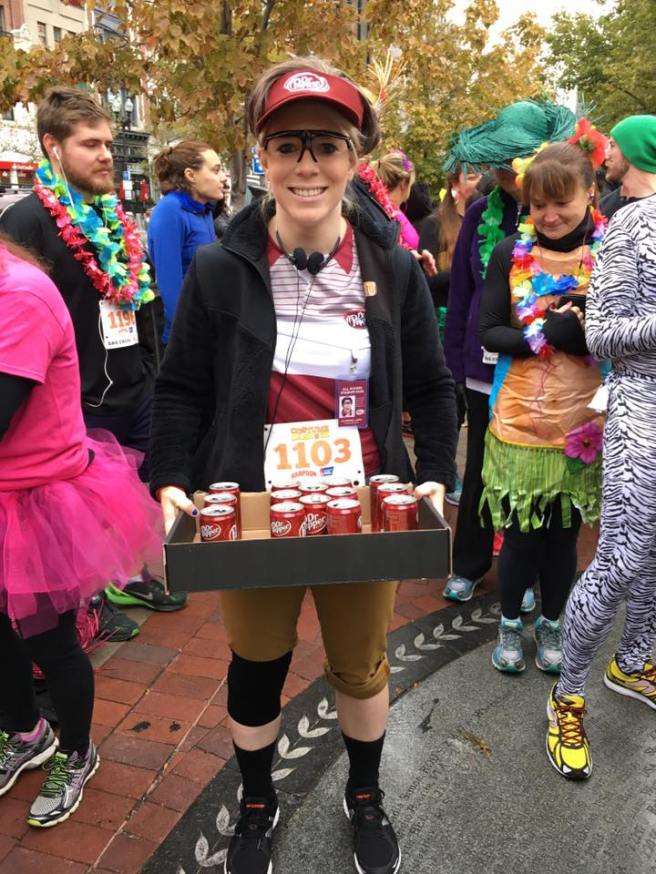
Halloween has always been one of my favorite days of the year. As I get older and feel less enthused about staying out all night and wearing a t-shirt and shorts in cool fall weather, the part that excites me more now is really celebrating the fall season. The pumpkins, gourds, apple cider, and earthy colors ease the looming anxiety that winter is coming, and the days will offer little daylight. I still enjoy dressing up- this year, I ran in a costume dash and baked several pies after finishing.

14906985_10207569043487354_3168132122801290548_n
Dr. Pepper, anyone?

Halloween also reminds me that fall is a season of dying. In many ways, death looks glamorous in the fall. The splendid leaves that burst in reds, yellows, and oranges on the trees that were lush green only weeks before are indeed dying, and eventually will fall to the ground. Once the harvest concludes, we face the end of outside activities- for the next few months, most everything we do will be inside in the warmth. The month of November in particular reminds me to be mindful of those I and the people close to me have lost. Every year, one of my friends has lost a loved one in November. Given the end of light and many crops, it makes sense that naturally, November would be a month of ends of lives as well.

In honor of Halloween and remembering my Grandma Mary, who passed away four years ago in early fall, here is a recipe for a decadent dessert you can make any time of the year, but is particularly special with a warm cup of Mexican hot chocolate (which really, is hot chocolate) and some warm socks. A Blessed Halloween and Dia de Los Muertos to everyone!

Pumpkin Chocolate Tres Leches Cake with Maple Syrup Frosting

  • Difficulty: easy
  • Print

Ingredients

  • 1/2 cup butter, softened
  • 1-3/4 cups sugar
  • 2 eggs
  • 2 cups all-purpose flour
  • 2 tablespoons Hersheys Special Dark cocoa powder
  • 1-1/2 teaspoons baking soda
  • 1/2 teaspoon salt
  • 2 teaspoons pumpkin pie spice
  • 1 14-oz can pumpkin puree
  • 3/4 cup evaporated milk
  • 3/4 sweetened condensed milk
  • 3/4 cup heavy cream
  • 1/2 teaspoon maple extract
  • 3/4 cup butter, softened
  • 3/4 cup vegetable shortening
  • 4-5 cups powdered sugar
  • 1/2 cup maple syrup
  • 1 teaspoon vanilla extract

Directions

  1. Preheat oven to 350 F and grease a 13×9 in. pan.
  2. In the bowl of an electric mixer, beat the butter and sugar on medium speed until light and fluffy.
  3. In a medium bowl, sift together the flour, cocoa powder, baking soda, salt, and pumpkin pie spice.
  4. Add the eggs one at a time to the butter and sugar mixture, mix until combined.
  5. Now, alternate adding the flour mixture with the pumpkin puree to the mixer in 3 increments.
  6. Pour cake batter into greased pan. Bake for 30 minutes.
  7. Let cake cool for at least 30 min. Once cool enough, poke several holes with a straw or anything that will make enough space for the leches.
  8. Mix together the evaporated milk, condensed milk, heavy cream, and maple extract.
  9. Pour mixture over the cake and let sit for at least 30 minutes.
  10. To make icing, cream together butter and shortening on medium speed.
  11. Add 4 cups of the powdered sugar gradually, one cup at a time.
  12. Add the maple syrup. If needed for consistency, add the last cup of powdered sugar.
  13. Mix in the vanilla extract.
  14. Once the leches have settled, frost the cake.
  15. Garnish with chopped pecans, if you like!

Why Honesty is Risky, Sometimes

I started my Memoir Generator class. There are 12 of us aspiring memoirists. All women identified, all pretty quirky. I have decided after our first meeting we are all hiding something. That’s why we want to write. We are trying to figure out how to unhide. 

PC: Hauke Morgenthau

We read two memoirs before the class so we could tear them apart. I don’t mean in a bad way, like a really tough movie critic- I mean we dissected them, made lists of characters and objects and places, and honed in on the authors’ strategies for effective writing. The books we read were When Breath Becomes Air by Paul Kalanithi (which I wrote about a few months ago) and The Suicide Index by Joan Wickersham. These memoirs are both about death- the first is about the author’s battle with cancer and his understanding, as a surgeon, of exactly what is happening inside him, and the second is about the author’s father committing suicide and her family’s quest to pick up the pieces for years. Literally, years- Wickersham worked on this book for 14 years. Kalanithi died about a year after he started writing the book. 
I felt so alive in our first class, even after a long day of work, even as the sun set and the bands of gold light turned pink and purple and then darkness flooded the window outside. I love learning, and what’s more, I loved being in a room with writers interested in understanding writing as a deep spiritual, artistic process. We agreed that writing a memoir takes time, reflection, and the final product will leave out quite a lot of what we write. “Don’t think every scene you write isn’t sacred,” our instructor told us. “But don’t think it’ll all be publishable either.” I admit, that statement scares me. But I’m still willing to try the process. I have stories and people and pain to unhide. 
In this first class, I learned something crucial about telling the truth amongst my new classmates. As we delved into the character list for Wickersham’s memoir, someone asked, “Why do you think she only mentions her sister once in the whole book? That seems strange to me. We don’t even know her name.”
It did seem strange- I suddenly wondered if the author was trying to tell us that her sister wasn’t very important to this whole experience, which I found unbelievable. My sister would be, if that ever happened in my family. Before that train of thought could spiral out of control, another student responded, “her sister probably asked not to be in the book. She probably wanted to be private.”
Oh. Yes, that makes sense. I realized in my quest to begin telling my own story how difficult telling the truth is, especially to the world who doesn’t know you and the people you love. Because “the” truth is actually your own truth. We have great power in our hands (literally) when we write down the stories we tell ourselves and share them. We are exposing brokenness and pain and memory that may be locked away for good reason. Someone in my class mused, “you’ll never please everyone when you tell the truth. The truth hurts. And usually we are writing because we are hurt, or we hurt others, and we write about the people who have caused us pain or for whom we have caused pain.”
I thought about my family and our collective secrets. What will happen if I write them down and share them? Even the stories we have exposed are told in a way that everyone feels they have agency. We’ve told these stories over and over, and drafted them in a way that confirms and contributes to the greater narrative of who we are. What if my writing challenges this narrative, shatters our story of “us”?
So I begin by asking “why.” Why do I feel such an ache to tell my story, even though I risk upsetting the people closest to me? For now, the answer is that sharing my story could also put forth the beginning of an honest conversation about our shared family pain that we’ve never addressed before. Telling the truth is risky- and maybe it’s a way for me to build stronger relationships with my family. I hope the memoir process helps me unhide from my own truth, and that I learn to listen for others’ struggles in sharing theirs. 

For the Women, and Everyone, that I Love. 

Most of us have heard and or read Trump’s sexual harassment comments and if you’re like me, have subsequently read plenty of articles floating around Facebook and Twitter that explain why these comments, this “locker room banter”, is so harmful. Many of these articles I can’t even read all the way through because they feel so invasive. I find myself sobbing uncontrollably, reliving, remembering, and trying to reimagine. I am so in awe of any woman, regardless of who they are voting for, that shares her story of sexual assault with me- especially if I’ve never met her. 
I’ve been struggling with this blog being “not political”, especially in the last year. Realistically, not a few hours pass without hearing a reference to the election in some way. It has not been my intention to ignore the pain and polarization I blatantly see, but I recognize that I have. My default mode of expression on this forum has been stories of my own experience and how they give me hope even among the atrocities in the world. People working together, talking together, laughing and crying together, despite their differences. I am sorry for not speaking more bluntly about the horrifying abuse that black, latinx, undocumented and documented immigrant, Muslim, Sikh, and other people have endured from a single man and his words. So, I will not speak for anyone but myself, and I will tell you my truth. This week I need to tell you why this “locker room banter” matters to me- as a survivor of sexual assault, yes, and more directly, as someone who lives in a woman’s body every day. 

PC: Jairo Alzate

When I wake up in the morning, I put on the outfit I picked out the night before, turn the coffee pot on, and shower/brush teeth/pack my lunch. Sometimes I forget to scoop the coffee into the pot and that adds a few minutes to my routine. I check the T schedule so that when I arrive, I won’t have to wait too long to get on. When I’ve got everything all together, I grab my backpack and head out the door. It’s scowl-face time. There’s a building across the street from my apartment that is under construction. Often, men are working when I walk to the T. I’ve seen them staring, at me and other women. Sometimes, they yell things like “hey, smile!” And “why so serious!?” I practice my therapist’s method of escaping the catcall trigger: name the discomfort (“a stranger yelling at me”), name what’s happening (“I’m shivering, my face is red, I’m walking faster”) and say your calming mantra (“I own my body, I own my mind, I am an agent”). Ignore the comments. It works better some days than others. 
When I make it to the T station, sometimes men will follow me closely so they can enter the platform without a ticket. For whatever reason, this makes me upset and I want to say “if you ask me, I would buy you a ticket” but I don’t because it’s safer to just ignore them. On the T, I try to stand where other women are standing because a few weeks ago the train was very crowded and a man held on to one of the handles with his elbow out and he touched my chest. I tried to move, but there was no space. We passed two stations with his elbow wedged into my chest. 
When I arrive at work, I try to make eye contact with everyone I pass on the way to the office. Self-defense classes taught me this in order to show that you’re aware of another’s presence. Sometimes I make eye contact with someone, usually a man, for a little too long and I feel my face turn bright red. Quickly, my eyes avert and I walk faster. I don’t want to give anyone the wrong idea. Once at work, I usually start my day answering emails or checking in with my coworker. Often we share experiences of micro aggressions that occurred on the train or walking to work. This is 9 am. Our bodies stay on alert for at least 8 more hours before we go home. 
Almost every day, I see women students whom I love that have experienced some kind of gendered micro aggression. Much of the time they don’t even call it that: they’ll say, “I wish I wasn’t scared to speak in class. I guess I just need to stop caring about what people think and speak up.” They’ll say, “I couldn’t tell him I was on my period, that would have freaked him out.” To my heartbreak, they’ll tell me that they should have called a guy to walk them home, their bad for getting followed or catcalled at night. They’ll admit that their male professor makes them uncomfortable and they feel bad about that, they’re just being “overly sensitive.” And I see them interact with classmates, staff, and faculty, and I watch them get interrupted, body shamed, and sometimes even harassed without even recognizing what is happening. This is magnified enormously by their race, their gender, their sexual orientation, their ability to speak English, their religion. And I want so many times to draw these women close to me, cradle them near my heart and in my arms and say, “let’s stay like this forever.” 
I am outraged by Trump’s comments, and even more by his lack of remorse. I can’t say I’m all that surprised, given the systemic non-apologetic oppression women experience every day for the bodies they live in. What scares me the most is the “normalizing.” The fact that people, not just men, live thinking that this kind of behavior is “how it is,” and that this dictates how we live our lives in almost every moment. It terrifies me that people live without the agency to name when someone treats them poorly because of who they are. And I absolutely cannot claim to fully understand this experience, even in my own body and mind. 
I write this because it is my truth, and believe that telling stories helps us make sense of experiences that are painful and traumatic. I also hope we will name our pains and our harms more. My hesitancy is always “people don’t want to listen” or “they’ll feel uncomfortable.” That is not my experience. More often than I have realized, the most intimate and open conversations start with one person’s honesty that they’re living in pain or anger or sadness. Even if we don’t relate, we can build trust this way. I commit to speaking up more, because silence can only hold me where I am. 

The Longest Loneliness

PC: Nathan Anderson

I have felt lonely all my life. Lonely as an objective feeling, not necessarily good or bad, happy or sad. Loneliness is a part of who I am and will be, perhaps forever. I decided to reflect on my loneliness this week because it has been contributing to some deep depression and anxiety, and writing usually helps me practice mindfulness toward my own experience. So I write this week not to complain or whine (though I apologize if it seems that way) but to contemplate what loneliness really is, and wonder when we might use it to help ourselves and others. 

Yes, there have been times in my life when loneliness dug at me like a metal spoon scraping the bottom of an empty ice cream tub. I saw my classmates, teammates, and peers develop close relationships with people whom they could essentially treat like siblings. My own sister has been best friends with 3 people since middle school, one since kindergarten. I certainly have experienced deep friendship at times, yet have never truly shaken the feeling of being alone, isolated. 

There have also been moments when loneliness has made me feel special and distinct. When I was little, my parents worried that I wouldn’t recognize how smart I was. They feared I would fall into complacency with school work and sports and Girl Scouts and whatever else was on the docket, only to find myself in the throws of mediocrity. So they reminded me constantly of how smart and talented I was, compared to my classmates. They spoke about me being the best softball player on the team as if it were fact. I began to believe that my loneliness was a sign of greatness: if I were so much more talented, intelligent, and “better” than everyone around me, no wonder they didn’t understand me! I was too much for them. 

As I grew this constant distinguishing caused some deep harm. I became a perfectionist. Anytime I performed below expected on a test or in a game, my instinct was to find an excuse. My parents helped me assuage the feelings of failure. “You weren’t feeling well today,” “that was a fluke,” “its because she’s jealous of you, that’s why she graded you harder.” I found my middle school self drowning from feeling both extremely confident that I was smarter, more talented, more perfect, and terrified that I would mess up and someone else would experience the glory of getting the highest grade on a history test. And I was lonely. So unbelievably lonely. 

I used to dream that one of the most popular boys in our class would talk to me. It wasn’t a particularly sensual fantasy- in fact, what I wanted most was to be welcomed in to his friend group by association. I imagined myself standing next to him, listening to one of his friends tell a joke, and laughing, really laughing. That fantasy has never completely left my consciousness. In my quest to constantly prove my parents’ opinions of me (and my own) as a unique, brilliant young person, I found deep down a desire to simply be the same as everyone else. 

I believe everyone experiences some form of loneliness throughout our lives. The popular movie motif of the “nerd” sitting by themselves eating lunch in the bathroom feels relatable to most of us in one way or another. And yet, I believe loneliness differs from feeling “alone.”

We combat loneliness by connecting with other people. We join clubs, play on sports teams, go to church or temple or the YMCA. We join a community. Feeling alone, even among members of a community, is not so easily shaken. The “aloneness”, I believe, stems from a fear or uncertainty about one’s purpose, namely, that perhaps there isn’t one. 

Have you ever felt as thought the more accomplishments you add to your resume, the more limited you are in your ability to find purpose? That sounds and is coming from a very privileged position, one I feel the need to honestly assert. Feeling alone has driven me toward the work I do now, supporting students in their quest to find community and to state their purpose in this world (hopefully combining their skills and interests). If I’m honest, I myself have not yet fully realized my own purpose. Feeling alone in the world may posit a real challenge, but the benefit is the motivation it sustains in me to keep working. I may not demonstrate my appreciation for every person I meet that teaches me something extremely well (and given the right mindset, this can be every person), but I do appreciate them inside. I cherish connection because it does help me feel the slightest bit less lonely and for a moment, not completely alone in the world.

I know many of us feel alone, and it can be near impossible to discuss, given our circumstances. It is my hope that the quest to end loneliness by seeking out community also moves us toward recognizing how not to be alone, or at least, that being alone does not have to freeze us.

A Shattered Thursday

shatter
PC: Jilbert Ebrahimi
Let me tell you about my Thursday.

I got to work around 8 am, carrying a cake for my co-worker’s birthday. I stayed up until 2 am making it. It tasted fantastic, so I heard. The weather was cool, and crisp, and dry. Perfect for caramel apple cake with dulce de leche icing.

After I hid the cake (it was a surprise) and bore witness to an angry student before our center even opened, I guided a meditation. 7 people came. I went back in my office and answered some emails. At 9:30, I heard about a miscommunication escalating to a fight, lawsuits threatened, people’s jobs in question. I fielded phone calls from other offices. I cleared my schedule to attend an urgent meeting. A student worker left early from the office because her grandfather passed away. I sent her a text: “So sorry my love. May everything run smoothly. Let me know what you need.”

At 11 am, I set up for a student affairs colleague meeting. We ate lunch and vegan cookies that I brought for the birthday celebration. We discussed mental health issues on campus. Our students are all over-worked, sleep-deprived, and expected to be happy, productive individuals every moment of every day. We imagined a potential collaborative internship for our students that would focus on an exploration of intersectionality and identity. I texted my partner to see if he was awake. He said he would bring the apples by 1:20. My shoulders relaxed. “Thank you,” I texted back. I scribbled some practically illegible notes.

As our meeting was ending, I texted back and forth with a student leader about which flowers to buy for the birthday girl. We went over the surprise plan. I would stall her until my student sent me the ok, at which point my co-worker and I would head to a “meeting” across the hall.  I said goodbye to my colleagues and walked back into our office, to find a student crying on the phone. My phone buzzed with the text “Come now, hurry!”-birthday time.

The crying student, my co-worker and I each took a deep breath. We processed the student’s anxiety all together. Finally, as suavely as possible, I ushered all three of us across the hall again for the birthday surprise. Everyone shouted. My co-worker sped out of the room for a moment. The students had arranged the cake, caramel apples, and gifts on a beautiful table. “This looks like the Garden of Eden!” My co-worker exclaimed. We watched the videos and messages the students filmed- one included pictures of me and her, one a choreographed dance, and one a Scooby-Doo parody. We laughed, and secretly, my throat began to choke up. Did she enjoy the surprise?

Another serious, tense meeting began just as the party finished. This one included several students- they felt angry and scared, but determined. As I finished cleaning, I gave the student who put all the videos together a massive, shoulder gripping hug. “Thank you so much for doing that,” I looked into her eyes. “I think she loved it.”

Back in my office, I found another distraught student. “What’s going on?” I asked. She didn’t want to talk, just sit in quiet. The sound of new emails sliced through the air several times. I got up to fill my water bottle. Students sat strewn around the front desk, the chairs leading to my office, and everywhere in between. The phone rang at the front. No one answered. “The air is tense in here!” Someone said. “MmmHMMM,” I murmured back with a mouthful of water.

Suddenly, the student who bought flowers for my co-worker appeared. She snapped her fingers. “Can you do something!?” I jolted up, hitting my knee on my desk. My water bottle toppled over.

One of the students in the serious meeting had fainted in the Director’s office. I tried to ask everyone to leave. I closed the door. Clutching his head and slumped over, the student explained, “This is too much. Everyone hates me right now. I have an assignment due tomorrow that I haven’t started and I’ve had two weeks. This meeting was so stressful. It’s too much.” One of his best friends had stayed in the room. She touched his hand. “I’ve been there,” she consoled him. “Sometimes you just have to fall apart. We are your friends. We’ll hold you up.” After a few more minutes, the student seemed stable. I quietly excused myself to continue an email exchange about a scheduling conflict in our Sacred Space. The crying student sobbed again. I took in a breath that filled my whole belly, and let it out slowly, through my teeth. My body instinctively stood up again to refill my water bottle.

Back in our Director’s office, I witnessed something that evaporated all the emotions I was so carefully juggling. The two students were hugging. They were smiling and giggling. They stayed in the embrace for a few moments. A tear silently grazed my left cheek. My lips lengthened into a slight smile.

You see, the student who had fainted is a Muslim, very active in the Islamic Society of Northeastern. He is also a Jordanian-Palestinian American. His friend, holding the fragility, channeling her empathy and care into the shattered young man before her, is Jewish. Their friendship exists in tension with the wider world. In other places, perhaps even in the same city, these two people could negate the humanity of the other. They could ignore each others’ existence. But they don’t. Instead, they choose friendship, they seek connection.

Sometimes we need to shatter for our souls to be assured that we are connected, we are seen, we are loved. In the midst of the pain, violence, and terror our world faces, maybe love cannot save us from breaking into a million pieces. Love makes the tiny slivers, the shattered pieces, sparkle like stained glass that is kissed by the sun.

To Be a Global Citizen, Turn Inward

This post was originally published on the Huffington Post Blog. You can find that version here.

global.jpg

As a higher education professional, I recognize that the term “global citizenship” has become a buzzword. We use it to advertise study abroad programs, accentuate courses of study, and develop leadership competencies. On Northeastern University’s campus, I direct the Global Citizenship Project. And I am frustrated.

At my university as well as several others around the country, we offer several programs that “train and develops global citizens.” Though every initiative defines global citizenship uniquely, many of the concepts that sustain these projects center around global awareness, practicing empathy toward different cultural norms and participating in service or civic engagement, often abroad. These are all excellent competencies. Unfortunately, the execution of teaching these competencies does not allow students to deeply understand their own particular values, thus prohibits them from knowing what they might contribute to the global community.


We are lucky at Northeastern to develop relationships with many international students who seek community. Many of the students are especially interested in faith, culture, and social justice. I remember sitting in a classroom one January evening in which our Center hosted a Global Citizenship Project dialogue centered on “immigration and belonging.” Around 35 students, both domestic and international, gathered on the floor to share a meal and tell their stories. In my small dialogue group, each person took a turn reflecting on their experience with immigration and belonging. I babbled happily about moving to Tokyo as a teenager and studying trigonometry in another language. When it came time for one South Asian student to share, he sighed, and stated: “I feel as though sharing my story doesn’t have any meaning. It doesn’t seem different than the other Indians’. I think maybe these concepts of dialogue and promoting an individual story is really just American.”


I suddenly realized that my definition of global citizenship posed a hypocrisy. As an American-born staff person, I do believe that deepening my knowledge of different cultural practices and learning to respect foreign cultural values is important. My culture and thus the worldview I hold tells me this is important mainly for my own self-awareness, focused less on the collectivist narrative. Thus if I equate these competencies with global citizenship, I am placing an American-centric lens on a term meant to reach beyond national borders. The term “global citizenship” needs to be re-examined, recognizing how narrow a lens it carries.


We in the United States are in the midst of a socio-revolution that seeks to bridge the increasing inequality gap and decrease violence on the already underserved. I see students and staff alike participating and struggling to address difficult questions around racial, gender, and socio-economic justice. My campus community, as well as many others, direly needs to explore competencies like cultural awareness, asset mapping, and civic engagement of our own deeply diverse America, and moreover our immediate communities. Thus I propose that we, the administrators of higher education institutions, need to encourage our students to turn inward. Forget transcending national borders. Our own campus is a world unto itself.


So what can a global citizen look like? As a higher education professional, I understand that students are complex. Individuals develop with many intersecting identities. The students I serve no longer accept a safe livelihood as the soul motivation to enter a particular field. They hope higher education will offer them a challenging space to explore their passions and how they might affect change. Student activists already tackle complex problems across boundaries. Many times, the work they do together more authentically addresses the national cultural revolution than high level administrative conversations around diversity and inclusion. Students as individuals already hold tremendous value. I mean this in a resource sense. Global citizenship, then, should be about cultivating and lifting up the many resources on our campuses so that the exchange of ideas is available through the practice of asking the right questions.


At Northeastern, students collaborate on a number of local and global social issues. This past year, the Northeastern University Interfaith Council decided to hold a student leadership conference around Nobel Peace Prize Laureate Leymah Gbowee’s visit to campus. They called this the NEISS: the New England Interfaith Student Summit. The student planning committee was faced with a great challenge from the start: How could a small group of students make such a large impact? As the team members reflected and recognized their own individual skills, from website development to cold-calling to leading meetings, each student realized their own resourcefulness. At the same time, each individual remained committed to their vision of bringing interfaith leaders around New England together for best practices sharing and deepening religious and cultural literacy. The NEISS took place amidst heightened Islamophobia, violence, and extremist attacks across the world. I saw the feelings of helplessness and despair many of these students previously felt transform into a strong commitment to continue their work together, to offer their resources.


Focusing inward, finding assets among individual community members has helped other institutions see their constituents as resources, not numbers. Christian institutions historically spent billions of dollars sending missionaries to different countries around the world. This practice proved ineffective and moreover harmful to other cultures and communities because the missionary process did not leave room for self-exploration or ways to find shared values. Now, however, many Catholic, protestant, orthodox, and non-denominational communities are turning inward to better serve their own community, recognizing the diversity within. How will they welcome refugees? How might they explicitly include members of the LGBTQ community, with such a wrought pain-ridden history? In an individual-centric culture, challenging every person to recognize our own particular value helps us to understand our purpose and obligation to the world.

Cultivating global citizens means we need to be frank about the inequality, privilege, and oppression built into our campuses and yet to believe we can still hold community. Let’s stop inundating students with thousands of skills and start showing them how they are valuable to us and each other.

Multiplicity: A Short Autobiography

multiplicity.jpg
PC: Charlie Harutaka

This summer, I have spent more hours in O’hare International Airport than hours shopping online or trying new recipes. That may sound rational. In my case, it means O’hare has become a second home (NOT- but Frontera is delicious).

This time, I was headed to the Windy City for a University of Chicago reunion and retreat with a great group of former Master of Divinity students. The themes of our retreat were integrity, multiplicity, and innovation. We spent some time thinking about each theme in the form of lecture/presentation, and then meeting in small groups to discuss our own “case studies.” On the first day, we discussed moments or experiences when we felt challenged in our integrity. We thought about our multiplicity, which Rev. Cynthia Lindner defines in her wonderful new book Varieties of Gifts: Multiplicity and the Well-Lived Pastoral Life as our “plural selves”-the different passions and gifts (and quirks and growing edges) that make up who we are. The next day, we grappled with innovation, and how the struggles we face in our respective ministries might be better answered by calling upon different parts of ourselves.

As a college chaplain, I think about the plurality of self quite often. My own self consists of many identities: a young professional, an avid reader, an emerging writer (most humble, of course), a marathon runner, an activist, a sister and daughter. In my work I often walk with students to discern how they can fuse multiple passions they hold. Often, the line of work they find easy and stable is not the work that truly feeds their spirit. Everywhere we turn, we are faced with diversity of identity, both out in the world and within ourselves. Pluralism comes when we cultivate a way to make these differences enriching, not divisive. We know this to be true in interfaith advocacy work, and I learned this weekend that our own selves can and should enrich the other parts of us. Sometimes, this is much easier said than done.

Dr. Dwight Hopkins, who facilitated our conversation around innovation in multiplicity, noted that “theology is autobiography.” I dwelt on this idea for a while. If this is true, and we consider ourselves to be multiple-minded, then our theology must also consist of various ideas from distinct roots. Our theology, the system in which our beliefs amalgamate, is constructed through a variety of experiences, relationships, and passions that we hold. As someone who works to build relationships across differences in young peoples’ theologies (among other elements), I believe that ignoring the multiple parts of our identity puts all of ourselves in crisis. If I spend no time reflecting on my identity as a higher education professional, and subsequently on my calling as an interfaith activist, my integrity is compromised because the norms and values each identity holds are in conflict and not in conversation.

On the other hand, the students that frequent my office who have embraced their multiple selves, who have lived into conflicting sets of norms for their identities by putting these identities in conversation (imagine a group of people in your own mind speaking to each other), thrive in their ability to make change. An eighteen year old Muslim woman leads one of the largest student organizations committed to dismantling institutional discrimination, utilizing her Muslim and Black identities to organize. Another Muslim student teaches his classmates Qur’an and uses mathematical analogies to help his peers understand (he studies physics). The examples of these students demonstrate their innovation within their own multiplicity, their courage to put different aspects of themselves in conversation.

In my world, the heroes who inspire me are often the people who have built their theologies upon both the plurality in our society and the plurality within. My advisor in college, Dr. Varun Soni, originally piqued my interest because he was not just a chaplain- he was an entrepreneur, an academic, and a sports enthusiast. He maintained his integrity and developed deep relationships with his students.

As I think about multiplicity with my students in this election season, this time of immense polarization, fear, and hate, I know that students seek safety and embrace of all the pieces of their identity, especially those under threat. My commitment is to keep ourselves in conversation with ourselves. By doing so, we turn a crisis of self into a dynamic autobiography. We begin to see common values across our different identities, and even find ways to mediate the values that conflict within ourselves.

Save