On the 5th of July

At 10 am on July 4th from the balcony of the Old State House in Boston, the Declaration of Independence echoed through the narrow streets just as it did 240 years earlier. This time, police on motorcycles and confetti surrounded the crowd. Some things have changed.

I followed the text of the Declaration on my phone. Beyond taxation without representation, so many conditions of the text stung me. The oppression that began the rebellion against King George, that spurred Paul Revere’s Midnight Ride, that motivated what we now snarkily call the Boston Tea Party, manifests in so many ways in our country. The text states these reasons for declaring independence against the monarchy:


He has plundered our seas, ravaged our coasts, burned our towns, and destroyed the lives of our people.

How best to celebrate this day? I wondered.Can I really wear red, white, and blue and pretend like the tyrant King George doesn’t manifest in our government, our society, our communities? How would those who are forced to live in this system that keeps so many “out” declare their independence when there is no ship, no new land? These questions plagued me as the sky lit up with fire.

On July 5th I arrived at the Center greeted by a Turkish student who is in process to becoming a US citizen. “How was your fourth?” I asked, expecting a somewhat solemn answer.

“You know…it was really good to be out and together as a city. It felt like the Boston Marathon. I loved it.”

Being together as a city. Suddenly, images of the day before flashed in my mind. A father trying to keep up with his three kids as they rushed excitedly over the bridge before the firework show. A group of friends acting silly together and laughing. Feeling the heat and light of the sun and gazing at the reflective deep blue ocean water along the harbor. There is joy all around, I remember. It’s moments we don’t often notice that really keep us alive. I am glad to have felt such community yesterday.

Holding myself and my country accountable is really difficult sometimes. I hear statements such as “but it’s gotten better, right?” and “we only hear about the bad things. Overall, people are good”. I don’t know if these statements are true or even helpful. Relativism does not heal the pain felt by so many in this moment. This afternoon, some students and I sat on the grass holding silence in honor of the victims of violence as far away from me as Dhaka and as close as just across campus. Providing this space is one of the only ways I feel like an ally. Focusing on the pain of individuals and celebrating their triumphs is what makes sense- for in a world rife with violence, we must recognize moments of peace as nothing short of miracles.


Orlando

As we know, it has been a week, and it has felt like a year, and it seems as though the event, the incident, the unspeakable tragedy has happened over and over and over again as I peruse facebook, grasping at articles and statuses and emoji.

I didn’t know if I should write a post. Frankly, why should I be speaking when I don’t identify as a member of the LBGTQ community, as Latinx, as Muslim, or really as marginalized in pretty much any sense of the word. And yet, if I am silent, I get to hide. I don’t have to worry about my own identity in danger at this moment. So if I go about my normal daily life without writing or speaking or extending my hand, it feels like ignorance and well, bliss of ignorance. So I would like to recount my week here in Boston and what I have learned. In this post, all of my friends and colleagues are kept anonymous because safety is not something to take lightly right now.

Monday felt long. The facebook world mourned and screamed and felt both as though a thousand things happened at once and nothing could happen because everyone sat in paralysis. At my university, we tried to decide how to respond to Orlando. I read articles that friends and colleagues posted on social media, and stayed quiet for most of the day.

Tuesday my colleagues worked on a response to Orlando and I felt the fresh pain of the tragedy bump up against institution. I heard individuals share their needs and others wonder about the needs of “the university”. As my coworker noted, “Just because you are in mourning doesn’t mean you can’t cause violence.” And I struggled to think about balancing a public display with the safety of those in the most pain. Sometimes vigils and public gatherings that are highly ritualized can be helpful as a starting point- we light candles, perhaps listen to readings or speeches or music, and hold some silence. This helps us set aside a time that is not normal, not part of the daily grind, recognizing that the lives touched by untimely death will never be the same.

Sometimes, order reminds us all too well that oppression is present in orderliness, in ritual, in public spaces. For many members of the LGBTQ community, religion represents oppression in the form of ritual and order. From separating gender in worship to hearing the words of old privileged men condemn the sins of those who do not comply with dogma, ritual and tradition remind many that they are not welcome, that they are who we pray for, that they are the ones who need saving. And yet, the first precept in my tradition reminds me not to take any one dogma as truth: the world is impermanent, after all, and who the hell am I to say what’s right has always been and will be? Furthermore, public vigils take a public stand. They say, “we do not accept the events that transpired, and thus, we are mourning.” Public vigils put individuals in the spotlight and these individuals do not come from equal places of safety. For the LGBTQ community and other marginalized people, safety is not guaranteed, and sometimes a public space creates a heightened sense of danger. The 50 murdered and even more injured in Orlando were murdered in a place that felt safe.

On Wednesday I attended a big staff meeting. I listened to a presentation about students’ experiences with racism and discrimination. The presentation and subsequent conversations allowed me to reflect on my own college experience, and I realized how the experience of students at my current university remind me of instances in which my friends experienced racism, oppression, and violence because they are Latinx, immigrants, or Muslim. My friends never explained or spoke about racism. We didn’t have that vocabulary or example. As women we assumed that we really did deserve to be catcalled because of what we wore. Only in the past few years have I learned that oppression is really an iceberg, that only a small piece is overt.

On Friday, I attended a Teach-In at the Law School and wrote eleven whole pages of notes in just under two hours. Law School faculty offered short reflections on topics like the Gay Nightclub, Islamophobia, and the history of HIV/AIDS in the United States. About fifty people sat on couches and chairs in the Law School commons, many queer, and shared personal experiences. Some cried, and the space felt somewhat safe despite all the factors. Folks shared that this tragedy hit so hard because the nightclub IS a sacred space for the queer community- it is a place where individuals can go, dance, drink, and be who they are. I immediately wondered, where is my safe space? And further realized, after having some trouble naming one, that my privilege prevents me from having just one. Safety is a privilege, and not one that many feel by default. This past week in a somewhat unrelated conversation with an international student, I asked the student if he felt like people in our office treated us differently. Us: me, a white, American-born woman, he, an Indian national man. The student said yes, of course he felt as though he is treated differently, but that it didn’t matter much. He shared that experiences with threats of violence and suspicious looks on the train and on the street (public spaces) because of his head covering has made him less sensitive to “being treated differently” because in the scheme of things, physical safety takes precedence over words and microaggressions. I tilted my head, thinking deeply.

As I listened to professors debate statistics and make brilliant point after brilliant point around gun violence, mass public shootings, and after witnessing the unflagging courage of queer individuals stand up to comments like “it’s not so bad out there, we don’t need to walk around afraid all the time”, I silently committed myself to a few things as I scribbled pages and pages. For this whole week, I wondered, what can I do, being a non-marginalized individual, wanting justice, wanting to care for the people I love?

I committed to keep reading. Through this week I have read about guns and gun control, how institutions perpetuate violence, and statistics that paint a picture unique from politicians narratives (on any side, frankly). And I have barely scratched the surface. Yes, there’s a great amount of crap on the internet, but with my reflective lens on, I think it’s worthwhile to hear many folks out right now.

In a similar fashion, I committed to listen. The folks targeted by this tragedy have been very brave and forthcoming about what they need- everything from food to being blunt about who loves them. I can’t even imagine the exhaustion, not just this week, but every day, for many. Being a person of faith and an individual who believes that ending the suffering of others is a duty means listening and acting on these needs.

And I commit to being compassionate, the obvious, the “duh”…But in all seriousness, compassion is almost impossible sometimes. In this moment, in the days to come, my job is to hold the suffering and mourning responsibly, to remember that pain can cause more pain. Sending metta, and lovingkindness. May all beings be free.


Fasting, Emptiness, and the Sonoran Desert

Yesterday (Friday, June 10th) I fasted for the first time this season of Ramadan. Ramadan is the time when Muslims around the world fast from food, drink, sex, cigarettes, and other amenities between sunrise and sunset for about 35 days. It is considered a very special, holy time, and many family gatherings and special iftars (the breaking of the fast) are arranged. I have fasted almost every year since I learned about the month- in Malawi, Turkey, Chicago, Los Angeles, and now Boston. It has been wonderful to learn particular traditions and feel like I get to share something with my Muslim friends.

Yesterday was a long fast, from 3:23 am to 8:21 pm. I skipped Suhoor (the meal before the first prayer of the day) to sleep, and for most of the morning, my hunger was subdued. During the afternoon, I felt slow- not a bad slow, though. Karin and I agreed that fasting helps us to realize how much time we spend thinking about food- from preparing it, to buying it, to eating it, to then thinking about our next meal. It makes a difference when you don’t spend time or money on three meals a day. We also agreed that the slowness we felt helps us be more reflective. Throughout the day, I returned to a comparison I always remember during Ramadan between Shaykh Al-Alawi’s teaching on fasting as “abstaining from seeing all that is other” to one of Zhunagzi’s Inner Chapters that distinguishes fasting from food to “fasting of the mind.” In advising a companion, Yen Hui, in political affairs, Confucius (a common character in the Zhuangzi), says:

You must fast!…I will tell you what that means. Do you think it is easy to do anything while you have [a mind]? If you do, Bright Heaven will not sanction you.

The exchange continues:

Yen Hui said, ‘My family is poor. I haven’t drunk wine or eaten any strong foods for several months. So can I be considered as having fasted?”

“That is the fasting one does before a sacrifice, not the fasting of the mind.”

“May- I ask what the fasting of the mind is?”

Confucius said, “Make your will one! Don’t listen with your ears, listen with your mind. No, don’t listen with your mind, but listen with your spirit. Listening stops with the ears, the mind stops with recognition, but spirit is empty- and waits on all things. The Way gathers in emptiness alone. Emptiness is the fasting of the mind.”

Emptiness is a key element to many faith traditions. My Christian friends describe their pursuit to be “empty vessels” for God to fill. In my practice of course, emptiness is associated with Nirvana or attaining enlightenment, which is the state of lacking any desires or cravings and not suffering from worldy impermanences. I could probably name examples from almost any faith tradition or ethical framework that somehow deals with emptiness.

Yesterday, I was thinking much about the physical state of emptiness. Perhaps this was because my stomach was empty, and I realized how much nourishment I both lacked from food and gained in solidarity with my friend and co-worker who is fasting for many more days than me. My mind was also preoccupied with the emptiness of the desert- a place I call home, and a place I recently visited with my colleagues and eight students (you can read more about the journey in past blog posts). I have always found the emptiness of the desert to be both terrifying and beautiful. The vastness of uncultivatable terrain, no water to be found unless you really know where it is, a place where only the strongest forms of life survive, and yet, the desert is so alive and colorful with the prickly cacti, poison rattlers, and gold, all-consuming dust. The desert is a place rich people go to cleanse their bodies in soothing hot springs, while only a few miles away, migrants die trying to find a better life.

Ramadan is a time to sit with our emptiness. The emptiness is, like the desert, an experience that both pain us and offers a unique opportunity to draw closer to the divine- and for me, this is the divine I see in every human being. I cannot forget that some of these human beings perish in the emptiness, empty stomachs, empty bladders, empty minds. Luis Urrea soberly visualizes the last moment of a man’s life in “The Devil’s Highway”, an account of several men who died or almost died crossing the Sonoran desert:

EMPTY NOTHING EMPTY BONES EMPTY HEAT NOTHING BUT SUN EMPTY NOTHING

Sources:

ʻAlawī, Aḥmad Ibn Muṣṭafá. Knowledge of God: A Sufic Commentary on Al Murshid Al-Muʻin of Ibn Al-ʻAshir. Norwich: Diwan, 1981. Print.
Urrea, Luis Alberto. The Devil’s Highway: A True Story. New York: Little, Brown, 2004. Print.
Zhuangzi, and Burton Watson. Zhuangzi: Basic Writings. New York: Columbia UP, 2003. Print.


High School Reunion

This past weekend, I rode up to New Hampshire with my two high school friends to attend our ten-year high school reunion. “We’re getting old!” jokes aside, it was an interesting learning experience. In the ten years since I have graduated from St. Paul’s School in Concord, New Hampshire, I have gotten to experience and learn quite a bit. I’ve traveled, completed more education, and met plenty of new and wonderful people. Yet sometimes, it is necessary to re-experience snippets of our past to make sense of our present. This weekend, the present became more clear to me.

High school was a generally positive experience for me, with moments of great triumph and hardship. My first year I remember waking up to snow covering my window on a December morning. This was the first time I could touch snow and it didn’t melt like it would in the mountains of California. The winter was very dark, and much of the time I felt alone, missing my family and friends. Finally during the Spring Term I started hanging out with a group of other freshman (Third Formers, to be official) who would become my best friends for the rest of high school. My outlook on the experience started to feel more positive.

Throughout my entire time at St. Paul’s, I struggled with a complicated relationship to food. The dining hall offered many options for both entrees and dessert, and my habit was to take multiple desserts at each meal. I think food reminded me of my family, because we always ate dinner together. As you can imagine, I started to gain weight, and by the time I was at the end of my freshman year, my clothes wouldn’t fit and needed two or three sizes larger in pants and dresses. Much of the time I avoided the mirror, or when it was unavoidable I sucked in my stomach and put my face down. My face also suffered from terrible acne. My weight would fluctuate a little through the four years- generally over the summer I would return home and naturally lose some, and would gain again most during the winters when being outside was difficult and cross country season had ended. It was not until my senior year of college that I would truly change my lifestyle and lose almost 40 pounds.

There were very few instances I can remember in which my weight was directly mentioned. No one necessarily called me fat to my face, or told me I couldn’t be part of something because I was too heavy. My weight affected me first, and my self-confidence, which in turn affected my ability to make friends and maintain relationships. This weekend, as we reminisced about high school and how we have changed, one of my friends commented “I think you’re just more comfortable in your own skin.” What she may not have realized is how literally that sentence holds meaning. My skin has less acne and isn’t stretched across rolls of fat. Running has never been more enjoyable to me than it is now, and I believe the real joy of it is quite separate from the calories I burn while crossing the three, five, or ten mile line. This weekend I realized that I have found things that bring me joy because I was forced to encounter times during high school (and beyond, in some cases) that caused me great pain. Hearing that one of the popular boys in high school as well as my freshman roommate thought I was weird initially brought back this pain, but as I process, I realize that pain, if handled properly, can push us to seek joy.

For many people this is quite difficult or even impossible, especially if pain comes from powerlessness. The preacher at the Alumni Memorial Service on Saturday spoke beautifully about powerlessness in death, in our fear of losing power and then feeling paralyzed when a loved one passes away. She called on the wisdom of all religious and spiritual traditions and ethical frameworks to help us begin to think about death now, not when it is too late. I could feel her love and joy from her encounters with patients of all sorts of backgrounds, how they have suffered, and how they have used the wisdom from their traditions to face the suffering. In reflecting on my own experience at St. Paul’s, my only regret is not turning toward my faith more fully to face my own pain- though I believe now that this may have been impossible given my life stage.

In conversations with various friends and classmates, I felt hope in the successes they have achieved so far. One friend described her exhaustion from the third year of medical school, another expressed her anxiety toward starting graduate school in the fall. Hearing about the work of these classmates put my own work in perspective, and the privilege I encounter as a college chaplain. To be honest, it occurred to me at some point on Saturday night that I had been mainly interested in connecting with fellow women-identified classmates, and sat with that for a while. In my work I am privileged to think deeply every day about privilege, intersectionality, and how to help students turn their passion into meaningful work, whether this includes religion and spirituality or not. For the most part my colleagues and coworkers listen and brainstorm with me, and I enjoy hearing their enlightened perspectives about making our community more inclusive and welcoming. Through these conversations I have felt empowered, because they help me understand my own identities better. This empowerment is a privilege. I hope that the challenges these conversations bring help me to continue finding joy, especially as pain surfaces.


Bajo La Misma Luna: My Trip to Tucson, Arizona Part 6

Monday, May 23rd

13310621_10154229664276255_2108836515309528475_n

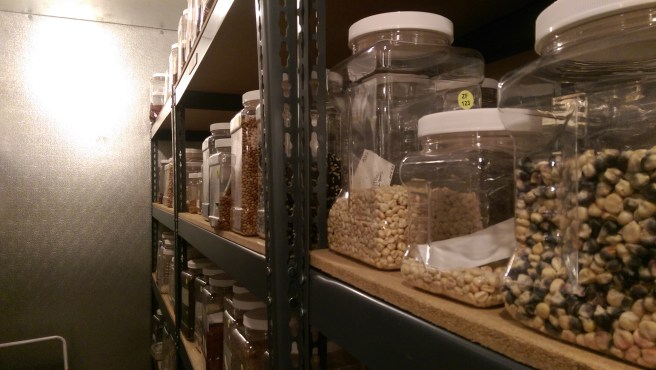
The final day of our trip and perhaps the hardest. I ran four fast miles along the road, pushing myself on the hills. My knee felt better than it had. We first drove to Native Seeds, an organization that seeks to preserve ancient seeds used by Native American tribes around Arizona so they can continue to grow the food so important to their history. A gorgeous sunflower greeted us. We met Stephanie, a young AmeriCorps Volunteer, who gave us a short tour of the site and the seed refrigerator. We were ready to step back into the heat after chilling in their for a bit. Stephanie talked to us passionately about her interests as an anthrobotanist, or studying the effects of plants and seeds on culture and human interaction. She was concerned that the organization sells the seeds they grow, because people from anywhere can buy them and try to grow them. This doesn’t work so well when a New Yorker tries to plant a desert flower. We learned a bit about grains and grinding seeds, and as we left decided to make an impromptu stop at Fort Lowell Cemetery. The cemetery itself is home to several members of the area, whose families have lived there for generations. Several veterans were buried there. In the neighboring building the remains of unidentified bodies found in the desert are interred. It was a beautiful, humble site.

20160523_093529

IMAG0801

We drove to the best Mexican restaurant in Tucson, El Charro, and sat at a patio table. I ordered my absolute favorite, horchata and chile relleno with chicken and Raza sauce. Yum. We ate plentifully and even our vegan contingent was excited to have some menu options. El Charro is the oldest family owned restaurant in the United States, so we had a good time exploring the property and old photos. From there, we walked to the US courthouse to witness Operation Streamline.

File_000

Operation Streamline is a business law (yes, business) that streamlines the process of criminalizing illegal entry into the United States (without proper documents). The convicts are given a choice: go to trial (and most certainly lose, making their crime a felony) or plead guilty, receive a misdemeanor, serve between 30-120 days in a detention center and get deported. The courtroom was beautiful, and enormous. A male judge sat overlooking several rows of convicts- all young men, handcuffed, scooted together on dark wood benches. Seven men stood close together at the front, where microphones waited for them. An attorney represented about seven men at once. Before a new set of men came up to the microphones, the judge would repeat information. “You are here for the crime of entering the United States illegally. If you choose to plead not guilty, you will go to trial and face a jury. If you waive your right to a trial, you also give up or waive some other rights.” A translator spoke in Spanish into headphones that each man wore. Each man answered four questions:

“Are you of sound mind to make a decision?”

“Is it true you are not a citizen or US national?”

“Is it true you attempted to enter this country under illegal pretenses?”

“Do you plead guilty or not guilty?”

And every man answered like this: “Si…si…si………..culpable.” Guilty.

We watched for a while as line after line of young men were led back to their cells. The judge always ended with “thank you gentlemen, and good luck.” A coffee vat sat on a table in the courtroom with white paper cups. I wondered who that was for.

We left the courtroom in silence and meandered back to our cars. We returned to Sonoran Delights and tried to pick up our spirits. This time I ordered raspados con nieve: like a snow cone with strawberry syrup and ice cream. It was just as delicious as the first time. I continued to process Operation Streamline in my mind- while watching the courtroom, it’s almost difficult to feel emotional because the process is so.. Mathematical. As I reflected on the rows and rows of young men in handcuffs, I wondered why they had come, how they had come, and if they would come again.

IMG_1676

At home, we napped and many of us journaled in quiet. For our final reflection, two students prepared a beautiful affirmations table on which each of us had a namecard next to a glass. We each wrote notes to each other, describing what we love about one another. Then we shared our favorite meals, our biggest challenges, and who we would like to connect with more on campus. It was a lovely end to a most meaningful journey together.

Tuesday, May 24th

The plane shook as we ascended into the desert heat. I watched the sand spread across the ground and gazed at the plateau formations. The desert slowly changed to ocean, and we turned to land at LAX. A tear escaped my face as the coliseum and 110 freeway came into view. Home.

Bajo La Misma Luna: My Trip to Tucson, Arizona Part 5

Sunday, May 22nd

13315256_10154229668776255_5440494048287964296_n

And an early morning it was! At 8:30 am, we arrived at Casa Maria, a house out of the Catholic Worker Movement that serves several hundreds of homeless folk meals each day. The leader Brian “greeted” us with a huff, and we were promptly set to work bagging sandwiches, cookies and eggs. The Spanish speakers in our group worked at the front serving soup, and I and one other student bagged muffins and cookies. He taught me a neat way to tie a plastic bag- flip it over twice and then tie it! One of the workers shared her story in Spanish and a student translated. She talked about coming to the United States and working so hard to provide for her daughters, even quitting her first job because the hours didn’t allow her to spend time with them. One of our students, the daughter of immigrants from Pakistan, shared that evening that she hugged Laura as we were leaving. She told Laura that she felt bad that her parents had worked so hard and sometimes she didn’t treat them the best. “They know”, Laura said. “They know”.

IMAG0794

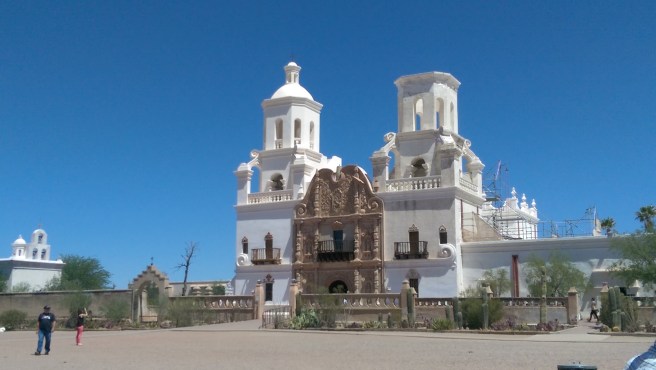
We drove a little south to the San Xavier Indian Reservation to attend Catholic mass at the San Xavier Mission Del Bac. Instantly I felt warmed- in the parking lot, several folks had set up stands selling fry bread with green chile, cheese and beans, or powdered sugar. I shared one with Karin and devoured it pretty quickly. The mass was packed full of people, so much that we had to stand. I loved the guitars that guided the hymns and that at the end, the priest thanked us for coming. It was lovely to see a community of faith so strong and a highlight of the week for me.

IMG_1652

It was time to have some leisure, so we drove to 4th avenue and sent everyone off on their own to find lunch. Karin and two other students and I ate at a burger joint, where I had a spicy spicy burger with habanero and jalapeño. It was life giving. Next we wandered to the Chocolate Iguana where we bought coffee and chocolates and one student bought a mile-long eclair. It was a cute store that would make us laugh later on, trying to say “at the chocolate iguana” without giggling. In a local artist shop, I bought a blue pig and a small cactus plant. We were all quite tired from the early morning, so we headed back to Alma Del Sol and napped for a bit. I put the lasagna in the oven and read Luis Urrea’s The Devil’s Highway, a true story about 25 men that either died or were found in critical condition in the Sonoran desert 15 years ago. The book details accounts of the coyote, Mendez, who led the group across the border but somehow found himself unable to navigate as usual. Eerily, the anniversary of the border patrol finding he bodies in the desert was this day, May 22nd.

IMAG0799

Everyone enjoyed my lasagna (thank goodness) and two students led us in a very fun and meaningful hot tub reflection on the importance of water. Four students revealed a secret synchronized Bhangra and Irish Step Dance they had choreographed and we had a big laugh. Some of us took a short moonlight walk around Alma Del Sol, and then we headed to bed for our final full day in Tucson.

Bajo La Misma Luna: My Trip to Tucson, Arizona Part 4

Saturday, May 21st

SONY DSC
SONY DSC

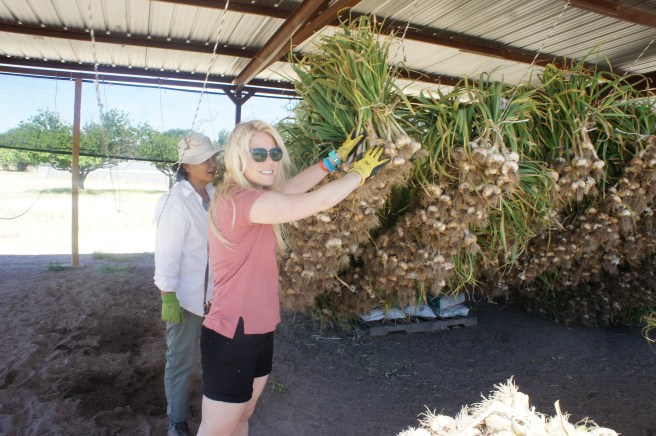
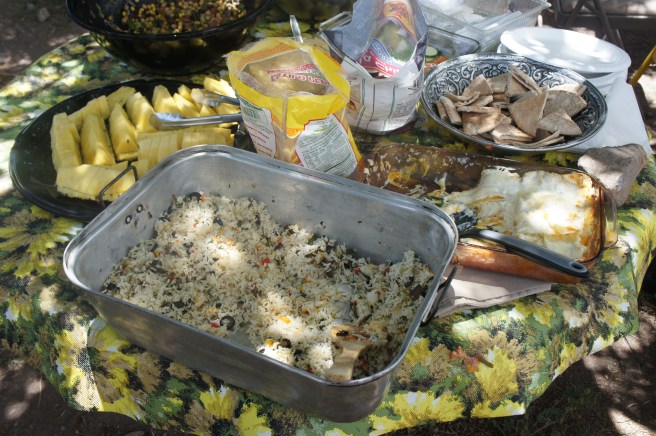
Ah, the weekend. But no rest for the weary… Or our group, in this case. We got ready early with our working clothes and sunscreen and drove south through Green Valley to Arivaca Road, where we drive twelve miles down to take another dirt road for Forever Yong farm. About halfway down Arivaca Road, a border checkpoint appeared and we stopped briefly. At Forever Yong, Yong and John put us to work on the farm. They were harvesting garlic, and some of us went out into the field while others waited by a set of tables to tie the garlic in bunches and hang it over ropes so it could be sold. We got nice and dirty and all smelled deliciously of garlic. After working for about two hours, we sat down near the farmhouse for a delicious, like WHAT in the world, almost totally vegan meal. Corn and black bean salad, rice pilaf, and the most intensely tasty butternut squash lasagna. The fresh iced tea was nice on our throats.

SONY DSC
SONY DSC

After lunch, John and a neighbor farmer sat down with us to talk about their experience with the border patrol. They described their area as a “constitution free zone”, one in which the border patrol roams free and searches their property without warrants. One of the most frustrating things for John was the BP’s neglect in trying to form relationships with the farmers, so they might understand the issue better. “It’s a hassle to even go to the grocery store with that checkpoint there,” John said. “We’ve protested it for months.” John also told us that while they still see migrants cross their farms, the numbers have decreased quite a bit. This is due to a few reasons, namely, that the Mexican economy is actually growing, and the real estate crisis of 2008 in the United States really effected migrants’ abilities to find work here, so there is less crossing. John firmly believes migrants are not dangerous, and mentioned only one farmer had been shot, but that he had gone hunting for cartel members. We thanked our hosts, dusted ourselves off, and began the rest of the journey down to the border at Nogales.

SONY DSC
SONY DSC

Nogales is a port city, and every day thousands of cars and pedestrians cross the border. Tourists cross into Nogales, Mexico to find cheap souvenirs, and workers with “green cards” drive sometimes several hours every morning to enter the US. The freeway ended, and we curved to the east where we parked next to a lot for customs workers. As we drove down the freeway, we could see the fence. It ran through hillsides, and we could see colorful houses on the Mexican side perched on the hill tops. One student sighed and said, “look at that big beautiful Mexican flag, waving slowly. It’s as if it is saying hello, beckoning to us.”

13312603_10154229670291255_3538767039934692134_n

IMAG0762

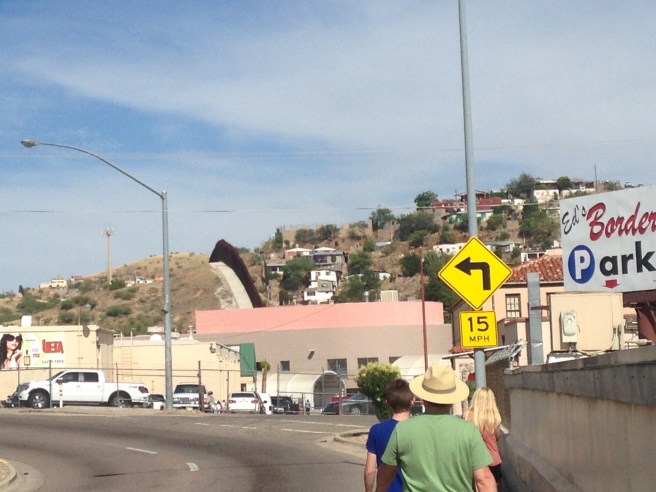
We parked and the giant steel fence stared us down. The fence is quite porous, though- a small child could fit through the bars. On the other side, buses line up to take people to other parts in Sonora, and shops advertised check advances and medical supplies. A family met on both sides of the border. They laughed and cried and we learned that the grandmother on the Mexican side hadn’t seen her grandchildren on the US side in 16 years. Up the hill to our right, a border patrol truck rested beneath a watchtower. A police man spoke to some of the students, revealing a tunnel from a house on the Mexican side to a house on the US side had been busted just last week.

IMG_1630

We decided to walk to the crossing, and I went ahead. Ed’s Border Parking Lot sprawled to my right. Tears rushed down my face as my flip flops slid along the pavement. The wall, though domineering and darkly regal, was just a wall. And yet, it separates an entire lifestyle and set of opportunities. I thought about my friends, undocumented in this country, who could very well be reaching their hands through to touch mine. This will never be my story. I can’t pretend to understand or be in solidarity, so I hope to hold the image of the wall in my mind as a reminder of my privilege and my own narrative. But there’s opportunity to build community. Some kids play volleyball using the fence as the net. In El Paso, a joint Catholic mass happens on both sides every Sunday. The fence may be made of steel, but the border won’t stop innovation. I wrote this in the car:

The exit numbers keep decreasing. The temperature marker in our car increases. I feel butterflies. International border signs flash. No weapons allowed in Mexico, some say. I feel familiar tears.

When we park at the border I smirk at the parking lot name. Ed’s Border Lot. It’s funny how the exclusion of a border creates opportunity, capitalistic. I’m feeling sad. I can see Nogales through the fence, through the slits. Children small enough could fit through. I see a border patrol truck parked up the hill by the watch tower. It’s hot. We walk slowly up the hill. I watch a family greet each other through the fence and then a girlfriend and boyfriend. I see signs in Spanish across the fence, banks, markets, shuttles. The line of cars to cross looks congested and slow.

I feel as though I bought a movie ticket and created a display in my mind. It’s a guilty feeling. The power in human connection should not be exoticized but should be acknowledged. The border is not my territory, it’s my privilege to walk free without anyone questioning me. The migrants are invisible and hope to stay that way. They don’t want any trouble, but the migra do. They zoom around, all over the farms, acting like they’ll protect us from the big bad wolf. More like those who cried wolf. The checkpoint patrol agent gives us a light talking to, reminding us to carry identification. Freedom?

I think about putting my hand through the border fence and quickly negate the idea. Fences, fences, fences. Cars. Barbed wire. The colorful houses look over the fence that sit on the hills of Nogales. The fence cannot hide the view.

IMAG0769

So many complications- such a Buddhist moment. One ripple causes several. A solution causes other issues, we have no answers though we think we might.
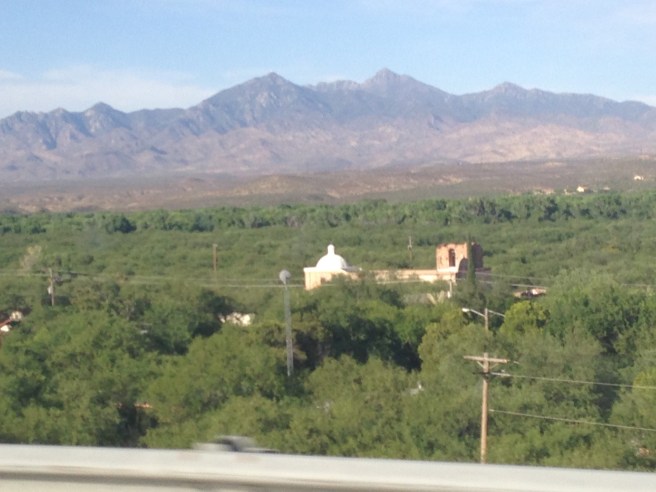
We stopped briefly at Tumacacori Mission before returning home. A beautiful church and historic site, Jesuits had used it to build up the Catholic community in the area. Warring tribes strained this though, and we learned that the whole property was abandoned for about 65 years. I felt distracted walking around. Across the street, I bought a delicious guacamole and carne asada mix at the Santa Cruz Chile Company. We drove home and Karin cooked us a fantastic specialty of hers, what she calls “feisty chicken”. After dinner we enjoyed a bonfire night, roasted jumbo marshmallows, and got to know each other through some quirky ice breakers.

Bajo La Misma Luna: My Trip to Tucson, Arizona Part 3

Friday, May 20th

It was a still morning, even warmer than the day before. I ran by two coyotes crossing the street. As I sat on the deck eating breakfast, I listened to the different bird songs and felt my grandmother with me. She had a big bay window in the kitchen that we used to watch all the birds through. Every morning she would fill the bird feeders and as the birds came to eat, she would tell us about the different birds. I remember the bushes so tight together just beyond the bird feeders, my cousins and I would clamber through them on our adventures. We would build forts around her house, using the trees and rocks and boundaries. Once she woke us all up early and told us a pirate had hidden treasure nearby and left us a map. We set out on an all day adventure, following the clues. The pirate had been running from some rival pirates and hidden the treasure in a place they would never find. My grandmother had always wanted to be an archaeologist, so I believed her. When we finally dug up the chest, buried at least a foot underground underneath her deck, we donned our plastic gold necklaces and eye patches and yelled “arrrrr!” One of the aunts filmed us. It was only several years later when I hid behind a chair my grandmother sat in to talk on the phone with someone that I heard the truth, she had planned the whole thing.

Half of our group ventured to Casa Maria this Friday morning, while the rest of us stayed behind to journal and leave for Jumah prayers at the Islamic Center of Tucson. Karin and I searched for parking and smirked- the Islamic Society of Boston Cultural Center had similar issues. We eventually parked and though we made it to the prayer almost on time, we soon went in search of some new sandals for Karin (no broken sandals in Tucson!). Finally we witnessed the last part of the prayer and met the rest of our group for a discussion with some of the Center’s leaders.

The first thing I learned was that at least two of the leaders were converts to Islam. Many of us commented on how diverse and organized the Center seemed. They noted that the Center served over 5000 people and hosted a variety of classes, activities and gatherings for children and adults. One particular issue we learned about was the high rise apartment building next door. Tenants throw glass bottles toward the Center and a few times, these bottles have almost hit people. Once, a bottle landed less than a foot from a child’s head.

This discussion arose out of a broader thematic question for our group: why does it seem that mainly Christian organizations engage in border justice activities, like water bottle drops? One of our hosts answered that in the first place, combating Islamophobia tends to be the main focus in Islamic Centers. This Center had tried to work with a church to do water bottle drops, but faced intense legal trouble for it. The church they worked with simply received a warning. The idea of “justice” alone is distinct for different faith communities- this also means that responses to injustices will be different. What I see is a type of privilege in this instance- an ability for one faith institution to engage in justice activities that may push legal limits while another is strictly prohibited. Perhaps this is an example of how privilege can be utilized to do good. Would we rather no one drop water bottles?

After our hosts provided us a fantastic and gracious lunch, we returned to the minivans to drive 90 miles to the Tohono O’odham Cultural Center on the Reservation. The reservation sprawls over the southwest of Arizona and continues across the border- and of course, this land belonged to the O’odham long before there was any border. The moment we entered the Reservation, our cell phone service plummeted. All around us was green- treetops, the distant mountain ranges, and crops. We passed a border checkpoint and continued on toward Sells, where we would turn off. Along the way, we noticed a slow procession of cars to our right. A ranger vehicle led, followed by a white pickup with a tall white cross along the back window and a coffin in the bed, and finally another ranger SUV. It seemed as though we drove for hours. After passing through Sells, we turned left onto a tiny dirt road where we followed the directions from the Cultural Center’s representative: head south and the road will curve east, go past a white landmark on your right, and turn on to Rt. 19. Follow the road 12 miles and when you see the water tower on your left, make a left. Miraculously, we made it to the Cultural Center and yet again, our hosts were so gracious to keep the Center open for us past closing time. Jeannette led us through the museum and outside, where we learned about some historic architectural buildings made from cacti ribs. One of us asked why the migra were crawling around the Reservation. “The cartels are big through here”, she said. “You don’t see it through the bushes and trees, but they’re there, and at night, they’re very active.” Some of our group shuddered. We learned further that the Tohono O’odham have experienced much trouble with the border patrol searching their homes and stifling their cultural gatherings. What’s more, the US Mexico border runs right through the Reservation, causing issues within the community as some members are documented US Citizens and some are not, and the divide between those with documents and those without has put great strain on their ability to preserve cultural competency. Jeannette also talked about the hierarchy of family lines within the O’odham. She said, “you see all these plaques with young people who have represented the tribe in DC and other places? They’re always the same kids, same families. Many of the young people would never dream of getting to do these things.”

IMG_1595

On our way back after taking two hours of Jeanette’s time, we began our drive back to Tucson. I wrote this in the car:

We start our drive on a familiar road, Old Ajo Way. It runs all the way through Tucson to the border with the Tohono O’odham nation. As we inch closer the road becomes less populated with gas stations and stores. At one point, I wonder what would happen to us if we got a flat tire. We see a funeral procession crawling on the right shoulder, a small wooden white cross in a pickup truck surrounded by Rangers. All along the road, the Border Patrol zoom past us in white SUVs with green stripes. La Migra. I look to my left at the vast cacti and creosote and notice dust kicked up in the distance. Mountains surround us at various distances. We are quiet, nervous- I hope I can follow the cryptic directions the man on the phone told me. We finally turn left off the highway and see a town. Small haphazard houses sit along the road. We pass a modest mall, a high school, and a district office, all mixed with more nothing. We see a cow and feel lifted. We see the water tower, our land marker- we turn left. Our car shuffles along the dirt road and we arrive at our destination, the cultural center and museum. I’m amazed that we made it, and grateful. On the way back we stop at the border checkpoint and the migra jokes with us. I feel like an invader, a mindless soldier behind the general. We have so many questions. How do the natives feel about the migrants? How dangerous is it- really? Why isn’t their more violence between the migrants and the natives? I can’t answer these questions. I know I’m feeling uneasy. I wonder if this will ever change. The desert is a blessing and a curse depending on who you are and where you are going, or not going. I feel love for the students in the car as I feel their emotions rise. We pass dollar general. We are back in Tucson, no passport necessary. 

After reaching Tucson we drove into town and picked up Ethiopian lentils and stew at Cafe Desta for dinner. Two students led us in a reflection on the last three days, and we slept.

Bajo La Misma Luna: My Trip to Tucson, Arizona Part 2

Thursday, May 19th


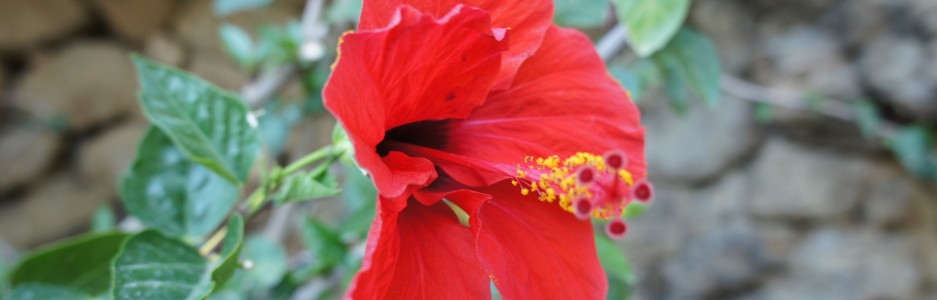
Cactus flowers

This morning, I woke up even earlier at 5:30 am because the sun lit up our room. I ran again, and two students joined me. It was really nice to have company, even if the temperature was significantly higher. While we trotted uphill, we waved to a man that looked half-Jack Sparrow and half-Indiana Jones. I saw him every day.

After a leisurely breakfast on our deck at Alma del Sol, we set off to visit the Tucson Indian Center. Though we didn’t have an appointment, the very generous Director of Programs gave us a thorough tour- so thorough that we had to rush over to the University of Arizona for our next meeting (“Travel is blessed”, Karin reminded me- we should always hold those whom we meet in our travels with highest respect). The TIC gave us all a significant amount of hope, especially given the brief history we received of the Center and the immense struggles their clients have endured. The TIC is over 50 years old, and many of the employees have worked their for more than ten years. Each day, they receive clients who wish to utilize wellness services or employment services (and many times both). Wellness services include health care referrals, meditation and exercise, diabetes courses, and a program similar to AA with specific cultural attention to the local tribes’ cultures. In every program, this attention is present. After greeting several employees and taking a hasty photo in the Center, we bid our new friends farewell and sped to the U of A.

At the University, we were greeted by a shy PhD student who led us down into a basement quarter with no windows. The space is home to BORDERS, a department devoted to the study and technology of national security and protection. We listened to the student describe a kiosk that they are developing for ports of entry to increase efficiency of immigration procedures. Then we got to see the kiosk in action, when one of our graduate student leaders asked if he could try it out. We all had a laugh when the kiosk avatar, named “Brad”, told the student leader that from his answers Brad “sensed deception”. “I’m sorry Brad”, he replied. This visit was quite important for our group- though we questioned the intricacies of the technology and its purpose, one student put it well when he said, “we should try to understand this…it’s the way of the future.” I had mixed feelings about the department. The technology is quite advanced, and could be utilized in other fields like healthcare. I couldn’t help but wonder if we will ever get to a point where no human interaction is necessary to cross a border (or be denied entry). And moreover- do we want that?


A local artist’s work in the Tucson Tamale Company

Karin and I stole away for a few minutes before the rest of our group finished asking questions, and bought delicious tamales for everyone to eat for lunch. Most students had never tried them- soft cornmeal cakes with cheese, meat, or vegetables on the inside. The whole cake is steamed in a corn husk (and in banana leaves or other vehicles in different countries). I devoured a green corn cheese tamal and a spicy chicken. After a lunch much awaited, we walked just down the street to a much different department on campus, the Binational Migration Institute, housed in the Mexican American Studies office. Though our appointment did not pan out, we poured over the research projects represented by detailed posters along the hallway. The Institute promotes research on abnormal migrants and their experience both during migration and after arrival. They recently released a study around unidentified bodies found in the desert, and unfortunately, the number has increased recently. I felt really drawn to the work of the Institute, perhaps because there is nothing more endearing in my mind than an individual or group crossing the Sonoran desert. I understand the complications around immigration processes and the law…yet realize that death is a very real fate for many who attempt the crossing. 

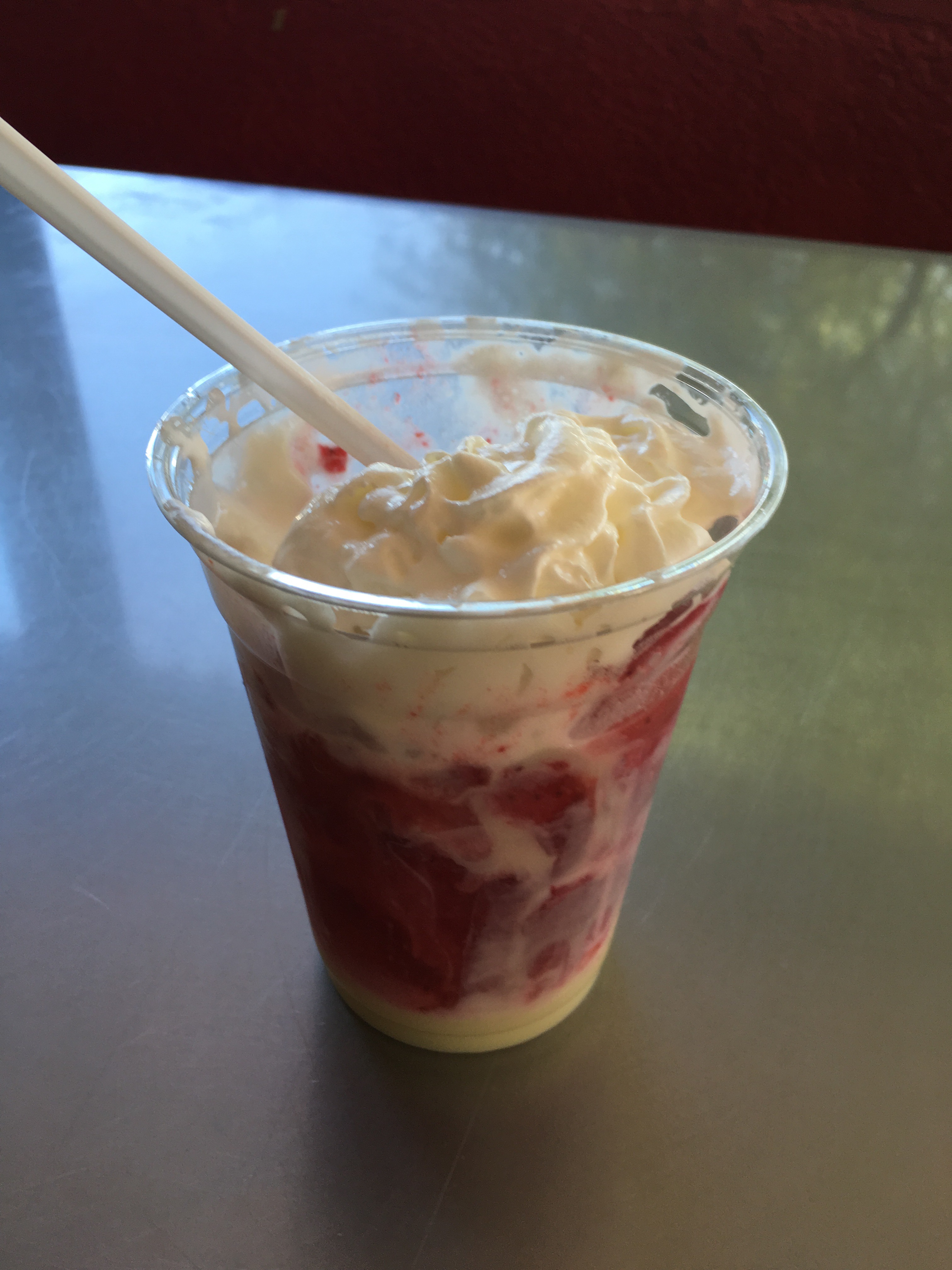
Since we had some time, we ventured to find raspados, or Mexican ice desserts. Most of our group ordered a “Macedonia”: fresh cut fruit with ice cream and condensed milk, or lechera. I ordered a big cup of fresas con crema, or strawberries and cream. It was a delightful midday break.


Our bellies full, we drove south of Tucson to Clinica Amistad, a free clinic that Father Ricardo, a Catholic priest engaged in border justice work, began a few years ago. The clinic is run entirely by volunteers, and sees between 30-70 patients in an evening. Clinica Amistad operates Wednesday and Thursday evenings and now Saturday mornings, and they hope to receive some grants that will quadruple their capacity. This clinic is so important, not only to the patients that are served here, but to the entire health care infrastructure. One of Clinica Amistad’s Board members explained to us that many “middle class” patients are now virtually uninsured- though they have insurance, they could never pay their high deductible. This is an increasing issue in the US. After we learned the history of the Clinic, which moved locations about a year ago, the clinic manager shared with us about growing up on the border. We again left in a hurry and I wished we could stay longer. In just two days, we had been blessed to meet several folks enthusiastic to share with us, even though we arrived unannounced. I loved one student’s observation of a house across the busy street- a dilapidated gate, vintage pickup truck with chipped paint, and the mountains singing blue in the background. “They are happy with this”, she said. 


Senor Papa

Our last stop for the evening was at El Tiradito Shrine in the oldest part of Tucson, Barrio Viejo. We met yet another enthusiastic new friend who runs a nonprofit next to the Shrine called Spoken Futures. Their mission is to give space to young people who have ideas and passions and channel them through poetry and spoken word. The director noted, “I think it’s silly to say that we encourage young people to have a voice. They already have a voice. We need to get people to listen.”After an improptu tour, we spent some time praying at the Shrine and waited for the vigil to start. The vigil happens every Thursday evening and is dedicated to the migrants and the lives lost. Members of Derechos Humanos and No More Deaths were in attendance. The vigil was led by a very nice priest named Father John, and we introduced ourselves. At dinner I shared the legend of El Tiradito with the group- a sad tale about a man named Juan who falls in love with his mother in law and in turn, his wife murders him. There are several versions of the story. El Tiradito is a cultural icon in Tucson, and full of wishes and dreams, some fulfilled, some still in waiting.

As I lay in bed, I reflected on how much the sounds and smells of Alma del Sol reminded me of my grandmother’s lake house. If only she were there to educate us on the different bird songs.

Bajo La Misma Luna: My Trip to Tucson, Arizona Part 1

Bajo La Misma Luna: Tuesday and Wednesday, May 17-18

Over the next few days, I will post about my recent trip to Tucson, Arizona. Along with the two other CSDS staff and eight student leaders, I spent seven days studying border justice, interfaith leadership, Native American history, and desert spirituality. This pilgrimage was offered by the Global Citizenship Project in the Center for Spirituality, Dialogue and Service at Northeastern University.

My alarm barked at me at 4 am on Tuesday. Dammit, it’s so early. I zombie walked into the shower and quickly got ready. My green smoothie froze my throat as I gulped it down. Ten of us met at the airport and anxiously awaited our flight to Minneapolis, where we would connect to Phoenix. The landing in Phoenix was terrifying- the high heat caused rollercoaster drops and jerks. After gathering our bags and waiting for the final two students to join us, we were on our way to rent our Kia Sedona minivans. Finally, we headed to our first meeting with the Arizona Interfaith Movement (AIM).

The AIM spoke to us about their work with congregations around Arizona, and their focus on the Golden Rule as a way to find common ground. They asserted that while not political, many of the participants in the work cared deeply about many social justice issues. “We are the most diverse interfaith organization in Arizona”, the Executive Director shared. I wondered what exactly that meant. Among the three full-time staff members we met, some students at Arizona State University shared the work of their interfaith group called Sun DABT, or Sun Devils Are Better Together. Their leader used much of the language familiar to the Interfaith Youth Core around shared values and social justice. As we left, AIM showered us with gifts: an interfaith calendar, an AIM pin, a license plate sticker with the Golden Rule, and several pamphlets. We were uplifted by our new friends and excited to learn about another campus’ interfaith work.


On the road to Tucson

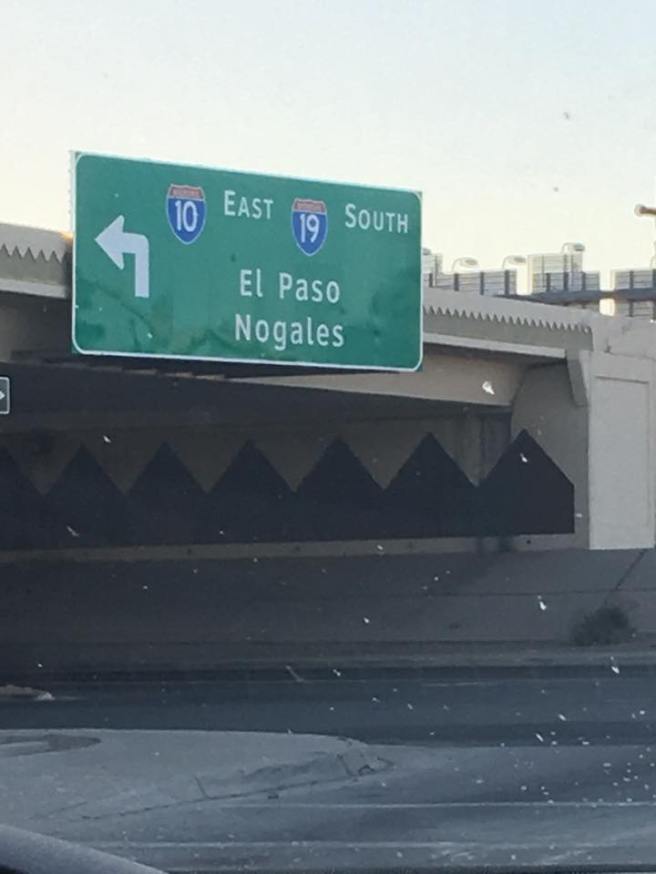
We ate our first meal together at the Original Burrito Company, where we devoured burritos and carne asada plates. I sighed. Finally, decent Mexican food. After finishing our dinner and feeling rushed by an oncoming dust storm, the twin minivans headed out of Phoenix toward Tucson, where our Air BnB awaited us. We drove 80 miles on the 10 E before exiting the freeway, and I suddenly felt closer to home: the 10 connects directly to Los Angeles. We drove another 20 miles into the dark desert, finally curving onto a dirt road where a beautiful solar house called Alma Del Sol welcomed us. The owner of the house lived next door and showed us to our rooms. Karin and I settled on one of the downstairs rooms, where I gladly chose a futon with a southwest-style blanket.

Though we all felt exhausted, Karin, three students and I jumped back in the minivan to pick up our groceries. We had decided to cook our own breakfasts and three meals throughout the trip, creating a deeper sense of community (and saving some money). Our drive to the store was perhaps the hardest I have laughed all year- two Indian students and a Pakistani-American student, along with Karin and me, discussed everything from the disgrace of processed salami to BHANGRA!!!!!!!!!!! We loaded our trunk with cereal and ingredients to make butter chicken, and finally headed home. I fell asleep in less than two minutes.


Familiar agreements (for Sunday School)

On Wednesday morning, I awoke at 5:30 am due to sunrise and jetlag. I pulled my spandex on to attempt my first run in the desert. What a thrill. The dry, warm air hit my face as I stared down the road. Cacti for miles. The view was priceless. I felt right at home, my shoes crunching in the dirt.Our first stop after enjoying breakfast leisurely was to Southside Presbyterian Church’s Day Labor Registry. Driving by the church, several men across the street jumped up and waved, hoping we were hiring cheap labor. We circled the church and entered the parking lot. Though we didn’t have an appointment, the coordinator of the Day Labor Registry, Eliezar, eagerly showed us inside and seated us. We spent almost two hours speaking with Eliezar as he shared his story of being undocumented and struggling to find work. Now that he is documented, he coordinates the Registry several days a week. Eliezar explained the rules of the Registry (he showed us how the lottery works, as well as the agreements that include not drinking or using illegal substances, not accepting less than the minimum wage, and completing a training course). He told us that often, undocumented people are caught by means of simple traffic violations or noise complaints. “I was at a party and we were drinking, but we were inside the apartment complex. Someone called the police, and they demanded ID from everyone. I didn’t have mine with me, and they threatened to call the Border Patrol.” It’s not uncommon for the BP to accept bribes from undocumented people. As we thanked Eliezar on our way to lunch, he educated us: “People call me illegal”, he said, “but I am not illegal. A person cannot be illegal. If someone runs a red light in their car, are they illegal?”

The view of our backyard at sunrise

From Southside Presbyterian, we made our way to downtown Tucson for lunch at Nook, where we enjoyed yummy but modestly priced fare. I devoured a vegetarian tamale pie with green chile sauce and a chai latte.


Decor and tamale pie at Nook

After our lunch, we headed back to Southside Presbyterian to meet with Reverend John Fife, one of the founders of the Sanctuary Movement, and Amy Beth, the Director of Ministry. John shared his story of starting the Movement with the legendary Jim Corbett, and Amy Beth told us about the work of Southside now, in a revived Sanctuary Movement. She shared some of the recent sanctuary seekers, including Rosa, who was able to stay in the United States to care for her children. After taking a moment of silence at Southside’s dedicated sculpture to the unidentified bodies found in the desert, we headed home to Alma Del Sol for a workshop on storytelling for social change, led by one of our graduate students. We spent two hours listening to the stories of our peers and coaching them to be persuasive and relatable. The workshop not only made us effective storytellers, it also served as a great way to be vulnerable with each other and thus to start building deep relationships.


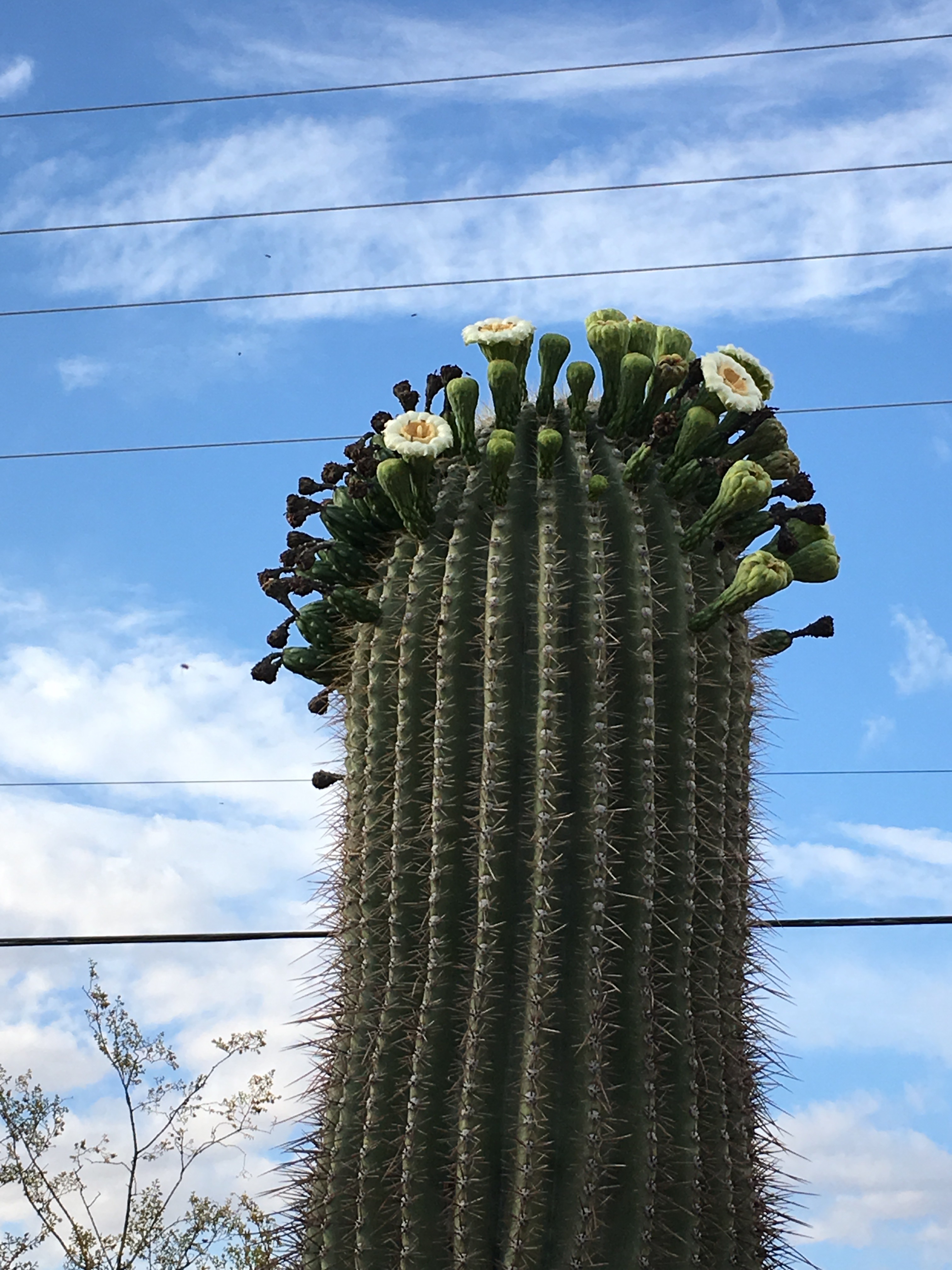
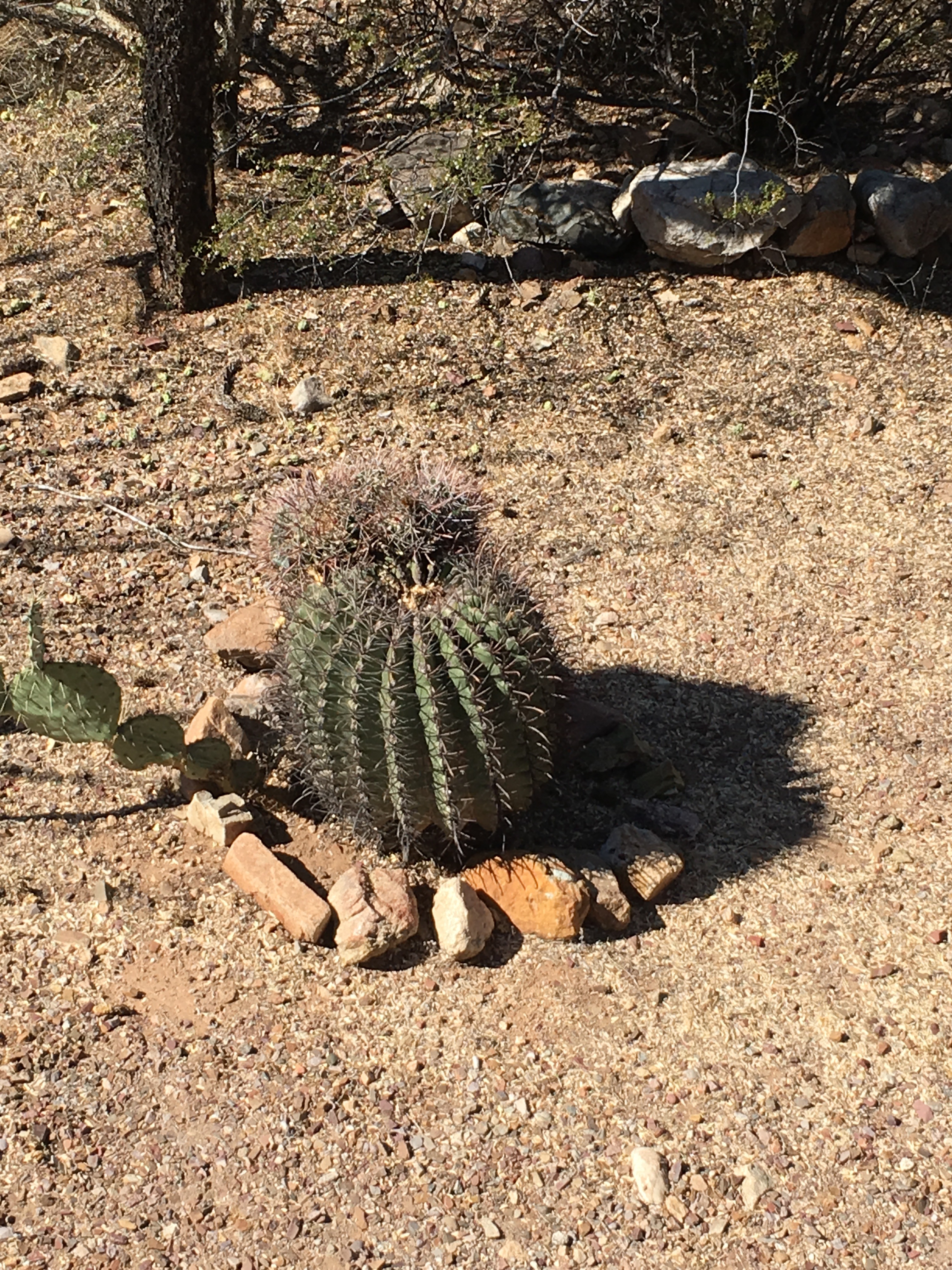
Cactus at Alma Del Sol

One of the Indian students made us a delicious dinner of butter chicken and gobi (cauliflower) and as soon as we gobbled it up, I fell asleep, ready to run again in the morning.