On Self-Diminshment and Owning Decisions

On Thursday morning, I read two lines from Parker Palmer’s The Courage to Teach and burst into tears: “No punishment anyone lays on you could possibly be worse than the punishment you lay on yourself by conspiring in your own diminishment.” (Palmer, 178) The context of this text was describing Rosa Parks’ courageous decision to sit in the front of the bus. She was willing to take the criticism and even physical arrest before playing a role in her own oppression. Wow.

The reason I burst into tears is because, honestly, this week has been tough. Several instances with students and staff challenged me in how I see myself as a leader. Without breaking anonymity, I will describe the greatest challenge and what I (think I) learned.

I remember the ministry class on leadership in divinity school. It is strange to study leadership from books, yet necessary, as I found this week. In our course, we diagnosed ourselves as leaders- what skills were particular to our leader personality? We analyzed an organization and how the leaders succeeded, or didn’t, in running the organization. Along the way we read different wisdom on leadership. We read Leadership on the Line, a book by Ronald Heifitz and Marty Linsky, two professors at the Harvard Kennedy School of Government. The thing I remember most from this book is that when leaders make decisions that involve change, especially change that undoes roles of individuals, people get upset. Some people may go so far as to leave the community. It sounded simple, but its real.

This week I had the difficult task, along with my two colleagues, of deciding who among the 19 excellent applicants would come on our pilgrimage to the US desert southwest. I knew this would be challenging for a few reasons. First, I experienced a blatant “who the heck am I” syndrome to be a decider of this fate. Second, many of these applicants are wonderful students that I know. And finally, I knew this would be deeply challenging because the issues around border justice and the interfaith action around this plague me and inspire me. In my humble opinion, the more passionate young people working together on border justice, across religious and spiritual lines, the better. It feels terrible to that people might believe, through my actions, they are not worthy to learn or serve- because they certainly are.

My colleagues and I made our decisions. We spent hours reading, discussing, arguing, and scratching our chins. Finally, we sent out the emails. I have been on the receiving end of countless acceptance and rejection emails. The acceptances make me giddy. I’ll admit, even the smallest workshop proposal acceptance makes me feel like I have accomplished something. Rejection is never easy. The process stinks. In my experience, I read the first line, close the email, and tell myself I didn’t care that much. I quickly negate that. I wonder what I could have done better. I wonder if it could be a mistake. I wonder if I should apply again next year, or find something else. I write in my journal. I call my mom. There is no rejection email, however emphatic of how excellent the candidate pool was, that can assuage one’s pain. At least, not to me. The worst kind of rejection is one that makes me believe my role in the community has changed, or has become less important. It is as if someone is saying “you really are not as meaningful to this community as you think”, even though this might be completely unfounded.

I know some of the students we love felt angry, upset, or dumbfounded. Frankly, their feelings are legitimate. I suppressed my urge to email them, text them, or call them and say “I am so sorry…I love you, you are amazing, you are essential!” because, unfortunately, real leadership demands that we stand by our decisions. In higher education, we talk often about not speaking for anyone but ourselves. Sometimes, however, leadership demands that we take a stand on behalf of others.

Making decisions is core to the human condition. As a Buddhist, I know this- change happens all the time because of decisions we or someone beside us make. Change drives suffering. Leaders are people with whom we trust to make decisions. When I took my current position, I deemed myself a leader of a community, and thus, someone who would make educated, fair, and informed decisions. Heifitz and Linsky were right- decisions that involve change make some people upset because they uproot the roles in which we have planted ourselves. This happens with rules and expectations as well- when rules change, we feel like our privileges are being taken away. I do not use the word privilege as a bad thing- I enjoy countless privileges that while I believe I have worked for, would be pretty upset if they were taken from me. This week I made a decision, with my team, that congratulated some and excluded others. People felt upset and angry because they felt as if their wonderful contributions to the community did not matter. And the hardest part of this is knowing I caused harm, whether I could avoid it or not.

Back to Parker Palmer and The Courage to Teach. The reason this quote made me burst into tears is because I have had to question my own understanding of myself as a leader this week. For a few days, I told myself “the reason students are upset is because they do not see me as a leader, and I am a bad leader.” Yet, this was not necessarily true- and irrelevant, to be honest. The crucial point is that I was not sure I saw myself as a leader. When we lead, we make crucial decisions that influence our communities. The real test of whether we are a leader or not is not the decision we made. The test is how we own the decision. How we carry on after we make a decision and continue to affirm every member of our community as essential reflects how just and informed we are. My leadership was tested this week, and initially, I failed. I let others’ pain diminish my view of myself. I am working to own my decisions this week, however big or small. Most importantly, I will work to affirm those who see themselves as diminished, because Parker Palmer is right- the worst pain is that which makes us feel as though we are less than we thought.
 

Religious Literacy: It’s Personal

“Dad,” I stuttered nervously. “I think I’m Buddhist.” My father looked confused. “What kind of Christianity is that?” he responded.

It was not easy to explain to my devout Catholic father why I felt drawn to another faith at the age of 16. I wasn’t hurt by the church, or bored at mass, or even trying to rebel…I simply found a practice and philosophy that made sense to me in a confusing, ever-changing world. Spending my junior year of high school studying in Tokyo, Japan, I delved into the study of Buddhist philosophy and the practice of compassion after a spiritual encounter at a Buddhist Temple. When I returned from Japan, the Four Noble Truths and the Noble Eightfold Path became central to my high school life, and still, they guide me in the work I do as higher education professional.

The good news about my father is that through our discussions and his willingness to learn, he has grown to embrace my faith and recognizes how essential my practice is to my work and success. He even organized an interfaith leadership conference for high school students, which warmed my heart. I feel lucky to have an open-minded father, and through my experience with him, I know that religious literacy is essential for both our society to flourish as a whole, and for individuals to feel welcome and included, that their identity matters. My dad showed me that I mattered to him by committing to learn about my faith and how the core elements of Buddhism guide me in my work and relationships.

Last week, Northeastern University students were on Spring Break, and many students traveled on Alternative Spring Break trips around the country and the world to learn, serve, and get away from homework. As the Director of the Global Citizenship Project, housed in Northeastern’s Center for Spirituality, Dialogue and Service, I decided it would be great to offer students unable to leave Boston a chance to “get away” and gain some religious literacy. Over the course of four days, we bused, rode public transit, and walked to nine different religious and spiritual sites. We observed worship, met community leaders, and took in the beauty and particularity of each sacred place.

Traveling to different sacred spaces with students is always a wonderful experience for me. I see them challenged with the discomfort of entering a new place and their struggle to remain respectful but curious. I see their eyes light up when they learn something surprising about a tradition that is not their own but that connects with their own convictions. But the most exciting part of these experiences is seeing students realize that their differences are an asset, that engaging with differences help us understand our own beliefs better.

Increasing religious literacy certainly includes deepening our knowledge of other faiths’ practices and rituals. Part of cultivating diversity means knowing what food to serve, how to dress, or where to sit. Yet I see a higher level of religious literacy not in the knowledge that we grow, but in the openness of our minds that we develop. Just as my students are learning to make connections between traditions and acknowledge particularities, my own father learned to view other faiths as members of the same team committed to love and justice. I am deeply thankful he committed to developing this state of mind, and that we can play for the same team.


How A Million Planning Meetings Taught Me to Humanize: Reflecting on the New England Interfaith Student Summit

12698482_1210046665691835_7266303570145258112_oI remember sitting in my friend Karissa’s living room, crammed between Sean and Antonia on a vintage couch, typing furiously. Around me, my fellow Interfaith Council members shouted questions to no one in particular:

“We need to update the website to change the time of the workshops!”

“When are the t-shirts getting here?”

“Did someone confirm the lunch order?”

This warm Los Angeles night, the twelve committee members of the Student Multifaith Leadership Conference (SMLC) worked late into the night. The SMLC was only one week away. We felt excited, but overwhelmed- how would everything get finished in time for the big day?

The inaugural SMLC took place five years ago this April. I remember plopping down on my couch that Friday evening when all of the chaplains, student leaders, and community leaders had finally gone back to their respective campuses. Though not everything went as planned that day, the committee agreed that the SMLC was a success. I took a long look around the room at my fellow Interfaith Council members who had become my closest friends. This conference had offered us so much- a chance to meet students from other campuses, event planning experience, and most of all, it had brought us together in a way only late-night planning sessions with snacks and laughter could.

This past Friday, the student leaders of the Northeastern University Interfaith Council (NUIC) welcomed over 100 students and staff from college campuses around New England to the first ever New England Interfaith Student Summit (NEISS). The day made me nostalgic for my last year at the University of Southern California (USC), the year I wrote two theses, chatted with Antonia long into spring evenings about our futures, the year the Interfaith Council “peace-lucks”, our informal snack hangouts, birthed the idea for the SMLC.

I remember that year feeling overwhelmed with the amount of work on my to-do list, yet somehow having the most fun during my time at USC. I remember sitting on Karissa’s couch a week before the SMLC thinking, :”Oh my goodness, there is too much to do! And yet- how the heck did we pull this off!?” I remember those planning sessions now, and I know that the friendships we formed working under stress and lack of sleep are unlike any other. I remember this past month watching the NUIC leaders with the utmost attention to their project, the NEISS, learning to work together and support each other. This past Friday, I witnessed the laughter among them, mirroring the close relationships I cherish with my fellow USC Interfaith Council members to this day. The truth is, I remember those late-night meetings more than the actual SMLC itself. I remember laughing at the chaos of coordinating all the moving pieces. I remember rushing out to buy Karissa a birthday cake so we could celebrate as we worked. I remember feeling so proud of our team, just like I do today.

The New England Interfaith Student Summit offered a Master Class with Nobel Peace Prize Winner Leymah Gbowee. I have admired Ms. Gbowee for some time, as the founder of an interfaith women’s movement in Liberia, her home country, that brought an end to the Civil War in 2002. Hearing her stories of triumph, struggle, and ultimately of working across difference made me think about my own foundational beliefs as an interfaith leader. Ms. Gbowee spoke about shared humanity in her keynote address to Northeastern on Thursday evening, posing a powerful question to all of us. She addressed the Northeastern community with a powerful assertion: “Until you have the difficult conversations, the ones that acknowledge our differences, you will walk around campus seeing the people like you as people, and the people not like you as objects.” She continued, “I see your humanity. Do you see mine?”

Thinking about shared humanity brought me back to Malawi during my training for the Faiths Act Fellowship. The Fellowship brought thirty young interfaith leaders together to travel around the world, gathering stories of interfaith cooperation around the United Nations’ Millennium Development Goals. With nine of the other fellows, I spent almost two months traveling around Malawi to learn from religious leaders about their communities’ actions to end poverty, specifically, to treat Malaria and other infectious diseases. I remember visiting a community hospital in the Mangochi District, an area in central Malawi on the bank of Lake Malawi. The hospital boasted three doctors- more than any in the district. Some hospitals in Malawi had no doctors, as we learned.

A line outside the hospital had already formed that morning as the twelve of us (ten fellows and two guides) piled out of our seven-person van. The line was comprised mostly of young women, many of whom craddled their newborns in their arms. The dust kicked up around us as we wiped the sweat off our faces. We followed our guides into the hospital and proceeded down a long corridor toward the Malaria ward. As we filed into a narrow room with several beds, our guide began to explain the history and structure of the hospital. I listened intently, scribbling notes. When the lead in my mechanical pencil broke, I glanced up, and suddenly the guide’s words fell away. A young woman around my own age at the time met my gaze. Her dark eyes seemed to call out to me with a look both inviting and filled with fear. In her arms, she craddled a tiny baby. The baby was pale and slept peacefully. Our guide gestured to the woman. Matter-of-factly, he said: “This child has Malaria. The paleness of the baby is due to severe anemia. It is not likely the child will survive.” My eyes welled with tears as I maintained eye contact with the young woman. How could my guide be so factual about this? Was he used to this? Did this mother know the chances of her baby surviving? Did it matter?

Ms. Gbowee described the immense work it took to bring the women together before they began the work of building a movement. She said, “We had to work on ourselves first. We had to show each other that we are more than someone’s wife. We are people. And we have passions, and we can use them to make peace.” She remembered telling the women that they could find common ground, despite their differences. Then she said something that so closely resonated with my own story. “When a Muslim woman cries at the loss of her child, are the tears different than that of a Christian woman with the same loss?”

I left the hospital in Mangochi holding back tears, recalling something my own mother told me once. I had asked her if she was excited when I was born. “I was terrified,” she said. “Here I was holding this tiny person and I knew that I was responsible for keeping you healthy and happy. And more importantly, I was responsible for teaching you to be a good person, to care for the world.”

Witnessing the NUIC leaders plan the Summit these past two months evokes Ms. Gbowee’s message of shared humanity. The leaders remained attentive to difference- from dietary customs to Shabbat observance. They offered the beginnings of difficult, perhaps deeply painful conversations about religion, race, and suffering in the world. Yet, they committed themselves to working together, and they formed deep friendships beyond the differences in their own creeds. They laughed together and listened to each other. I called my mother, exhausted after the seemingly endless week of printing, emails, and food orders, and told her how proud I was. In my thoughts, I sent silent messages of thanks to my USC Interfaith Council friends, feeling grateful for the friendships we hold dear today.


A Trip to the Gurudwara (or, nourishment for mind and tummy)

I handed Ramandeep tickets in 4s, the maximum we could purchase at once. When we finally procured day passes for everyone, thirty students (and me) rushed down the stairs to catch the Orange Line to Sullivan Square, where we would catch a bus to the Guru Nanak Darbar Gurudwara in Medford, Massachusetts (we didn’t end up getting the bus, but that’s another story for another time). A Gurudwara is a Sikh place of worship, and there are currently two in the Boston area.

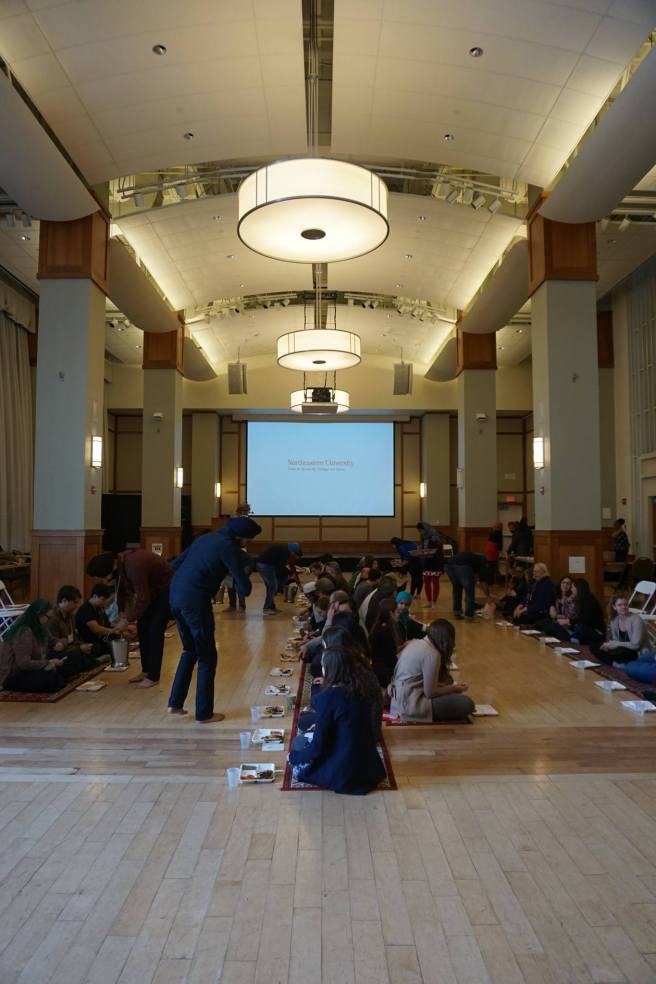
Outside the Gurudwara, I rushed to put on my scarf, and then to pull my boots off before our first encounter: breakfast. I piled my plate with pakoras (fried vegetables) and chutney, and my new favorite sweet: besan burfi. After cleaning my plate, I circled back to the buffet line and reached for a second burfi…woops! The man behind the counter gently pushed my hands away and put three on my plate (my hands were dirty from eating). Then, he wrapped a big pile of them for me to take home- he could tell I was enamored.

We made our way upstairs to watch the Kirtan, an expression of praise to God based on singing and chanting. I tried to match the Romanized Punjabi words on the screen with the music, frequently distracting myself by watching the children around the room. You can learn much about a community by observing children, I find- their actions are nothing but authentic. My coworker Karin and I sat cross-legged among the women on the right side of the Kirtan hall. Everyone faced the screens behind the Guru Granth Sahib (a compilation of words of the Guru) and remained seated for the most part. At a few points, we stood and bowed. When the music ended, everyone chanted for a few minutes, and finally the Guru Granth Sahib was carried back to a resting place.

As others headed back downstairs for Langar, the practice of serving a meal to everyone on long carpets, our group gathered for a question and answer session. A Sikh man, Gurinder, and some others shared some basic knowledge about Sikhism, relating the concepts to those in other faith traditions. Hardeep and Ramandeep, two leaders of the Northeastern Sikh Student Association, chimed in the lively presentation. As I listened, I caught myself nodding my head often, showing that I was familiar with what we were hearing. And I paused, realizing something crucial about religious literacy.

My job for the last nine years as an interfaith leader has been to build my knowledge of other faith traditions, from practice to theology to the languages these faiths speak. I have shown off my knowledge to adherents of these faiths- speaking the few words of Arabic, Japanese, or Punjabi that I know, seeking acceptance and perhaps some praise. I have spoken up when people around me are not familiar with a practice or concept- delightedly sharing my wisdom that has come with the amazing experiences I am blessed to have. Yet today, I realized that no matter how many times I hear someone describe the Five Pillars of Islam, the contention over the meaning of the Eucharist, or today the “Five Ks” (five objects Sikhs carry with them, symbolizing different values), that each person’s story is unique to their own experience, and it is a privilege to hear these stories. Watching our presenters dialogue with each other over a ritual’s meaning, history, and the relationship with their faith prompted me to quiet my mind and listen.

I think sometimes religious literacy feels like a huge hole that we seek to fill with knowledge, and as we fill the hole, we “advance”, we increase our literacy. Yet today I wondered if religious literacy is more a mindset than holding on to “what we know”. Visiting sacred sites like the Gurudwara today reminds me that embracing the current experience and learning to be a good guest by dropping assumptions is the best way to be an imperfect stranger. Knowledge of rituals, greetings, and practices is certainly important, but even more so is the willingness to learn something new every time we encounter someone new. This openness is what interfaith work is about- taking the time to hear one person’s story, even if we know the basics. Stories connect us on an individual level, a human level, regardless of our way to find meaning. This to me is what truly defines global citizenship.

As I enjoyed Langar number two with the other Northeastern students, we joked about the bus mishap earlier, noting that despite this, we all enjoyed ourselves. I find that putting ourselves in new situations is a good thing for two reasons: it allows us to learn, and it allows us to laugh. As we continue our “Souljourns” this semester, my hope is that everyone will learn and laugh. We grew together as a Northeastern community today, and we get to keep growing as we share more experiences together.

Guest Post: Conversations that Matter: A Dialogue About Immigration and Belonging

I am excited to introduce my first Guest Post on Shiawasen Sangha! This is a piece by Sagar Rajpal, an Office and Program Assistant at Northeastern University’s Center for Spirituality, Dialogue and Service. Sagar is currently pursuing his Masters in Engineering Management at Northeastern University.

Jiddu Krishnamurti, a speaker and writer on matters that concern humankind, believed that dialogue is a form of communication in which question and answer continues till a question is left without an answer. He went on to say that it is a conversation in which investigation reaches a certain point of intensity and depth which then has a quality that thought could never reach. Don’t you think such conversations are refreshing, or even liberating?

At least that’s what we at the Center for Spirituality, Dialogue and Service believe and hence have started “Conversations That Matter: A Campus Dialogue Initiative” which will create a comfortable space for participants to indulge in meaningful conversations. Our most recent dialogue was held in the warm Sacred Space on a cold January evening and attended by a diverse group of students from various fields and backgrounds. The dialogue was centered around the idea of Immigration and Belonging.

A group of over 25 participants along with facilitators from the center started off the discussion with how and when they felt like they actually belonged to a place away from home. Students spoke about the process of gradual adaptation to the new environment. One of the participants pointed out that back home, we are set in our ways. To venture out of the comfort zone is a massive step to take but the experiences that follow, build, strengthen and uproot some values and that is how one grows and broadens one’s horizons. Someone added by saying that we take our perspectives for granted and believe that the world is exactly how we think it is, but only when we are in the midst of the most diverse settings, we realize how wrong we have been.

The group agreed that going away from home is not easy, but it definitely gets better, mostly because in due course, you meet people who share the same ideas and people with contrasting ideas, both making you wiser and hence altering your personality for the better.

Next, the concept of Home was discussed. The facilitators asked the participants what it might mean to not have a place we call home or to never be able to return to a place we call home. Numerous answers popped up, some said home is where they are happy, others were of the opinion that home is where family is. One of the students shared his experience of leaving the comfort of his home and shifting to a new place. He said that the decision felt like shutting the doors on the life he once had. He said that the whole process was a storm inside his head, but meeting and becoming friends with people who come from such different backgrounds and learning something new every day made him believe that he made the right decision. An introspective vibe spread across the room as everyone began contemplating over their journey and sharing their experiences with the group.

The facilitators then asked the group how they can ensure that everyone feels a sense of belonging, regardless of generation. A student excitedly volunteered to answer and just said one word: Food. The group broke into laughter and after a good few minutes, a beaming facilitator asked the student to elaborate. With the utmost sincerity, the student said that she believed that in a University having people of different races, religions, languages and mindsets, food is the only thing that brings them together, the only universal language with which you cannot go wrong. She went on to say that if she would want someone to feel welcomed and included, she would cook for them. Everyone nodded in agreement and one student pointed out how he felt the same warmth when he entered the Center and saw the numerous desserts from all over the world. A facilitator reassured that he can get back to them soon as the group had almost come to the end of the dialogue.

A general agreement stood suspended in the air as everyone looked around at placid and peaceful faces. One student broke the silence and said that he admired all the people who put themselves in such different and difficult situations to get closer to their aim. Another student added that amidst all the classes and assignments, she doesn’t know whether she’s happy or sad,  but she does know that she’s at ease.


A Life and Death Resolution.

It’s January 6th. Happy New Year. Is this post late? Maybe. Regardless, I have some important thoughts about a resolution this year.

On Christmas Day (December 25th), I finished reading Atul Gawande’s book Being Mortal. Gawande is a practicing surgeon at Brigham and Women’s Hospital in Massachusetts. In Being Mortal, Gawande takes issue with the current state of end-of-life care for the aging and dying here in the United States. With all the “care” available, from nursing homes to hospices, the aging and dying experience discomfort, dehumanization and sometimes downright depression as we tend to ignore individual desires in order to “fix the problems of aging.”

As Gawande explains, the advent of modern medicine has surfaced an entirely new field of medicine: caring for the aging, elderly, and the dying. Before modern medicine, most people died when they acquired a particular disease. Even the common cold could turn fatal. So the idea of aging- of particular parts of our body beginning to malfunction or deteriorate- is indeed new. The “natural causes” we die of would not even have surfaced in most people 300 years ago. Modern medicine also warps our perception of death: when we can defy it, even for a while, death becomes the enemy. This, despite dying being the most natural thing humans do.

Being Mortal explains that the problem with end-of-life care is the dissonance between doctors’ relationships with medicine and care. Most doctors see themselves as fixers- a patient has an illness, and their job is to piece together the cure or treatment puzzle. The problem with the aging and the elderly, or further the dying, is many times there is no easy answer- treatment causes other symptoms, patients’ bodies may not be in shape to receive it, or the risks may be too great. Doctors tend to give options that weigh time vs. comfort- take this treatment to lengthen your life, but you’ll be miserable. What is important to those who have a very limited time left on earth? When asked, most said time was less important than creating significance for the last months, days, or even hours.

The most important difference between me and someone in their early 80s is perspective. In two days I turn 28. Perhaps this is selfish and prideful, but I am not ready to die. In my mind, my life is only beginning- I have so many more experiences to share and so many people to meet. To someone who has lived a bit longer, this attitude may seem quaint. At every stage of our lives, we hold certain people and certain activities dear. We prioritize. I am not sure when we reach the turning point to say “I’ve lived enough, let me die in comfort and peace”…perhaps that attitude it dictated to us when we discover our bodies have reached the end of their ability to function.

My cousin Heather passed away when she was 28. She was hardworking, sarcastic, and adored her son Austin and husband Ryan. I found out when I was training to be a campus fellow for the Interfaith Youth Core in Chicago, and flew home immediately. As much as I missed her and felt the pain my aunt, uncle, cousins and family felt, the best word to describe my overall sentiment was eerie. Her death was unnatural, it was wrong and unfair. Someone so young had so much left to do. As I turn 28, I wonder if she felt the same way I do, or if forced nearness to death brought some form of peace and acceptance of a life lived from beginning to end. Perspective dictates what we deem important at different moments.

Gawande concludes Being Mortal by suggesting five questions we must ask as we plan for the end of life, for others and ourselves. They are:

“1. What is your understanding of where you are and of your illness?
2. Your fears or worries for the future
3. Your goals and priorities
4. What outcomes are unacceptable to you? What are you willing to sacrifice and not?
And later,
5. What would a good day look like?”

What would it look like if we asked these questions regardless of our perspective- if I, 28 years old and seemingly healthy, asked myself regularly, “what would my goals and priorities be if I really did only have a week to live?” It seems like a silly ice-breaker, but facing this seriously each day in 2016, I have already begun to recognize some hidden priorities and places where I waste time. The last question intrigues me most: what would a good day look like today? As 2016 hums along, my resolution is to wrestle with end-of-life questions, learning to understand more deeply what really matters to me and the people I love.

Citation:

Gawande, Atul. Being Mortal: Medicine and What Matters in the End. New York: Metropolitan, 2014. Print.

Advent for a Buddhist

My family is Catholic. I grew up writing letters to Santa Claus, listening to Christmas carols (and belting them in the shower- oh wait, still do that) and getting more and more excited each day I took another chocolate from my advent calendar. My assertion was that December 21-24 was the best time of the season: the rush began to quiet, school was finished, and I wasn’t disappointed yet that all the presents were open.

Studying at a Catholic school, advent was always full of messages of waiting for the birth of Jesus. “Waiting” was so hyped…I could barely wait 24 days, let alone the thousands of years that people waited for the coming of a savior. Every year, we hear the same message: advent is about expectations, possibilities, and…waiting.

As an “adult”, the advent season seems a little less about waiting and a little more about a frenetic rush to check off the gift list, hopefully winning at sales and door busters. If only there were more waiting! That would mean more time to finish all the shopping. And in the midst of the rush, we hope to enjoy the lights, songs, and events surrounding the season. Beyond the traditions, this season is quite difficult for many- the ideals of family and friends sharing joy just isn’t a reality for many. Basically, the only thing we are waiting for is the moment we actually get to relax without any thought of braving the mall or attending a holiday party- or hearing another word about “holidays”.

Our students have been feeling the stress of finals, on top of everything else going on. They stay up all night preparing, take labored exams, and wait for the results of their hard work. In the same way, they feel time working against them. I hope they know how proud we are of them.

In this time of waiting and working, I remember one of the gathas or sayings of the Buddha that I use in my daily practice. “Breathing in, I dwell in the present moment. Breathing out, it is the only moment. Present moment, only moment.” What if, for only a moment, we could make this true? What if we could truly be completely immersed in this, the only moment…just for a moment?

Sometimes when I feel like there are too many items on my to-do list and the day only has so many hours, I sit back, close my eyes, and imagine that nothing around me exists. This moment is perfect- I have my breathe, my smile, and it is perfect, as perfect as a moment can be in this impermanent world. Just in this very short time, my body feels content, my mind is not racing, and I can breathe deeply without worry. Can we replicate this more throughout the day?

I remember taking exams and thinking at certain points, “I reallllly don’t want to do this anymore!” All the information I knew flooded into my head and simultaneously confused me. It was frustrating. All the studying and staying up late, strategy and flash cards, they didn’t seem to matter. Finally, after years of this, I learned to zone out for a moment, if only to give my eyes a rest. I sat back in my cramped desk, softened my eyes, and imagined my family at the dinner table, laughing. Even if it took 5 minutes out of my exam time, this practice helped me refocus. Perhaps this was a way to access the perfect moments I’m thinking about now.

It might never be possible to live in this ecstasy all the time, especially during this time. But these moments of complete presence and attention to our breath can refocus our minds just enough to complete our projects without feeling exhausted and bitter. It takes practice and dedication. Practice makes perfect- perfect enough.


Movement

As one who practices Buddhism, one of my truths is impermanence and constant change within the world. As people in the world, we are subject to these effects. I could write, “this week has been hard, the world is really hurting now” as if it weren’t last week, or month, or year. The truth is, the world is impermanent, and part of this truth is suffering and mortality. Just two days ago, my city of Los Angeles became the city of Lost Angels, as 14 people lost their lives in only one of the mass shootings that day. In an instant, we witnessed irreparable damage.

As a human being, I can’t help but carry a tiny bit of the weight of global suffering on my head. There seems to be so much in the world, and within every person. This week after an eventful Monday evening at Northeastern University, a word has been circling through my mind with multiple meanings. That word is “movement”.

Movement is change, and the world is always in motion. People, too, are constantly on the move, and this movement creates harm when it is unwelcome or seemingly threatening. Movement is what happens when a central place or system begins to cause unbearable suffering.

Today, over 12 million people have been affected by the crisis and violence in Syria. This is a season of migration, of moving, of people losing their homes, families, and identities. As the Syrian people seek refuge, the rest of the world must respond. People have always moved, always migrated in search of life that is safer, more prosperous, or offering something new. In this migration, we are exposed and vulnerable, whether we are moving or not.

In my current city, Boston, movement has demanded a capital “M” recently. Student activism is increasing on campuses here and around the country on issues from the Fight for Fifteen to Institutional Discrimination to Divestment. Movement is happening at the grassroots and is beginning to climb the administrations of institutions. Whether I agree with particular statements and actions or not, I do believe this nonviolent, intentional activism is something to be encouraged. Someone once complained about my generation being lazy because we “don’t have a Vietnam to protest.” On the contrary, the new campus Movements are part of a larger protest toward inclusion, safety, and true pluralism.

Part of my job at Northeastern University is to direct the Global Citizenship Project, an initiative to explore how we can utilize the resources of our Northeastern and wider Boston community to train students, faculty and staff to be global community members. Our Executive Director Alex Kern describes the vision of this project in three statements: “You belong, you are connected, you are needed.” These feel like immense but essential statements at this moment. They dig deeper at the popular “Think global, act local” we so commonly hear on college campuses and in global activism.

On Monday evening, I realized that Northeastern students do participate in global citizenship as they recognize this movement in the world, from global migration to caring for one another. A group of students from different faith traditions came together to assemble winter packs for homeless citizens of Boston. Many of those students stayed for the Islamic Society of Northeastern’s weekly Deen and Dine to share a meal with other Muslim students and listen to a fellow student offer some wisdom about a passage from the Holy Qur’an. From there, many of the same cohort of students attended a fundraiser for Syrian Refugees, an event that brought together students from a variety of cultural and religious organizations. As I listened to a very enriching talk by a Northeastern Professor about the current climate of Syria and neighboring countries, I realized these students are modeling global citizenship. They are thinking and acting globally and locally. They understand that change requires movement, and movement catalyzes change, and they are cultivating a sense of what this movement could look like. Despite the constant violence, harm and sadness we see in the world, I know there are young leaders that give us reason to smile.


Hospitality, Not Hostility

It has been one week since the terrorist attacks in Paris and Baghdad and a week and a day since the attacks in Beirut. It has been two days since 80 died in Nigeria at the hands of Boko Haram. Today, at least 21 people have died due to a terrorist attack at a hotel in Mali.

The examples of terrorism, hate, and violence need not even leave my own country to overwhelm me. Every minute, it seems, someone dies at the hand of a gun. There is so much anger, so much pain.

Last week, members of the Islamic Society of Northeastern University (ISNU) showed me a post on their group’s facebook page that read “Burn Your Local Mosque” with the comment “here ya go, scumbags”. This post highlighted the broader rhetoric present in the US media, especially around the upcoming elections. Words like “internment”, “ID cards”, “security”, and “Islamists” have been thrown around. Does this remind us of anything? It brings to mind much darkness for me.

In a time when it is easy to feel despair, I remain committed to telling the stories that demonstrate community building, not combat. The stories of positive work across difference, of practicing compassion toward strangers, of turning away from fear and hate to welcome those under threat are the foundation of hospitality. When we tell these stories, we show that fear and aversion to difference need not control our lives- and when love and friendship do, we defeat the suffering that comes with hate.

Yesterday, NU’s Intervarsity Christian Fellowship sent an email to ISNU and CSDS with an attached letter and invitation:

Recently, the Muslim community has been alienated and attacked unfairly by many across the country. We recognize that this discrimination isn’t new, but is only more intense and more visible over the past few days, and that much of this has come from those of the Christian faith. The Intervarsity community is sorry and insists that this is not in line with the Christian faith and is not the heart of God. No one should be judged based on generalizations or live in fear because of their identity. As Christians here at Northeastern we support you on this campus.

The letter concluded with an invitation to ISNU’s members for a shared Thanksgiving dinner next week. The most powerful piece of this letter and invitation for me is a group of students reaching out to community under threat. IV acknowledged that though this might not be the first time this hate has infiltrated this community of Muslim Students, and moreover that it might even seem commonplace,  this bigotry is unacceptable. It is unacceptable for Muslims (or anyone, for that matter) to live in fear because of their identity. On this day, the National Transgender Day of Mourning, the day we mourn over 1000 lives lost due to violence this week, the day one group of students decided it is better to extend a hand than turn their backs, I beg us to keep the strife of the world on our minds, but to keep the possibilities of this hospitality in our hearts. Our minds can remind us, but our hearts should guide us.

My Fire Sermon.

In accounts of the Buddha’s life, the Buddha was known for giving sermons. Once, he spoke about burning and desire in a talk we now know as “the Fire Sermon”. In this sermon, the Buddha said, “Bhikkhus, all is burning.”

“The ear is burning, sounds are burning…

The nose is burning, odors are burning…

The tongue is burning, flavors are burning…

The body is burning, tangibles are burning…”

Last, the Buddha says, “the mind is burning.”

What did the Buddha mean by this? Why is all burning?

Burning is the consequence of our desires, our passions, our ambitions. Our senses burn as we seek to fulfill them. Our ear burns with the desire to hear beautiful music. Our nose burns with the want to smell colorful flowers. Our tongue burns with the craving to taste delicious food. Our body burns with lust.

Our mind burns with the passion for knowledge.

All is burning in our bodies and our minds. The burning causes prohibition from liberation. Simply: the burning of desire controls us, it does not make us free.

This burning has gone beyond our bodies. This burning has taken over our communities and our nation. My friends: today, this Veteran’s Day, we remember those who have sacrificed their time and their lives for the fulfillment of our own freedom. They have served. They have seen the burning, and they want to extinguish the flames. Our freedom, though, is unreachable, set apart from us by a ring of fire.

Our own nation is on fire. Our own nation is burning.

Just as the ear burns, our houses burn.

Just as the nose burns, our streets burn.

Just as the tongue burns, our schools burn.

Just as the body burns, our churches, mosques, synagogues, Gurdwaras, and temples burn. Our sacred places are on fire, and the flames grow and emit black smoke as the walls are incinerated, falling, crumbling to the earth, dragging the bodies with them.

All is burning. This Veteran’s Day, people are giving their lives around the world and next door to us, to extinguish the flames that prohibit the path to liberation. In our own communities- on college campuses, at political rallies and debates, in the streets, our liberation melts away. The fires of injustice rage, and the firefighters are sprayed with tear gas.

Last night, I read something that set my own mind ablaze. Pastor Shaun King posted on his Facebook page: “If you EVER wondered who you would be or what you would do if you lived during the Civil Rights Movement, stop. You are living in that time, RIGHT NOW.”

We are living in the year that saw the deadliest hate crime against Black Americans in the part 75 years in Charleston, South Carolina. We are living in the year that saw more Black Americans killed by police than were lynched since 1923. We are living in the year in which every day, the Council on American Islamic Relations posts a story online of at least one hate crime against a Muslim American. We are living in a year in which Sikh people are targeted for wearing turbans and beards, mistaken for people of another faith, both deeply misunderstood. We are living in a year that sees a constant conflict between freedom of speech and marginalization, between exploring new ideas across cultures and deepening divides between people. We are living in a year in which colored cups seem more important than colored lives. We are living in a moment when we might finally have to admit that our country is on fire, and the ashes are growing taller and taller.

Indeed, we are living in a time of upheaval, movement, and for some, a clinging to maintain “order”, the “order” that suppresses, quiets, and locks out the external flames of progress and motion. Perhaps this can go on for a while- the flames can protect. But the Buddha is right to say that the burning prohibits all of us from liberation. Only when we have extinguished the flames in our own mind and bodies can we embark on the path toward liberation together. The fires in our schools, sacred places, homes, and streets will burn and destroy until we quench our own desires for power and influence, causing our inability to listen. Love quenches these flames. Love is a flame that does not destroy us but burns the distractions from our own liberation. The path to liberation is found separately, but traveled together. Fire can sustain us, and can also annihilate us.

Every day, I look for an example of someone feeding the flames of love while extinguishing the burning of desire that inhibits justice, that walls off liberation. My students, sometimes loudly, sometimes subtly, are working for justice. They are taking the love in their hearts for each other and for the earth and seeking to make change. I hope they do not give up. I hope they can alleviate the burning with the flames of love, the flames that illuminate the blood and sweat on their faces as they face the teargas. All is burning.