!

Today I rode my bike to church on campus for a special multifaith celebration. During the service, 24 students were officially commissioned as Fellows for Religious Encounter. This year, they will meet every Wednesday over dinner for dialogue and to hear from engaging speakers. They will visit sacred sites and experience rituals and practices they may have never seen before. As they recited the commissioning prayer before the congregation this morning, I couldn’t help noticing two things: time FLIES, and how necessary this kind of intentional learning is as religion either brings us wisdom to seek justice or violent division.

chris-ensey-87456
Photo by Chris Ensey on Unsplash

I remember stumbling upon a Buddhist Temple in my neighborhood when I was little. It was a temple dedicated to Kwan Yin, a beloved bodhisattva in the Mahayana tradition known for her mercy and compassion for human beings. Inside the temple, there was a wood floor with black square cushions lined along the edges of the walls, and at the end of the long hall there was a statue of Kwan Yin sitting on a lotus flower. My entire understanding of God and faith shattered as I scoured the public library, trying to find books about this way of life called Buddhism. My grandmother told me whatever she knew, and encouraged me to keep looking. I didn’t know any Buddhists, though, so all I could do was take my reading at face value.

Seeing these bright young faces this morning made me want so many things for the fellows. I hope they don’t shy away from noting disagreement, especially when it is harmful. I hope they are forced to wrestle with a misconception dispelled in conversation. I hope they feel a range of emotions: anger, confusion, sadness, and joy when wonder strikes. I hope they listen and learn, and talk openly and teach. I hope they are confronted with not just questions about religion and privilege, but constantly engage in self-reflection.I hope they enjoy each other’s company. Of course if all these wishes are fulfilled, these students will inevitably be transformed.

Meeting someone who practiced Buddhism proved quite different than reading about the life of the Buddha and the Four Noble Truths. My teammate’s grandmother didn’t talk about her beliefs in an organized, bullet-point style lecture (she didn’t draw me a chart), she told me about her father and his father going to temple on New Year’s Day, and contacting monks for funeral services, and living life with compassion at the forefront of her mind. Every Sunday I sat in church and learned about the life of another man who preached compassion, who died so that we could go to heaven. I was confused and upset, scared to talk to my parents about these discoveries but excited about my findings, and bouncing from deep discomfort to honest wonder.

I think about walking in to that temple more and more these days. It seems like if everyone could walk into an unfamiliar place, ask some open questions, and struggle through some necessary discomfort to learn an alternative worldview, we could feel this wonder more often. Of course this is not so simple, but interfaith work is not simple at all. Feeling vulnerable to both share one’s own beliefs and subsequently hear views that thwart them takes courage and patience, and not the least of all trust. It is a worthy exercise for anyone to be faced with doubt. Often, confronting this leads us to an even wiser truth that we don’t take for granted.

I hope they learn. I hope they laugh. !

Lightning Storm

Last night I watched a fantastic Incubus show right underneath a glorious and terrifying lightning storm. I drove 300 miles to Phoenix from San Diego yesterday morning, through the desert, along the steel wall that separates Baja California and Sonora from the United States. Border patrol stopped me, asked to search my trunk, and I said “no.” The agent listened. I went on my way unharmed.

david-moum-238279
Photo by David Moum on Unsplash

2000 miles away, some of my greatest heroes stood arm in arm facing men with riot gear and automatic weapons. They weren’t police. These heroes are the clergy of our time. They’re pastors and preachers. Scholar activists. I admired a picture of them standing linked together, singing and praying while just feet from them violence erupted and a young woman lost her life as a terrorist plowed his car into the crowd. Their prayers and songs are heard. They were echoed this morning in churches around the country, and will be this week in many forms of sacred space.
I’ve found such hope in the writings and teachings of Zen Master Thich Nhat Hanh. He was an activist, exiled from his home country and now helps people from all nations understand that Buddhist practice requires us to recognize we are all connected. Our suffering is bound up together, and thus we must show up and care for each other.
Sometimes it feels as though my faith has told me not to get attached to the fight for justice. At the root this teaching points to attachment as the core of suffering, and I believe this to be true. But turning off the thirst to learn and simply exist ignorant from the real suffering in my country at this moment does not lead any closer to Nirvana, it only lulls me into false notions of self-care as the only necessary form of practice. We come to the cushion to find awareness of ourselves, and this is called a “practice,” not “our life.”

Because the world is waiting for us when our sit is over. Sitting helps us to be mindful in the action, to remain unattached to outcomes but stand hopeful that love will prevail.
I’m proud of the religious and spiritual leaders for recognizing that they have voices. I was thinking today about the Civil Rights Movement and subsequently the internment of 120,000 Japanese immigrants and American born citizens, two moments that feel both far in time and close in context. We might read about the leaders who ushered change and progress in textbooks, or hang pictures in our offices years from now. But they show us a great example of remaining present in this moment, armed with the texts and words of timeless prophets and teachers, focused on saving lives today.
The lighting storm terrified me. It lit up the sky as if we sat trapped in an electric glass bubble, and the thunder boomed directly on top of us. I kept looking to my right to see if I could run for it. The band had left the stage, and I wanted to book it to my car. But I stayed in my seat, feeling safer among the crowd. The cheers and shouts around me reminded me I wasn’t alone, even if I was terrified. We are not alone in this fight, we have arms to link and songs to harmonize. I am grateful for every pulpit that spoke truth today, especially to call us in.

Ramadan Sunset

This post appears on the Parliament of the World’s Religions’ blog in the series “Interfaith Ramadan.”


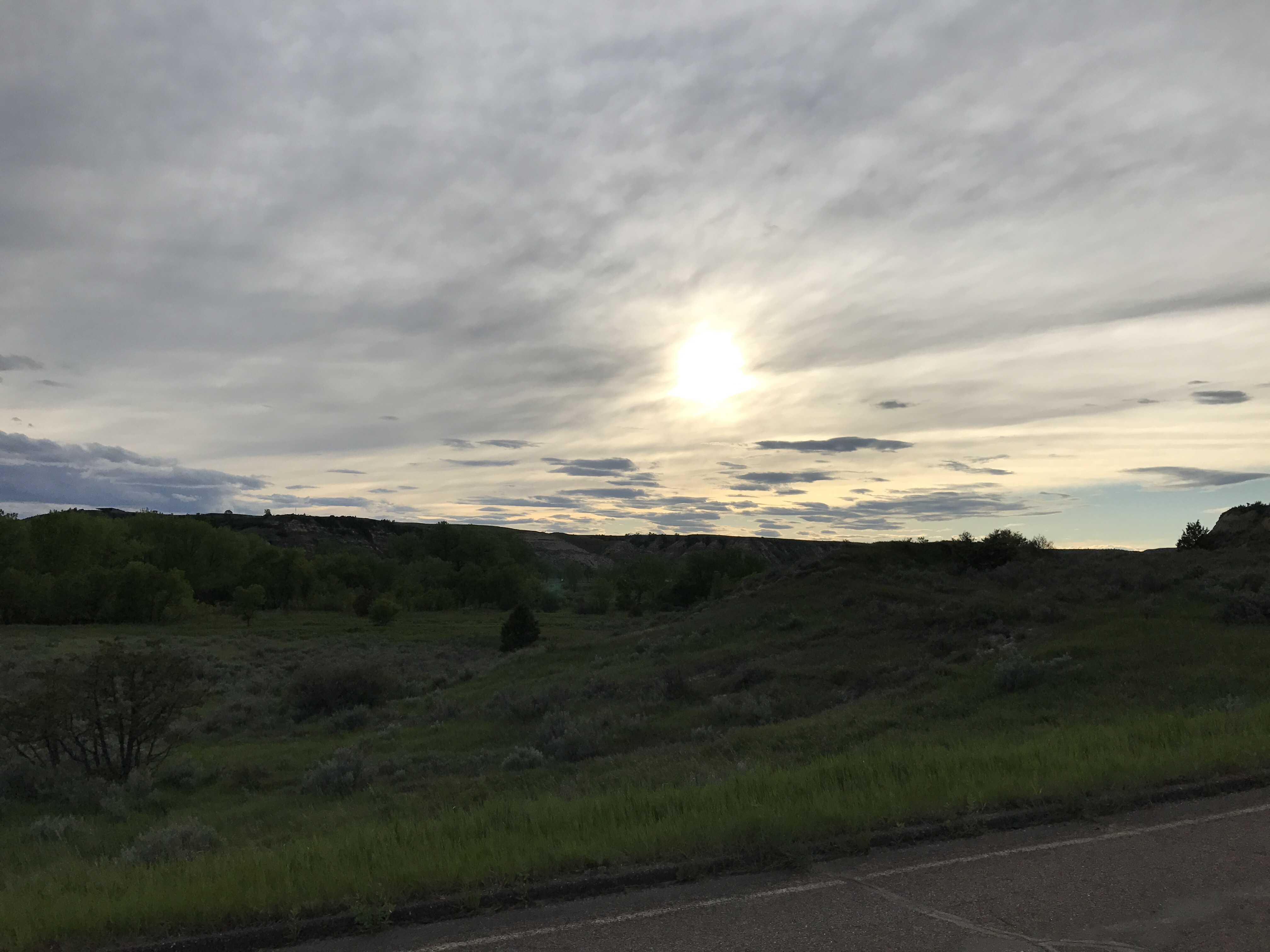
I’m watching the sunset over Teddy Roosevelt National Park in Medora, North Dakota and thinking about my Grandmother on this first night of Ramadan. She passed away a few years ago, but growing up, my family would visit her in Lake Isabella just above Bakersfield in Central California. This view before me, a vast scatter of pink, purple, blue, red and yellow, also reminds me of the many evenings I spent as an archaeologist in Antalya, Turkey overlooking the Mediterranean Sea, watching the sun kiss the warm salty water before it disappeared behind a nearby mountain range. I remember these nights during Ramadan, in July or August, when we would fast for more than 16 hours and eat our iftar meal, the time to break fast, outside overlooking the coast.

As far as I know, there is no mosque here in Medora, North Dakota, population 132. Minneapolis, the city I drove from this morning, is about 550 miles away, but feels so much further. Compared to Boston and Chicago, my two previous home cities, Minneapolis is a small city, but boasts everything a metropolis would- art museums, fancy coffee shops, skyscrapers, and of course religious diversity. I’ve been on the road now for almost a week across the Northern United States, westbound eventually for Los Angeles, and have used the long drives to reflect on leaving Boston, a place I celebrated Ramadan with a sizeable number of my students and colleagues who were Muslim, and others who have grown to cherish this time and tradition, just as I have. As the landscape has subtly shifted every day on the road- from forest to plains to badlands- I can’t help but think about Ramadan as a time to notice subtle threads of particularities- the things that make us all different- meeting in the middle, finding a common center, flourishing in the most sacred part of the year.

Our world right now feels pretty scattered, just like this sunset in front of me. Driving this road has also exposed me to ways of living I have never encountered, growing up in one of the most physically vast cities in the world, Los Angeles. And yet, if I step back for a moment, while the colors in the sky remain distinct, they each meet and blend slightly. All over the world, Muslims practice in distinct ways during Ramadan- from eating particular foods at Iftar to feeling anxiety about celebrating publicly in places where Muslims are marginalized and under threat. From breaking fast under big city lights to listening for the call to prayer in small villages, Ramadan differs greatly from place to place, people to people. Nonetheless, the common knot in the center is stronger than the particular strands of thread. Ramadan always reminds me that no matter how divided and far we feel from those with whom we disagree or those whom we do not understand, there is something that binds us together- to recognize this is sacred. For me tonight, this connection is with the spirit of my grandmother who would be admiring the same sunset 1700 miles away if she were still with us. The valley seems to carry on endlessly in front of me, and at the furthest point where the sky meets the land, I wonder if there is a family breaking fast at this moment.

We Never Should Have Met

Facebook has been reminding me of memories recently (this must be a new feature- unless I’m only now realizing it. Or old enough to get memories?) and I have been feeling nostalgic. How much has changed in five years- and yet, how much really hasn’t.

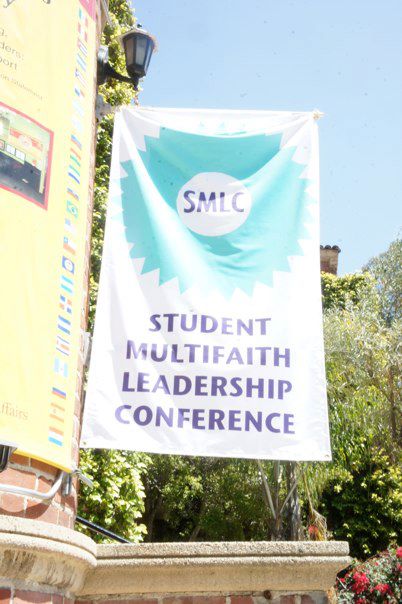
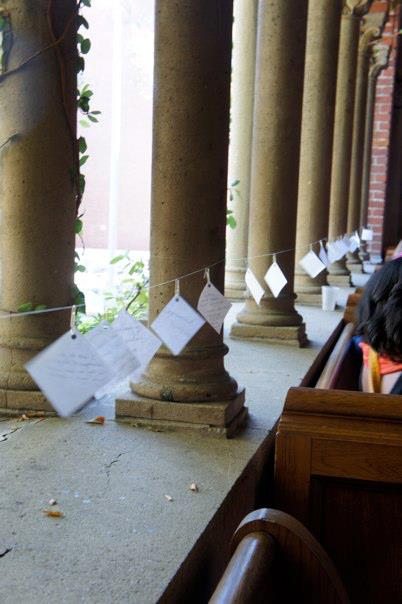
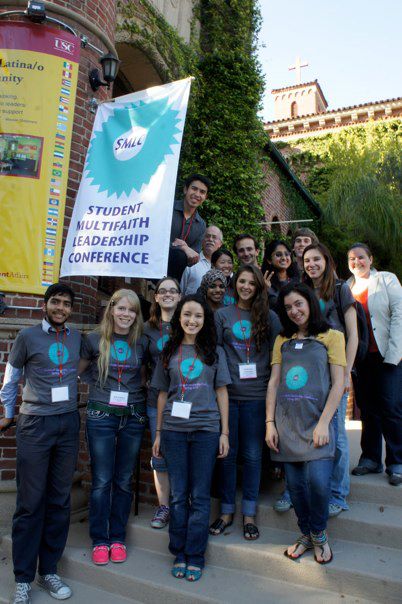
This morning, Facebook informed me that five years ago today, the USC Interfaith Council hosted the first ever Student Multifaith Leadership Conference (SMLC) on campus. I remember planning that conference with the other IFC members. We spent many nights crammed in one of our apartments, working tirelessly to get spread the word and get our logistics in place. It was my last semester at USC, and I recall a distinct feeling of being busy beyond imagination- writing two theses, taking twenty units, still fulfilling my role as IFC president, and finding time to make the most of LA with my friends- and yet experiencing pure joy despite the stress. The IFC really bonded as a team.

580220_3031658753644_1409522558_n

Reflecting on myself five years ago, I can’t help but feel proud of the students I served at Northeastern, and the amazing interfaith leaders I have met around the country since the SMLC. The world is in a different place, sort of- on the whole, these students are much more aware of the role interfaith communities must play in dismantling systems of oppression and including various identities at the table. I see a great success and opportunity in partnership- beyond dialoguing and learning, the young people are showing up for each other to seek racial justice, gender equity, rights for immigrants and the undocumented.

My Senior Ministry Project at UChicago focused on interfaith dialogue as a model for building identity awareness. I think it’s no secret that when we seek to hear convictions that conflict or sometimes even threaten our own, we learn more about ourselves. We are forced to contemplate our own beliefs. One afternoon on the fourth floor of Swift Hall (the home of the Divinity School), I presented my thesis to the Dean of the Divinity School. He asked me to dig deeper on a couple points, and finally, he said, “Tell me honestly- how many students do you really think would participate in this kind of thing? It seems like such a specialized program.” “All of them should,” I responded. He laughed. “You really believe that?”

The idealist in me says yes, I do believe that. I think everyone should participate in interfaith dialogue- even the vehement atheists. Education is about confronting ideas that bring us discomfort. Interfaith dialogue at it’s height is deeply uncomfortable. I have learned over several years of doing this work that humans are pretty particular when it comes to our worldviews. And yet, voicing our particularities is exactly what makes the work together so meaningful.

521979_3031662113728_838276500_n

I remember the day of the SMLC donning my purple and turquoise shirt proudly. There was a typo on it, but that made it our own. At the closing panel, I sat next to my friend Antonia, a pagan writer and anthropologist, feeling a little sad that the experience was over. We had all put such heart into the work. And we never should have met, that group of people. We studied different fields, traveled to different places, called several nations home. The intentionality of the group is what gave me so much life, so much joy. As I continue to reflect on my journey at Northeastern, I believe the days I felt the most joy were the days I saw that intentionality in my students.

529956_3031667153854_1864528299_n.jpg

When there is no reason for us to meet, we are faced with our own truths. We can’t fall back on assumptions that we are friends because we find the same things interesting. Discomfort brings learning. It also helps us build deeper relationships because it helps us dismantle the systemic urge to stay safe in our bubbles. If every person we encounter is meant to teach us, we learn most from those who are most distinct from us. We never should have met. And yet, here we are, finding joy in the world together.

Full Circle

I don’t have to tell you that the world is funny, that life is not linear, that time is sometimes not a helpful tool for us- and sometimes it is.

joey-kyber-115166.jpg
PC: Joey Kyber

Just last week I was writing a short story about stepping outside my comfort zone. I wanted to talk about joining the Interfaith Council at USC after meeting Varun, the Dean of Religious Life. The story of finding Varun is a silly one, it involves pulling a newspaper out of a trash and seeing his name in the headline. “What’s a Dean of Religious Life?” was the first question that popped in my head. The article in the Daily Trojan (our university’s daily paper) described the many experiences Varun lived that led him to this role. Living in Nepal as a Buddhist Monk, finishing both a Master of Theological Studies degree from Harvard University and a law degree from UCLA, hosting a radio show, meeting His Holiness the Dalai Lama, even being an avid sports fan- all of these influenced the person he is today. Reading about them, I thought, “I want to live like this person. I should probably meet him.”

Nine years (!) later, I’m sitting at my desk at Northeastern University in Boston, where I have served in a chaplain role for almost two years. First I see the text messages from my mom and dad: “Did you see the LA Times article about Varun? I think he mentioned you.” Friends are sharing on Facebook. Varun himself emails me a link to a stunning story about his trajectory at USC, as a non-ordained Hindu attorney. It sounds just like the article I read as a lost sophomore at USC, at a time when I knew I loved studying religion, but had no idea what to do about it. This was the article that pushed me to email him in that chilly office on the second floor of the business school, that for the first time showed me I could live a life full of passion like Varun, combining so many different interests. And it’s my last week here, which feels as though a circle has been completed.

I think it’s really important to experience nostalgia sometimes, as a reminder to feel gratitude for the people who have been a constant support in our lives. I was going to post a bunch of vignettes this morning from my time at Northeastern, because there are so many wonderful and hilarious moments from these two years. I only got to tell a handful at my lovely going away party. This morning I took a Lyft to work because I baked too many treats to take on the T, and as we inched along on the 93 toward Roxbury, I looked out at the Boston skyline centered on the Prudential Center, its windows shimmering in the sunlight, and realized today is my last Monday here. Only two years ago, my mom and I attempted to navigate this ridiculous freeway and street system to move me into my tiny apartment in the North End. I remember sending Varun a picture, knowing I had made him proud. The community here has made me proud, especially after so much hardship. On the wall behind me hangs three simple letters that welcomed me on my first day: J-E-M, my name. I’m taking them with me to hang in my new office (if I get an office).

Link to the story: http://www.latimes.com/local/lanow/la-me-usc-chaplain-20170403-story.html

The Interfaith “We”

Last week my friend Katie Gordon visited Boston so of course we had to get dinner and catch up. I showed Katie around campus, took her to the LGBTQ Resource Center to see our mutual friend and colleague Lee, and after a quick tour of our Sacred Space, we wandered over to Newbury Street. We stopped in Trident Books and mused over some titles, mainly discussing what had been happening on our respective campuses. We nerded out about a few particular books, mostly related to feminism and/or religion. Finally, we sat down to a delicious South Asian dinner.

samantha-sophia-195012.jpg
PC: Samantha Sophia

Katie is the Program Manager for the Kaufman Interfaith Institute at Grand Valley State University in Grand Valley, Michigan. She identifies as secular, but make no mistake- Katie is one of the most influential interfaith leaders of our time. She trains for the Interfaith Youth Core’s Interfaith Leadership Institutes and has introduced Krista Tippett, creator and host of the radio program On Being, because she’s that cool. I have known Katie for a while through our mutual Interfaith Youth Core affiliations. One thing I really appreciate about Katie is her ability to unapologetically be who she is without inhibiting anyone else from doing the same. She is open about her whiteness and privilege, but not guilty or frozen in working to make change.

At some point in our conversation, we both expressed concern for the interfaith movement as it exists now. What does it mean to train leaders when many people of faith live under real threat for their lives- because of their faith? Can white, secular young people train in the same spaces as black Muslim women? As queer Jews? As Hindu immigrants? As refugees who, despite looking death in the face, have held close to their devotions? How do we expect those who seem to lose power and voice every day to lead others when there is real, imminent danger?

I have been reflecting on this question for some time now. One of the reasons I feel so strongly about activist and filmmaker (among other amazing things) Valarie Kaur’s message and definition of Revolutionary Love is that I feel so strongly about Valarie herself. She represents to me the very type of leader that begins to answer this difficult question of how we as developing interfaith leaders might live into our identity as such. You see, Valarie may have several thousand Facebook friends, a database of over 100,000 subscribers via different projects she has started, and one of her recent speeches has now acquired over 16 million views on social media (that’s remarkable, just FYI), but Valarie never does her work alone. She always thinks, speaks, and acts in community because she recognizes that while her voice is essential- as a woman of color, a Sikh American, an accomplished pioneer in filmmaking and civil rights law- hers is by no means the only voice with one particular set of concerns. We need not look further than the daily news to see how many communities need more voice for dire concerns.

In this way, I think our answer begins not at the “I” that defined the previous era of interfaith leadership, the years I spent building my toolbox and story collection. Interfaith work has always been about bringing communities together, but allowing particular individuals to serve as the face of communities, to represent traditions and belief systems even if inadvertently has in the past been enough- we look around our table to see a Christian, Jew, Muslim, Hindu, Buddhist, and seeker, and we feel good about our group. We can dialogue and serve together. We might not talk at all about the intersections of our own identities, or how unequal access to this table might be.

We have reached a moment in our public landscape in which the “I” interfaith leaders will quickly feel devastatingly alone or completely exhausted, and probably both. The interfaith movement is at a true “we” moment- a time when it needs to be acceptable and encouraged for us to ask each other to do things like march on the front lines, speak publicly against bigotry, or give money to civil rights organizations. Going to prison for disorderly conduct. The reality is, we cannot all risk the same things. We need to know our limits. Focusing on “I” can help us learn these things about ourselves, but will not build networks. Right now, the fact that our different identities afford us unique privileges is an advantage if we use them in community.

As Valarie so beautifully stated recently, “We can practice Revolutionary Love for those who are in prison because they have committed great harm. This does not mean they shouldn’t be in prison. This means we free our hearts to believe they can be greater.” For some of us, practicing Revolutionary Love, just like interfaith leadership, means asking our allies to put their words and bodies on the line. At the same time, for some of us, it means being asked and saying yes.


Upaya in Elon, North Carolina


Even though it was 4 am, I felt joy seep through my veins as I quietly tiptoed out of my apartment. On Friday I hopped down to Elon, North Carolina to experience the 2nd Annual Ripple Interfaith Conference at Elon University. My friend Carrie graciously picked me up from the airport at 8 in the morning, coffee at the ready. That was the first of many acts of hospitality I received from everyone involved in the conference.

The theme of the Ripple Conference this year was “mindful plurality,” and I gladly accepted the invitation to share my thoughts on mindfulness, interfaith work, and Buddhism as an accessible set of values. Not because I am an expert (heh, NO) but because I have fallen in love with my faith in the past year and felt encouraged that mindfulness practices have entered the realm of activism and resistance. That’s what this blog is all about- practivism. How we sustain ourselves in the long, arduous haul against oppression, violence, bigotry.


On the opening plenary, five folks of different faiths shared what mindfulness means to them. We heard from a practitioner of Ignatian Spirituality, a Protestant with a regular mindfulness practice, a Tibetan Buddhist, A Rabbi, an Imam, and a Zen/Engaged Buddhist. I felt unworthy to speak after listening to such great wisdom. After we each shared, a member of the audience asked perhaps the most urgent question of the moment: “How do we remain mindful under threat, when I wear this (points to hijab), when people have strong negative assumptions about me just by looking at me? How can I simply work on my inner peace when others are dying without dignity every single day?” Long pause.

A version of this question has plagued me for quite a while- in fact, it has caused me nothing short of a faith crisis in the past year and a half. I do not wear hijab, and I pass easily as a “regular ole’ white woman.” So- isn’t it my job to get my behind out in the streets and be on the front lines? Yes. And how, then, do I work on my inner compassion?

As Zen Buddhism would have it, there are at least two relevant concepts to begin chipping away at this question. First, interconnectedness. We can’t hide from the world and luxuriously put our feet up in the enlightenment hot tub, for our world continues to suffer. We are still in the world. We are responsible for walking with those who suffer. The second concept is one that frankly, I hadn’t thought about in a while. Upaya: expedient means. What works for you in this present moment to walk toward enlightenment? Upaya is about our context: it puts the quest for ultimate truth aside so that we might take a step in the right direction without doing wrong. Simply put, it means we don’t need to feel frozen: try something and see if it works. More importantly, upaya recognizes that the presence of everyone around you at any given moment is necessary. All Bodhisattvas (Buddhas who opt to stay in this world to help the rest of us) offer us different skills and wisdoms- human beings do the same.


As I reconnected with this concept I realized that all of us in the room needed to struggle through this question together, in that moment and moving forward. I fell in love with each of the students and conference planners as I began to see their complex identities. Each moment I was gifted a story and inner desire over coffee, a joyful memory in the Truitt Center kitchen, even a moment of anxiety or uncertainty as is par for the course of any conference, the expedient means of each community member unfolded as the weekend pressed on. It felt so good to witness the success of this group of people, to be reminded of my time in Japan and the opportunity to travel, to talk honestly about how Buddhist communities must work for racial justice, and above all, to laugh uninhibited. Laughter surely is upaya at its best

I am grateful for this weekend as we continue to invest in interfaith leaders as the key to our future. As one of my students often tells me, “the people that needed to be in the room inevitably came to the room, and it was good.”


What Love Teaches Me About Rage: Spending the Day with Valarie Kaur

Snow crunched under my boots as I paced the sidewalk. Valarie was finally here! It had been 8 years since I last met her in person and up close. She gave me a great hug before we trekked back to the Curry Student Center to drop off her bag and begin her Master Class as the opening to the New England Interfaith Student Summit.

Valarie captivated everyone’s attention immediately. She also helped participants feel like they could be vulnerable in a group of 35 others-as we learned to tell our own stories for movement building, I witnessed several soul-baring moments. Moments of shame, of fear, of knowing acutely how different one felt from everyone around them because of their queer identity. We learned together how these moments blossomed into activists and teachers and interfaith leaders.

16708655_10103495157637871_6060008837786264158_n.jpg
PC: Valarie Kaur

I fell in love with the students I serve all over again. After a snow day that cancelled our planned Keynote Address with Valarie just the day before, they committed to each other to make the day a success. They treated every participant and staff person with kindness and jumped at opportunities to be helpful. A few students ate their lunch with Valarie, and offered some of the most poignant wisdom and relevant questions for leaders and activists at this time. “What is the boundary I am allowed to set when it comes to engaging with people who do not agree that my humanity is sacred?” “How do we actually take time for self-care, and what does it look like?” “Who are the MLK and Gandhi’s of OUR generation- the folx that understand the context in which we struggle?” I scribbled notes furiously.

After lunch Valarie planned to show snippets of her first film, Divided We Falland take questions. “What if instead, we show the Public Radio International video of Rana and me calling Frank Roque?” She asked me. This is a 30-minute video of Valarie and her Uncle Rana calling the man who murdered Rana’s brother Balbir Singh Sodhi four days after 9/11 in Phoenix, Arizona. This man’s act of violence is what broke Valarie’s heart and made her an activist and filmmaker- the first hate crime against Muslims or Sikhs after the towers fell. Balbir was killed because of the turban he wore on his head, and the beard he kept long as a sign of his faith. The murderer’s name is Frank Roque. He has been sentenced to life in prison.

“I want to know the audience’s reactions. I’ve never seen the video in full.”

I loaded up the video in the crowded workshop room. About 20 of us watched Valarie and Uncle Rana sitting in Rana’s kitchen, speaking to Frank. Valarie holds the cellphone so Rana can listen and respond. I hear Frank say he “couldn’t help” what happened, that he had experienced a mental breakdown. I watch Valarie’s frustration but miraculous ability to stay calm. Rana listens politely, and when he does speak, pours love out from his heart into the phone. He tells Frank that he, Rana, already forgave him, that he sends love to Frank’s wife and daughter, that if he had the power- he would release him from prison. I have watched this video three times, and each time my eyes cannot help but respond to this with tears, in awe of the grace Rana bestows on Frank.

About halfway through the video, Frank tells Rana that he never forgot Balbir’s name. But it isn’t until almost the end that Frank addresses Rana using his name instead of “his brother.” “Rana,” he says, “I am sorry.” Finally, I thought. A tiny transformation. Frank has finally started to humanize the person whose life he destroyed, who still lives in pain and suffering yet loves without chains.

One audience member spoke about feeling dissatisfied with the conversation. “Frank isn’t there,” he said. “He didn’t ask you (Valarie) or Rana any questions, and he didn’t seem to fully admit his harm.” We agreed. In my reflecting on NEISS as a whole, I believe it is necessary that we remain deeply dissatisfied AND recognize the tiny transformations. This is Practivism, the ability to believe our work, our suffering, our struggle is working even when we cannot see it.

Don’t tell us to calm down, for we are angry.

Don’t ignore our rage, for we are outraged.

Let us ask one another and ourselves WHERE the outrage comes from, and understand that the root is love.

As I walked with Valarie back to our office so she could prepare for the closing, with tears in her eyes she stopped to hug one of the participants who watched the video. “My grandfather was killed in a hate crime,” he told us all. “Please write me,” she said. “You are not alone.”


“When you let rage fester in isolation, this is when it becomes violence,” Valarie said as she closed her Keynote Address. “Love is a choice, an act of faith and courage.” I knew at that moment that the dissatisfaction we all felt with Frank’s response is rooted in faith- faith that Frank has more to change, more tiny transformations to experience, and much more love to choose to put out in the world. We all have this capacity. And we are not alone.


Womens’ March: How Art Will Save Us

On Thursday evening, my writing class got real. We talked about self-care through the arduous process. The craft of writing, especially memoir and personal non-fiction, is wrought with danger. We bring our most vulnerable pieces forward, public: here is my brokenness. Of course, we couldn’t help talking about what would happen the next day.

I’ve never considered myself an artist. My sister, yes- at age 10, people asked to buy her paintings. She has that unique ability to make animals (her favorite subject) look real on the canvas. The closest I’ve come to pursuing a career in fine art is my wearing wild clothing in many different colors. Regardless, my appreciation for art has never waned. I find art soothing, a reminder that there are myriad ways to express our pain, joy, and everything in between. Words are my “art,” and sometimes words fall short. Nevertheless, I find myself consumed in books much of the time, looking for inspiration in my own craft.

Running for me has also become an art. Yesterday I joined a marathon running group and headed to Riverside for an 11-mile run. We faced the notorious Newton Hills: miles 17-21 on the Boston Marathon course. The final uphill portion has earned the name “Heartbreak Hill”, on which runners have struggled since the beginning of time (ok, no. But since the beginning of the Boston Marathon, yes) after some intense downhill for the first half of the course. For the last year, I’ve run alone the majority of training, but this time I was transformed by the power of running with others.

Yesterday I learned that running is so personal, of course, but requires the art of community building. Thousands of people climbed the hills yesterday, and as I clomped by Boston College’s campus I marveled at the pleasantries exchanged between strangers, even though we all must have felt exhausted (my knees were screaming at me).

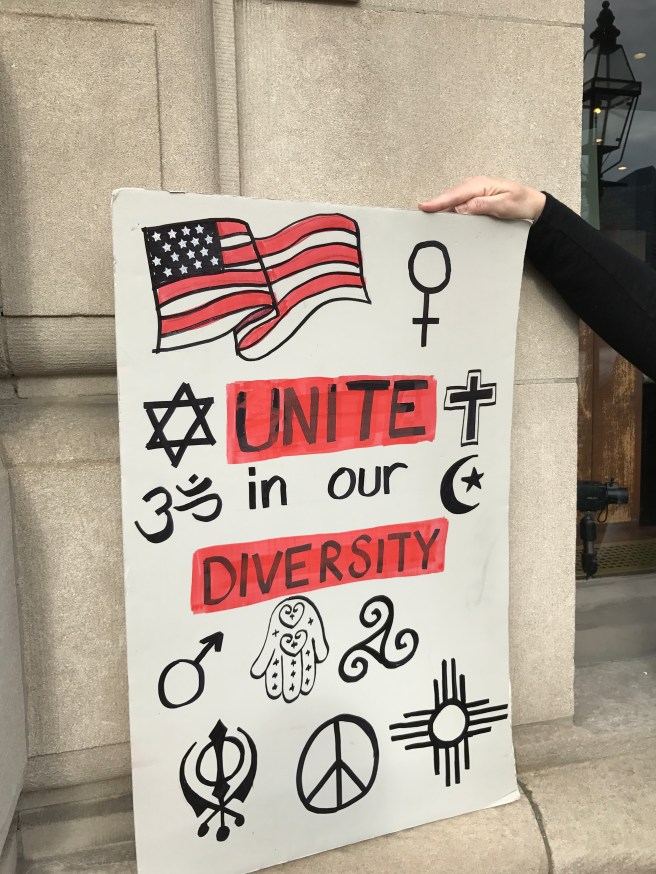
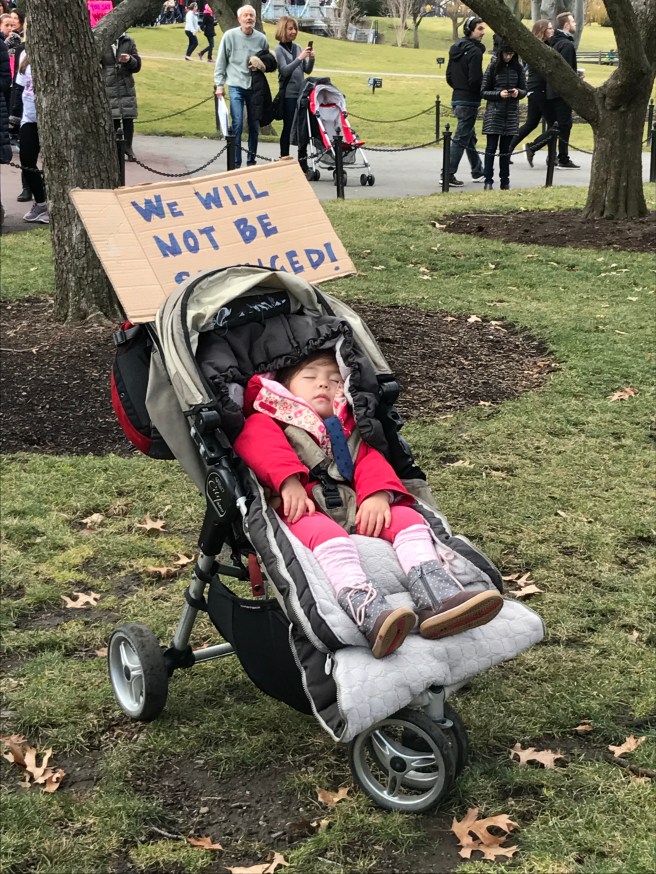
As I neared the end of the run at Fenway Park, I started to see the signs. I mean the actual signs people were carrying to the march. Some were bigger than me! And the sass, oh the sass. It dawned on me: In this time of great divide, Art will save us.

img_0203

Because the trains were packed, I decided walking another mile and a half wouldn’t kill me. There were more and more signs as the crowd neared Boston Common. Then I saw the buses.

IMG_0199.JPG

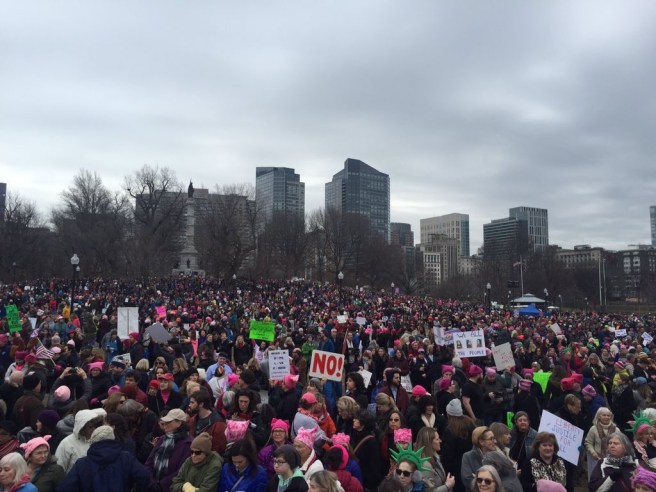
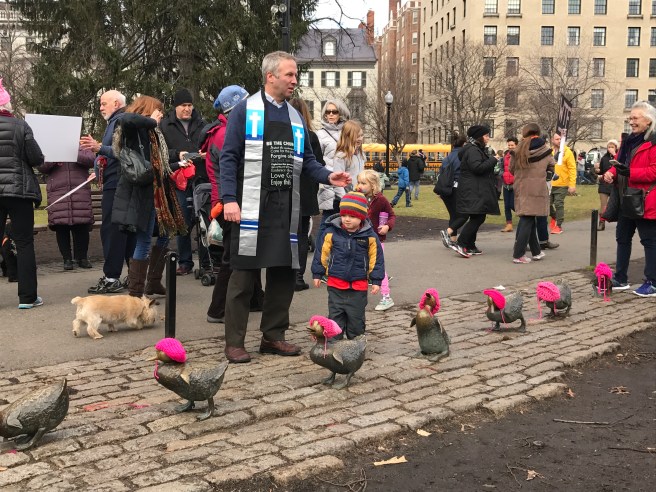
Buses and buses and BUSES. And beyond the buses, a sea of pink hats. The entire Boston Common, the same park I had run through only days before, was entirely covered in bodies. I had never seen anything like it.

img_0215

I admit to feeling a bit disappointed the previous day. Many of my students, colleagues, and friends had made the trek to our nation’s capitol to literally March on Washington. Why didn’t I get my act together to witness history? Looking before this very crowd, I knew this was where I was meant to be. Boston: the runner’s city, the home of some of the first abolitionists, the site of the first siege that began the Revolution. Scrolling through Facebook and Twitter my heart leaped again: my beloved Chicago, home for three years, the place I met my love, the city of incredible hospitality, had SHUT DOWN THEIR OWN MARCH BECAUSE SO MANY PEOPLE CAME OUT. BOOM. And THEN- my one and only home, the place my heart stays, the City of Angels, rocked the entirety of downtown with signs in multiple languages. My partner and I exchanged pictures of the best signs and posters around us. Sister marches around the world (yes, the world!) all the way to Antarctica popped up in my newsfeeds.

img_0213


Art will save us. Not the paper, the glitter, or the sass (though the humor really enlivened us) but the creativity. You cannot regulate art, you cannot control the visions of the innovative. And in these days, I believe that the creativity we witnessed this past week gives us fire to keep finding alternative ways of action. I’m claiming myself an artist. I will strive to be creative and think big. I’m so thrilled by the showing up for each other yesterday- it’s one day, and we’ve got quite a few more. Blessings to the artists, you are leading us.

IMG_0212.JPG

img_0200

img_0210


Preflection.

rdvp7whoibw-niels-weiss
PC: Niels Weiss

HAPPY 2017!!!

Another day turns into another year. Here we are! Today I checked my social media channels frequently to see what friends and family were feeling as the new year approached. I’m so proud of y’all! You achieved an incredible amount this year, despite some serious tragedies amidst every day strife and violence. If we are honest, changing the last two numbers of the date today to 17 don’t wipe any of this away, and surely, as we have already seen in Istanbul, tragedy looms over and over.

I really loved my friend/co-worker/colleague/tea buddy Kaitlin Ho’s reflection questions that she posted a few days ago. They certainly helped me put my own experience in context and focus on the present time. Though so much could be written for my responses to each question, here are my reflections and preflections as we begin a new year:

Where did I see glimmers of hope/light?

My students and co-workers. This past semester was exhausting for everyone, I have never seen so many young people physically show signs of fatigue and anxiety. Yet- the people around me, students and co-workers alike, delved deep and found unrelenting compassion for each other. The day after the election, 45 of our university’s community members gathered to dialogue and share, and I witnessed active listening, people making space for each other, and even strangers hugging. A week after that, a group of students attended a workshop I facilitated for the Global Citizenship Project around storytelling for social change- republicans, democrats, and international students included. Though I felt nervous, the students made themselves vulnerable to each other and shared some heartwarming and heart-wrenching stories about living with depression, experiencing their parents’ divorce, and other touching experiences. For a moment it felt like we had created community across an unbridgeable divide.

Where did I experience darkness?

I witnessed the ugliness of bureaucracy and large corporate institutions. I felt dehumanized and witnessed through my own lens of privilege how deep-seeded oppression is around me.

What did I see in my character that I’m proud of/want to see more of?

I ran 3 half marathons and started training for my first full marathon this past year. I’m gearing up for Boston in April. What I’ve learned in my running journey so far is that health cannot be achieved through only physical well-being, it’s so much more about the mind. I found that attempting to be gentle but encouraging of my body and mental state got me so much farther than beating up myself up for missing a day, or running too slow, or not stretching enough. I felt more motivated to take care of myself when I was merciful. As I start the serious training, I want to see more appreciation of the immense task it is to live, love and breathe on this earth day in and day out- appreciation of my own body, and of others’.

What do I want to change?

I want to engage in more honest, uncomfortable conversations that will continue to educate me in the fight for equity. I learned this year that I can’t expect people to call me out unless I create that norm and culture, demonstrating that holding each other accountable is an act of revolutionary love. I don’t want to feel frozen in my humble social justice work, and staying in motion means finding opportunities to educate myself at every turn.

Who are people I’m grateful for?

I literally start to cry when I think about how many people rooted for me this year, and how I could never repay the kindness and generosity they have shown. People I love donated to the charity I will run for in the Boston Marathon, listened to me complain and express frustration and still stuck by me, read my blog and other writings, gave me meaningful projects to work on, and met with me to give advice or just be in good company. I’m grateful for the interfaith movement, for the Revolutionary Love Fellows, for my students, for my new writing partners, for my family, for my partner, and for the people who were not afraid to ask for favors.

Who are friends with whom I need to reconcile?

I struggled with forgiveness, mercy and reconciliation this year. It took almost all year for me to realize that forgiveness and mercy are truly divine, but cannot be hurried. Rather than thinking about specific individuals, I’m going to continue challenging myself to hash out these concepts as they relate to healing and how I can be a better friend and family member to others.

What are my greatest desires and needs in my relationships, my faith, my work, my health?

This is such a good and difficult question. I like being needed and feeling important, but I think what I actually need is the opposite- a chance to be in communities where I don’t play a leadership role and simply exist among others. I need to continue struggling in my faith and what I believe about ambition and justice. I need to keep writing, focusing on meaningful writing rather than quantity. I need to be my own best advocate for my health and in doing so, learn to be a fierce advocate for others.

And finally…here’s to reading 100 books this year 😀 mostly for pleasure.