A Halloween Recipe (Try it, it’s yummy)

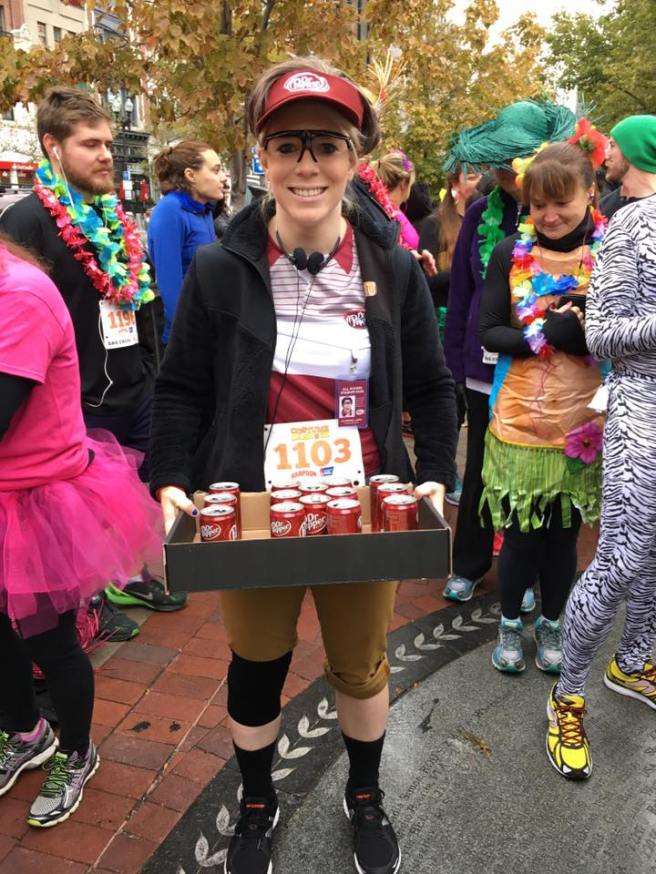
Halloween has always been one of my favorite days of the year. As I get older and feel less enthused about staying out all night and wearing a t-shirt and shorts in cool fall weather, the part that excites me more now is really celebrating the fall season. The pumpkins, gourds, apple cider, and earthy colors ease the looming anxiety that winter is coming, and the days will offer little daylight. I still enjoy dressing up- this year, I ran in a costume dash and baked several pies after finishing.
14906985_10207569043487354_3168132122801290548_n
Dr. Pepper, anyone?

Halloween also reminds me that fall is a season of dying. In many ways, death looks glamorous in the fall. The splendid leaves that burst in reds, yellows, and oranges on the trees that were lush green only weeks before are indeed dying, and eventually will fall to the ground. Once the harvest concludes, we face the end of outside activities- for the next few months, most everything we do will be inside in the warmth. The month of November in particular reminds me to be mindful of those I and the people close to me have lost. Every year, one of my friends has lost a loved one in November. Given the end of light and many crops, it makes sense that naturally, November would be a month of ends of lives as well.

In honor of Halloween and remembering my Grandma Mary, who passed away four years ago in early fall, here is a recipe for a decadent dessert you can make any time of the year, but is particularly special with a warm cup of Mexican hot chocolate (which really, is hot chocolate) and some warm socks. A Blessed Halloween and Dia de Los Muertos to everyone!

Pumpkin Chocolate Tres Leches Cake with Maple Syrup Frosting

  • Difficulty: easy
  • Print

Ingredients

  • 1/2 cup butter, softened
  • 1-3/4 cups sugar
  • 2 eggs
  • 2 cups all-purpose flour
  • 2 tablespoons Hersheys Special Dark cocoa powder
  • 1-1/2 teaspoons baking soda
  • 1/2 teaspoon salt
  • 2 teaspoons pumpkin pie spice
  • 1 14-oz can pumpkin puree
  • 3/4 cup evaporated milk
  • 3/4 sweetened condensed milk
  • 3/4 cup heavy cream
  • 1/2 teaspoon maple extract
  • 3/4 cup butter, softened
  • 3/4 cup vegetable shortening
  • 4-5 cups powdered sugar
  • 1/2 cup maple syrup
  • 1 teaspoon vanilla extract

Directions

  1. Preheat oven to 350 F and grease a 13×9 in. pan.
  2. In the bowl of an electric mixer, beat the butter and sugar on medium speed until light and fluffy.
  3. In a medium bowl, sift together the flour, cocoa powder, baking soda, salt, and pumpkin pie spice.
  4. Add the eggs one at a time to the butter and sugar mixture, mix until combined.
  5. Now, alternate adding the flour mixture with the pumpkin puree to the mixer in 3 increments.
  6. Pour cake batter into greased pan. Bake for 30 minutes.
  7. Let cake cool for at least 30 min. Once cool enough, poke several holes with a straw or anything that will make enough space for the leches.
  8. Mix together the evaporated milk, condensed milk, heavy cream, and maple extract.
  9. Pour mixture over the cake and let sit for at least 30 minutes.
  10. To make icing, cream together butter and shortening on medium speed.
  11. Add 4 cups of the powdered sugar gradually, one cup at a time.
  12. Add the maple syrup. If needed for consistency, add the last cup of powdered sugar.
  13. Mix in the vanilla extract.
  14. Once the leches have settled, frost the cake.
  15. Garnish with chopped pecans, if you like!
Why Honesty is Risky, Sometimes

I started my Memoir Generator class. There are 12 of us aspiring memoirists. All women identified, all pretty quirky. I have decided after our first meeting we are all hiding something. That’s why we want to write. We are trying to figure out how to unhide. 

PC: Hauke Morgenthau

We read two memoirs before the class so we could tear them apart. I don’t mean in a bad way, like a really tough movie critic- I mean we dissected them, made lists of characters and objects and places, and honed in on the authors’ strategies for effective writing. The books we read were When Breath Becomes Air by Paul Kalanithi (which I wrote about a few months ago) and The Suicide Index by Joan Wickersham. These memoirs are both about death- the first is about the author’s battle with cancer and his understanding, as a surgeon, of exactly what is happening inside him, and the second is about the author’s father committing suicide and her family’s quest to pick up the pieces for years. Literally, years- Wickersham worked on this book for 14 years. Kalanithi died about a year after he started writing the book. 
I felt so alive in our first class, even after a long day of work, even as the sun set and the bands of gold light turned pink and purple and then darkness flooded the window outside. I love learning, and what’s more, I loved being in a room with writers interested in understanding writing as a deep spiritual, artistic process. We agreed that writing a memoir takes time, reflection, and the final product will leave out quite a lot of what we write. “Don’t think every scene you write isn’t sacred,” our instructor told us. “But don’t think it’ll all be publishable either.” I admit, that statement scares me. But I’m still willing to try the process. I have stories and people and pain to unhide. 
In this first class, I learned something crucial about telling the truth amongst my new classmates. As we delved into the character list for Wickersham’s memoir, someone asked, “Why do you think she only mentions her sister once in the whole book? That seems strange to me. We don’t even know her name.”
It did seem strange- I suddenly wondered if the author was trying to tell us that her sister wasn’t very important to this whole experience, which I found unbelievable. My sister would be, if that ever happened in my family. Before that train of thought could spiral out of control, another student responded, “her sister probably asked not to be in the book. She probably wanted to be private.”
Oh. Yes, that makes sense. I realized in my quest to begin telling my own story how difficult telling the truth is, especially to the world who doesn’t know you and the people you love. Because “the” truth is actually your own truth. We have great power in our hands (literally) when we write down the stories we tell ourselves and share them. We are exposing brokenness and pain and memory that may be locked away for good reason. Someone in my class mused, “you’ll never please everyone when you tell the truth. The truth hurts. And usually we are writing because we are hurt, or we hurt others, and we write about the people who have caused us pain or for whom we have caused pain.”
I thought about my family and our collective secrets. What will happen if I write them down and share them? Even the stories we have exposed are told in a way that everyone feels they have agency. We’ve told these stories over and over, and drafted them in a way that confirms and contributes to the greater narrative of who we are. What if my writing challenges this narrative, shatters our story of “us”?
So I begin by asking “why.” Why do I feel such an ache to tell my story, even though I risk upsetting the people closest to me? For now, the answer is that sharing my story could also put forth the beginning of an honest conversation about our shared family pain that we’ve never addressed before. Telling the truth is risky- and maybe it’s a way for me to build stronger relationships with my family. I hope the memoir process helps me unhide from my own truth, and that I learn to listen for others’ struggles in sharing theirs. 

A Shattered Thursday

shatter
PC: Jilbert Ebrahimi
Let me tell you about my Thursday.

I got to work around 8 am, carrying a cake for my co-worker’s birthday. I stayed up until 2 am making it. It tasted fantastic, so I heard. The weather was cool, and crisp, and dry. Perfect for caramel apple cake with dulce de leche icing.

After I hid the cake (it was a surprise) and bore witness to an angry student before our center even opened, I guided a meditation. 7 people came. I went back in my office and answered some emails. At 9:30, I heard about a miscommunication escalating to a fight, lawsuits threatened, people’s jobs in question. I fielded phone calls from other offices. I cleared my schedule to attend an urgent meeting. A student worker left early from the office because her grandfather passed away. I sent her a text: “So sorry my love. May everything run smoothly. Let me know what you need.”

At 11 am, I set up for a student affairs colleague meeting. We ate lunch and vegan cookies that I brought for the birthday celebration. We discussed mental health issues on campus. Our students are all over-worked, sleep-deprived, and expected to be happy, productive individuals every moment of every day. We imagined a potential collaborative internship for our students that would focus on an exploration of intersectionality and identity. I texted my partner to see if he was awake. He said he would bring the apples by 1:20. My shoulders relaxed. “Thank you,” I texted back. I scribbled some practically illegible notes.

As our meeting was ending, I texted back and forth with a student leader about which flowers to buy for the birthday girl. We went over the surprise plan. I would stall her until my student sent me the ok, at which point my co-worker and I would head to a “meeting” across the hall.  I said goodbye to my colleagues and walked back into our office, to find a student crying on the phone. My phone buzzed with the text “Come now, hurry!”-birthday time.

The crying student, my co-worker and I each took a deep breath. We processed the student’s anxiety all together. Finally, as suavely as possible, I ushered all three of us across the hall again for the birthday surprise. Everyone shouted. My co-worker sped out of the room for a moment. The students had arranged the cake, caramel apples, and gifts on a beautiful table. “This looks like the Garden of Eden!” My co-worker exclaimed. We watched the videos and messages the students filmed- one included pictures of me and her, one a choreographed dance, and one a Scooby-Doo parody. We laughed, and secretly, my throat began to choke up. Did she enjoy the surprise?

Another serious, tense meeting began just as the party finished. This one included several students- they felt angry and scared, but determined. As I finished cleaning, I gave the student who put all the videos together a massive, shoulder gripping hug. “Thank you so much for doing that,” I looked into her eyes. “I think she loved it.”

Back in my office, I found another distraught student. “What’s going on?” I asked. She didn’t want to talk, just sit in quiet. The sound of new emails sliced through the air several times. I got up to fill my water bottle. Students sat strewn around the front desk, the chairs leading to my office, and everywhere in between. The phone rang at the front. No one answered. “The air is tense in here!” Someone said. “MmmHMMM,” I murmured back with a mouthful of water.

Suddenly, the student who bought flowers for my co-worker appeared. She snapped her fingers. “Can you do something!?” I jolted up, hitting my knee on my desk. My water bottle toppled over.

One of the students in the serious meeting had fainted in the Director’s office. I tried to ask everyone to leave. I closed the door. Clutching his head and slumped over, the student explained, “This is too much. Everyone hates me right now. I have an assignment due tomorrow that I haven’t started and I’ve had two weeks. This meeting was so stressful. It’s too much.” One of his best friends had stayed in the room. She touched his hand. “I’ve been there,” she consoled him. “Sometimes you just have to fall apart. We are your friends. We’ll hold you up.” After a few more minutes, the student seemed stable. I quietly excused myself to continue an email exchange about a scheduling conflict in our Sacred Space. The crying student sobbed again. I took in a breath that filled my whole belly, and let it out slowly, through my teeth. My body instinctively stood up again to refill my water bottle.

Back in our Director’s office, I witnessed something that evaporated all the emotions I was so carefully juggling. The two students were hugging. They were smiling and giggling. They stayed in the embrace for a few moments. A tear silently grazed my left cheek. My lips lengthened into a slight smile.

You see, the student who had fainted is a Muslim, very active in the Islamic Society of Northeastern. He is also a Jordanian-Palestinian American. His friend, holding the fragility, channeling her empathy and care into the shattered young man before her, is Jewish. Their friendship exists in tension with the wider world. In other places, perhaps even in the same city, these two people could negate the humanity of the other. They could ignore each others’ existence. But they don’t. Instead, they choose friendship, they seek connection.

Sometimes we need to shatter for our souls to be assured that we are connected, we are seen, we are loved. In the midst of the pain, violence, and terror our world faces, maybe love cannot save us from breaking into a million pieces. Love makes the tiny slivers, the shattered pieces, sparkle like stained glass that is kissed by the sun.

Why Writing Brings Me Joy

It seems like all I can talk about these days, besides my moving woes and the storm that is Welcome Week at a large urban university, is my writing. What joy writing has brought me! Someone asked me recently: “Have you always been a writer?” I have always written papers and blogs and reports, yes- but it has not been until this summer that I have mustered the courage to call myself a writer.

A few weeks ago, I shared my experience at the Kenyon Institute seminar on spiritual writing on this blog. The seminar pushed me to make writing a priority, because of the joy and healing the process evokes. As soon as I returned from Gambier, Ohio, I decided to enroll in a GrubStreet class (a Boston non-profit dedicated to providing resources for writers of all ages), mainly for the accountability to write every week. A six-week Online Memoir Generator was about to begin, so I signed up and began to think about my memoir.

writing.jpg

The first week, my classmates and I discussed the topics of our memoirs in the online forum. Death, heartbreak, illness, leaving a life behind to start another- these all made the list. I struggled to describe my story- struggles with faith, growing up, finding community. My eyes rolled as I typed these words, they seemed so overused. Was I whining? I submitted a scene about losing a wiffle ball over the fence that separated my family’s back yard with our neighbor’s house and our quest to retrieve the ball, knowing full well our neighbor lived with dementia. The story provided a little humor and demonstrated the relationship between childhood me, my sister Mallory, and my dad. As words filled my page, though, something else happened. My soul transported back to that scene, that moment, and I remembered walking home after our quest, unsuccessful in retrieving the ball, and having my first encounter with a religious ritual that was not my own. The meaning is in these small details, I decided.

In the next weeks, my classmates shared their work and we commented on each other’s pieces. I found myself cringing to open their submissions on my computer. Am I ready for this? I wondered. Every time I read about the death of my classmate’s sibling, the struggle to raise a child, the reality of living as a gay man, the feeling in my chest resembled a shame as if I had taken off all my clothes to strut my far from perfect body in a room full of people. How unworthy was I to witness these life experiences with the people who lived them, and then to critique their writing about them?

“Work is love, made visible,” wrote Khalil Gibran, in his famous work The Prophet. The course continued, we completed our assignments, and I began to find joy in the work. I wrote about my struggle to feel like part of a community my whole life. I wrote about the car accident that totaled my big red Jeep and my childhood. I wrote, though didn’t submit, a short piece about my cousin who died far too young by her own hand. She was 28, the same age as me. Through the pain revisited on the page, my classmates took me in, and we held each other. I cried at their losses, their love, their pain. And I began to heal, or at least to feel what healing feels like. “Work is love, made visible.”

The love I felt through this process illuminated the source of the joy that I call writing. The source is the community. Writing is such a personal process- we know our story, we own our methods and tactics for telling it. Yet we write to share (if only with our future selves), to connect with our readers. Finding community has been a real challenge for me my whole life, and yet, it only took a website and some discussion forums to find a group of seven people willing to be vulnerable and intimate, willing to put love into the work.